|
|
May 6, 2006 - Saturday
I'm so sorry for teasing you dog people yesterday with promises of more Kaaawa dogs that led to a dead end. Hopefully I managed to fix that link and now you can click on Mr. Moki and get the real thing.
Rep. Roy Takumi, who is on my very short list of thoughtful all-around good guys who also happen to be elected officials, responded to my comment yesterday about the Legislature's approval of the "three strikes" bill:
Okay, it wasn't a shout but there was a bit of noise, in my opinion and 16 'no' votes. It's the worst bill of the session, in my opinion. It's the policy equivalent of when your clothes catches fire, you feel you gotta do something so you run which is the worst thing you can do.
So it is with this. You gotta do something, anything about crime so we pass out a three strikes law even though it doesn't work.
But put it in the political environment we're in. We have a governor that is pushing it along with Bennett, Carlisle, et. al., and on a national level, we have a right-wing president who is surrounded by like-minded types and it creates an atmosphere that manifests itself in bills like this.
And Rep. Takumi also sent along a copy of his floor speech against the bill, which I've taken the liberty of reprinting.
Another reader added this bit of end-of-the-session insight:
Although the dailies seem to have reported that the Legislature killed the bill to tax internet sales into Hawaii (HB 2419), they seemed to have completely missed the fact that in doing so, the Legislature killed funding for the Tax Department to implement the biggest tax increase in Hawaii history--the county surcharge on GET to fund mass transit. This too was a part of HB 2419, Conference Draft 1.
The Boston Globe picked up the Associated Press story on the errant phone call of Evan Dobelle, but the Hartford Courrant had by far the best headline:
"Ask not for whom Dobelle called"
And so it goes on this Saturday morning.
May 5, 2006 - Friday
A story from the Chronicle of Higher Education was quickly making the rounds at the University of Hawaii yesterday, and appears in both the Advertiser and Star-Bulletin today. According to the Chronicle, a caller posing as an intern at the newspaper left a phony name and telephone number when contacting the University of Maine to request information about the salary and benefits of Chancellor Joseph W. Westphal, who just recently announced his resignation.
But the university's caller ID system recorded the actual phone number which, when called back, was answered by none other than former UH President Evan Dobelle.
A strange tale indeed. But perhaps not so surprising to those familiar with Dobelle's style.
Should the legislature's approval of a conservative "3 strikes" crime bill be blamed on the skewed priorities of broadcast news coverage? Local television news in Hawaii, as in most of the industry, devotes an inordinate amount of coverage to courts and crime, at least in part because it's easy and inexpensive to cover court proceedings. But one important result is that the public is left with the belief violent crime is an unusually serious problem here, although official statistics show our violent crime rate is very low by mainland standards and has been falling over the last decade. And that mistaken public belief, fueled by overemphasized crime coveage, in turn led to at least the perception of political pressure favoring the "3 strikes" lock-'em-up-for-life measure. An unfortunate outcome that should be disquieting to those in the media world.
Yesterday's entry about a problem with Hawaiian Telcom DSL service brought a quick response from a senior company manager seeking to "escalate this within my organization to get this corrected."
And I'm happy to report the problem was quickly corrected. The original source reported last night:
The download speed has improved remarkably after your work this afternoon and now -- at 8:57 p.m. -- appears to be equal to or better than what my family got from Verizon. Many thanks for your prompt and professional service.
The company's service also drew support from Aaron Stene in Kona:
In regards to the HawTel DSL user that was having speed issues. I figure it is localized problem, as I have 3Mbps/768K DSL service through HawTel and I'm not having any speed problems. The speeds I get are usually very consistent day and night. Overall I've been very happy with HawTel's service.
A reader flagged a recent Los Angeles Times story by Kathy M. Kristof critical of high-fee insurance plans recommended to teachers by their National Education Association-affiliated unions, which are paid for their endorsements.
While the endorsements and the accompanying payments clearly benefit the unions, they also may cause union members to pay substantially more than necessary for their insurance coverage, the article alleges.
"The HSTA does this same thing to the local public school teachers," the reader said in an email. "They endorse VALIC, and a couple of other companies, and, the companies pay a fee to the HSTA for access to the teachers."
| Moko is among a number of dogs we've met for the first time recently, hence a new gallery of Kaaawa morning dogs. Just click on his photo for more. |
|
May 4, 2006 - Thursday
From Editor and Publisher, an excellent column on the Pulitzer Prize announcements as an indicator of journalism's woes, including the decline of investigative reporting in this age of economic cutbacks.
Here's another report of transition woes at Hawaiian Telcom:
There is another issue with Hawaiian Telecom. During the evening, when more people are online, HawTel's DSL computer downloads barely approach modem speed. It was much, much faster with Verizon, which used to advertise that its service was speedier than RoadRunner. HawTel's customer support person said today there is a transition problem that will take another week to resolve, but she didn't know what the problem was. It's been almost five weeks now. Meanwhile we are getting billed at the premium DSL rate.
So much for the "shared straw" advertising pitch for DSL over cable.
I received a very rewarding email last week from Hawaiian activist, writer, artist and musician Laulani Teale requesting permission to use several of my photos of Kawaipuna Prejean on the web site of her band, Kahuli. She wrote:
Kawaipuna was such an important personal mentor to me that I felt a strong need to include him in some way in our musical work, for which he inspired us greatly, even though most of my band were still schoolkids when he passed away. Your pictures of him are so beautiful that I often go to your site just to look at them when I need inspiration and a reminder of our roots in the work that we do.
Thank you SO much for this awesome collection!! To me, it is one of the best historical resources in Hawai'i, and I appreciate it very, very much.
The photos she's referring to are part of my slowly growing collection that includes the first protest landing on Kahoolawe in 1976, and several of the events and rallies that followed over the next year. Hopefully I'll get time to scan some additional negatives now that the legislative session is ending.
| Here are a couple of new additions to the readers gallery of fine pets, Tucker and Koji. Just click on either for larger photos and a bit of background. And just email your pet's photo with a brief description and I'll add them as well. |

Tucker
|

Koji
|
May 3, 2006 - Wednesday
Another reader reports the switch from Verizon to Hawaiian Telcom is not going smoothly:
Just FYI. The Hawtel switchover is not going well. They sent me my monthly bill and their new and "improved" software switched my long distance service to Hawaiian Tel which resulted in $20 in additional charges . They did so without my notice, something that is illegal (and also known as "slamming") They also instituted charges of $1.99 for each directory assistance call. On my old plan, I had this service for free with my residential local telephone service. If they want to "Save the Line" they sure have a funny way of showing it. Can't imagine this will do anything but speed up their problems in retaining customers.
Don't miss the Los Angeles Times story on how Two Buck Chuck has shaken up California's wine industry.
Brenda from Austin waded into the immigration issue this week:
My mother immigrated to America, after marrying my father. They met in the Philippines while Dad was stationed there, then they moved to Wright-Patterson AFB, Ohio.
Mom went through all the steps to legally become a citizen. And, cruelly, my mother said the other day: "I didn't come to America to work, but I went through all the correct steps regardless."
We, and almost everyone we know, feel that these undocumented workers need to see that they need to make changes in their own country before trying to make changes in this one. Maybe that's a narrow-minded viewpoint, but we don't understand why anyone should get a free ride anywhere in the world.
I have to admit that I haven't sorted out all the issues in this one. My father is the son of immigrants from Scotland, so I'm not that far removed from at least some of the issues. And I am strongly opposed to draconian policies that further criminalize immigration offenses. But the shape of a rational immigration policy is something I haven't grappled with. Anyone want to suggest items for a top 10 reading list on the subject?
Hey, what happened to the Democrats at the Capitol? They managed barely a whisper of dissent while passing a terrible "three strikes" bill to impose life sentences on certain offenders convicted of three felonies, a Republican approach largely discredited on the mainland. And this while Hawaii's crime trends, including violent crime trends, have been on the decline for a decade or more. Auwe.
May 2, 2006 - Tuesday
The campaign finance measure now awaiting final votes, SB 2922, was generating lots of calls and emails at the capitol yesterday so it's worth taking a closer look.
The problem, as I understand it, arose from the overlap of two provisions in the current law.
First is the definition of a political committee:
“Committee” means:
(1) Any organization, association, or individual that accepts or makes a contribution or makes an expenditure for or against any:
(A) Candidate;
(B) Individual who files for nomination at a later date and becomes a candidate; or
(C) Party;
With an exception that follows:
Notwithstanding any of the foregoing, the term “committee” shall not include any individual making a contribution or expenditure of the individual’s own funds or anything of value that the individual originally acquired for the individual’s own use and not for the purpose of evading any provision of this subpart, or any organization, which raises or expends funds for the sole purpose of the production and dissemination of informational or educational advertising.
This means that a corporation or union that uses its own funds to make campaign contributions is considered a committee and must file reports disclosing its activities.
So far so good.
Then down farther in the law is a separate provision tucked away in the section on contribution limits (Section 11-204):
(b) No person or any other entity shall make contributions to a noncandidate committee, in an aggregate amount greater than $1,000 in an election.
This latter provision was part of an amendment to the statute passed last year (Act 203, 2005)
(b) No person or any other entity shall make contributions to a noncandidate committee, in an aggregate amount greater than $1,000 in an election[; except that in the case of a corporation or company using funds from its own treasury, there shall be no limit on contributions or expenditures to the corporation or company noncandidate committee].
And this apparently is where the confusion or disagreement comes from. Some legislators may have meant this last restriction to apply to a corporation's contribution to a committee pushing an issue or formed independent of a candidate, like the groups accused of last-minute "smears" in prior elections.
But the additional impact, perhaps intended by some but not foreseen by others, was to restrict a corporation from shifting more than $1,000 from its own treasury to political use by the same corporation acting as a committee.
It may have been a stealth move to eliminate corporate cash or, as claimed this year, simply an oversight.
The legislative history supports the latter interpretation and suggests that the intent was not to create a general limit on the use of corporate funds.
The SD1 version of HB 1747 (2005), which became Act 203, included a provision prohibiting corporations or banks from contributing except through a segregated political fund in which corporate funds could only be used for administrative purposes and solicitations. But this provision was dropped in conference and did not appear in the final version of the bill passed by the Legislature. the question, to be decided today, is whether to "clarify" that corporations can use more than $1,000 of corporate funds--actually, an unlimited amount--to fund their own political committee.
I don't think I can describe the background of the current issue more neutrally than that.
| Morning clouds and passing rain a couple of days ago created layers of gray in the distance towards Kaneohe. I tried to capture the feel in this photo. Just click for a large version. |
|
May 1, 2006 - Monday
A reader provided this bit of "designer humor": A font walked into a bar, and the bartender said "Get out of don't serve your type."
I ran into an interesting story on Allstate's reversal of a policy which had denied certain auto body services to customers in Hawaii. It is tucked away in Auto Body Repair News, not the most familiar of sources.
While browsing, I also see that you can now order a copy of a biographical essay describing Meda as "the mother of feminist criminology." No wonder she has so much fun doing her work.
As the legislature careens to a close, a bill still moving.is drawing strong criticism from backers of campaign finance reform, including the Oahu County Democratic Party. SB 2922 CD1 would require most businesses, including corporations, limited liability companies, and partnerships, to make all campaign contributions through their own political action committee. This has contradictory aspects. On the one hand, it means that no corporation can give more than the legal maximum to any one candidate. But it also means that a corporation can transfer unlimited amounts from its own coffers to its political action committee.
Federal law does not allow corporate funds to be used for campaign contributions, instead only allowing political committees to accept voluntary contributions from individuals.
The logic of this bill is not obvious from the committee reports. The Senate Committe Report noting the change cites only testimony in favor from the Hawaii Transportation Association and GEICO.
Generally, this would appear to be a bad idea, a major concession to special interests with money to burn. But there doesn't appear to be enough public outrage yet to see it defeated on 3rd reading.
The origin of this bill actually goes back over 20 years. I had just started working as executive director of Common Cause/Hawaii in 1983 when this same issue was being debated at the capitol. At that time, it was an attempt to slip in an exclusion to contribution limits through a skillful use of words. As I recall, that measure would have limited contributions from any "individual" to whatever the limit was then, probably $2,000 per candidate. But it would also have meant that entities that were not individuals, such as corporations and unions, could have legally made unlimited contributions to a candidate. The move was then referred to as the HGEA amendment, although I don't recall whether or not the union was actually the force behind the curtain.
I also don't recall whether the "individual" language had actually been in the law for one election cycle before being rolled back...perhaps a bit of research into the legislative history is in order to refresh our collective minds on how all this has developed.
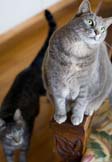
| The mail delivered two new "Cat Aerobics Action Toys" this weekend. Our old one remained a favorite of the household felines, although it had lost much of its ooomph. But the new one was drawing lots of attention right out of the package. Here's Ms. Wally focused on her aerobics, although not yet in motion. That's Romeo in the background. Click for a larger photo. |
|
April 30, 2006 - Sunday
| There's a dream house going up along Kam Highway in Kaaawa near the post office. The owner is building it himself, based on his own experience and a bit of book learning, as well as help from friends. |
|
Even before there were walls, there was a Hawaiian flag hanging off a beam, and when a wall appeared, so did a pair of black rubber slippers, carefully nailed in place. I'm guessing that these are "don't steal from me, I'm just one of the folks" kind of symbols, but that's just a guess. Can anyone enlighten me further?
"Keep praying! Give thanks!"
| That's how my sister, Bonnie, ended an entry several days ago in her unflinching online chronicle of living with her husband's lung cancer. Ray has had, and is having, a very rough time. Bonnie copes by sharing with a small circle of friends via the internet. It is tough reading, but a reminder that small things are very important. |
|
Yesterday she wrote: "We had two very pleasant surprises -- an old friend that we have not seen in what seems like forever dropped by to visit, and a grown-up foster kid now living in Sonora also dropped in. It was nice to have the visits...Life looks up."
And so it does.
Have a good day.
|
|