|
October 11, 2003 - Saturday
I've got to be out early Saturday morning, so this is going up Friday evening. to be sure I don't miss the day altogether.
With the critical attention to problems in recent years in the St. Louis athletic program, this lecture at the East-West Center next week caught my eye: "The Selling of Masculinity in the Saint Louis School Recruitment Commercial" by Scherie Kaneshiro, Department of Education,UH-Manoa.
Saint Louis School (Honolulu, HawaiŒi) is a Catholic school currently educating males in grades 6-12. During the 2000-2001 academic year, a school team began a campaign to revitalize the school and to improve its public image. The following year, a new set of recruitment commercials began airing in mid-September. The ad campaign's intent to recruit students to the school was not accomplished through the promotion of academic excellence but rather through the selling of "legitimate" masculinity. This presentation will be an analysis of the two commercials.
If you're so inclined, the presentation is scheduled for Wednesday, October 15th, noon - 1:20pm, EWC Burns Hall 2118.
Thanks to the folks at FAIR, I checked out this web site tracking U.S. and coalition casualties in Iraq. It's found numbers considerably higher than usually reported by the American news media. It's worth an extended look.
| It's been a beautiful week in Kaaawa, with enough clouds in the mornings to produce vivid colors. It's just about the perfect time of year, with the sun rising around 6:30 a.m., which leaves plenty of time to get home, eat, shower, and head into town at a reasonable hour. As the sunrise gets later over the next several months, our schedules tend to suffer badly. |
 Thursday's dawn
|
I hope to add some new cat photos sometime over the weekend. Stay tuned.
October 10, 2003 - Friday
The UH Center for Labor Education and Research (CLEAR) has posted labor historian Ed Beechert's obituary of Max Roffman. An obit prepared by his family did appear in the Seattle Times and also as a paid announcement in yesterday's Star-Bulletin. If you can get to those paid announcements on the S-B web site, I haven't figured out how, although it's obviously a feature that families (and readers) would greatly appreciate. The S-B followed with its own obit today, recognizing Max's wide-ranging contributions to labor and the broader community.
I missed this description of the difficult times of public television across the U.S. when it first appeared. Better late than whenever.
And here's an interesting piece by former Watergate figure John Dean on the legal issues surrounding the investigation of the White House-CIA leak.
October 9, 2003 - Thursday
Sad news from Seattle that former United Public Workers official Max Roffman died October 3 at age 93. Max, along with then-UPW state director Henry Epstein, grew the union until they were ousted by Gary Rodrigues and James Brown around 1981 or so. Their UPW was a very different animal. The union hall was used for meetings of community groups, and they both were active and visible in social causes and organizations, giving labor a much broader reach than it claims today. Their unionism was progressive and democratic.
The news came via Hawaii labor historian Ed Beechert, now living in Vancouver, Washington:
An obituary, written by his daughter Laurie will be in the Seattle Times and the Post-Intelligencer tomorrow, Thursday. I am writing an obituary for CLEAR to put on their web site, probably by Friday or Saturday.
Your stories on the UPW did much to vindicate the work of Max and Henry.
I didn't see that obit when I check the web sites earlier today, but hopefully it will be available soon.
Yesterday's diatribe drew several replies. Here's one:
"I had two other recent brushes with the same lesson. We attended a friend's wedding several months back. Like most contemporary weddings, it couldn't be considered complete without the high-priced photographer and his staging assistants who, with a strict timetable, herded the wedding party through a series of predefined poses."
Some wedding photographers can't trip the shutter without first freezing everyone in place. And they'll completely miss some of the best spontaneous moments in their quest to get that one shot.
Also, some bridal couples are so concerned about recording the perfect moment that they've forgotten that what's important is the moment itself. It's the fairy tale syndrome. They turn a social, spiritual event into a massive multimedia production, complete with long, boring speeches. Whatever happened to just having fun?
I've also shot a few weddings myself, and prior to the festivities I'll remind the bridal party that the most important thing is to enjoy the celebration. Don't worry about the photos as I'll shoot things as they happen.
That's the difference between some commercial photographers and news photographers -- news photographers are accustomed to covering events as they unfold. After all, it's kind of hard to tell someone, "Hey, I missed that touchdown play. Could you guys do it again? And this time, look at the camera..."
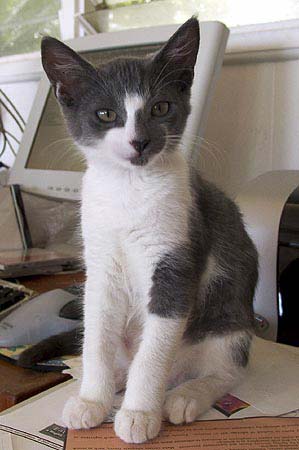
| We were sitting at our dining table yesterday morning after our early walk, enjoying a bit of coffee and the morning's newspapers, when Meda looked at me and said: "Annie just went out the cat door!"
We both jumped and headed across the room and there she was, prancing out across the deck after a kitten initiated exit.
|

Ms. Annie |
And then, not more than a minute later, zoom, back through the little plastic door and into the house.
This was unexpected because it is more than a bit unusual. She just went outside for the first time on the afternoon of October 1, and I've got photos to prove it. And now, just a week later, she's zooming out the cat door on her own power.
Most of our cats had to be taught the cat door, with learning sessions where we shove them wiggling and protesting back and forth through the little entry way until they get the idea that they can do it on their own and at times of their own choosing. This kitten, though, appears to have figured it out by just watching the other cats.
Over the next ten minutes or so she proved this was no fluke--she was in and out repeatedly as if to show off her prowess. We decided that it wasn't the first time she's been out--she must have been practicing for a while and just selected a time to disclose it to us.
This is both good and bad news. Good news that we don't have to go through that learning process. Bad news that she's now free to get into different kinds of trouble when we're gone. But she didn't go overboard yesterday, and was in the house waiting when we arrived home at the end of the day.
October 8, 2003 - Wednesday
After the decision by California voters to elect Governor Terminator, I couldn't help searching out a link to that group known as the Situationist International and their concept of the society of the spectacle.
A translation of the book by the same name begins with this quote from the philosopher Ludwig Feurbach, which just goes to show that this is not a new phenomenon:
“But for the present age, which prefers the sign to the thing signified, the copy to the original, representation to reality, appearance to essence. . . truth is considered profane , and only illusion is sacred . Sacredness is in fact held to be enhanced in proportion as truth decreases and illusion increases, so that the highest degree of illusion comes to be the highest degree of sacredness.”
—Feuerbach, Preface to the second edition
of The Essence of Christianity
Arnold rapture becomes the latest chapter in the "I'm not a doctor but I play one on TV" syndrome. Reality--real experience, real knowledge--mean nothing when stacked up against the Hollywood images that create our lingering vestiges of a shared cultural experience.
I had two other recent brushes with the same lesson. We attended a friend's wedding several months back. Like most contemporary weddings, it couldn't be considered complete without the high-priced photographer and his staging assistants who, with a strict timetable, herded the wedding party through a series of predefined poses.
At one point immediately after the wedding ceremony itself, the bride and groom had just exited the chapel and were surrounded by friends. Undeterred by this real celebration, the photographer snatched the newlyweds and whisked them off to another photo shoot, this time of staged family photos. This followed the staged ceremony, which was necessary, I suppose, because the real thing wouldn't offer such pristine images.
And what will last, captured in the expensively packaged albums, will be the images of the fake wedding, the pre-and-post recreations of the ideal wedding, rather than the real thing. And all will be pleased.
It's a strange world, isn't it?
A less personal but equally interesting vignette came in an NPR interview with the author of a recent book on gated communities (Behind the Gates by Setha Low). After reviewing the characteristics of gated communities, she mentioned that one recent trend is the creation of fake gated communities. They've got entrances with guard shacks and gates standing open, but the gates never close, there are no guards, and the fences just run a few feet on either side of the entrance. It's all illusion, but popular nonetheless.
The news media, of course, shares the responsibility for the way images are crowding out reality. Don't confuse the public with the nitty-gritty details of the processes of public life, just stick with the highlights, "what it means for them" summaries, sound bites. Gannett's latest exercise is calling all this "real life." Irony within irony.
October 7, 2003 - Tuesday
Several interesting newspaper items today.
A retired newspaper editor, writing in the Denver Post, offers a scathing look at the business of journalism:
Many newspapers have cut costs to the bone. So instead of investing in better delivery programs, the usual sloppy service has become sloppier. Instead of adding reporters and improving local news coverage, corporate owners have told editors, "Think more like a businessman and learn to do more with less." The reader, they claimed, will never notice, so long as you promote every change (i.e., reduction in quality) as content improvement.
What's happened, of course, is that years of cutting have forced editors across the country to do less with less. And, yes, readers are noticing.
And you might want to search down towards the bottom of this transcript from yesterday's White House press briefing (down towards the end) for the exchange over Karl Rove and the "leak" investigation....
Thanks to Jim Romenesko's daily blog for both these links.
And Editor & Publisher reports on Gannett's latest top-down effort to remake news writing throughout its chain of newspapers, including the Honolulu Advertiser to "connect" with younger readers.
For those who asked: We did drive up Kaaawa Park Lane on the way home yesterday and make contact with Chris, the woman who has been feeding a stray gray cat. It wasn't Lindsey. But we left a couple of photos, and she'll keep an eye out for him.
October 6, 2003 - Monday
After several months of organizing, the Hawaii Newspaper Guild has succeeded in organizing Gannett's PMP Publications, which puts out several community newspapers, and its two local classified papers, Pennysaver and Buy & Sell. After the Guild collected enough support to force a representation election, Gannett agreed instead to voluntary recognition of the union. About 23 employees will be included in the new bargaining unit, which now faces the task of negotiating its first contract.
If you're interested in issues of media ownership, check out Columbia Journalism Review's online "Who owns what" list. It's a quick and simple way to check the reach of the media giants. And then back up one level for CJR's links to useful journalism tools.
There's a current listing on eBay for a Star-Bulletin coffee mug. So far, no bidders. Six days, 11 hours to go.
We couldn't reach the woman who is feeding the stray gray cat, but left a flyer about Lindsey on her front door and talked to one of her neighbors. Hopefully we'll hear something one way or the other.
October 5, 2003 - Sunday
It may be a false hope, but at least for now that's better than none. We learned last night that a woman who lives down the hill, across the road, past the row of houses, over the stream, and up the hill on the other side, has been feeding a stray gray cat. She told a friend that it is an older cat, which would fit with Lindsey, although she says its a female. Could Lindsey be mistaken for a female? Who knows. He's obviously not an unfixed male, but...in any case , we'll be heading over there a bit later this morning to track the woman down and check on this cat.
Sean McLaughlin, executive director of Akaku, Maui's public access television provider, pointed me to Senator Inouye's extended remarks when the Senate voted against the FCC's proposed rules on media ownership (found in the Sept. 11, 2003, Congressional Record):
Mr. INOUYE . Mr. President, I rise today in support of S.J. Res. 17, the bipartisan resolution offered by Senators Dorgan, Lott, and others that would repeal rule changes recently adopted by the Federal Communications Commission that, if allowed to go into effect, could dramatically alter the shape of the American media landscape.
The foundation of our democracy is based on the free flow of information guaranteed by the first amendment. As the Supreme Court explained more than 50 years ago, the first amendment ``rests on the assumption that the widest possible dissemination of information from diverse and antagonistic sources is essential to the welfare of the people.'' Unfortunately, the FCC 's recent changes to its broadcast media ownership rules call into question that agency's commitment to this fundamental principle.
On June 2 of this year, the FCC voted to significantly relax rules that protect the American people from the ill-effects of concentrated media power. Already, in television and in print, large media conglomerates control an alarming amount of what Americans see, read, and hear. In fact, 75 percent of what Americans watch during prime time and 90 percent of the top 50 channels on cable are controlled by just 5 media companies.
Against this backdrop, the FCC 's decision to allow greater concentration of ownership is clearly a step in the wrong direction. If allowed to go into effect, these rules will result in fewer creative outlets for independent television and content producers; higher ad rates for large and small businesses; fewer antagonistic sources of news and opinion; and less air time for community groups. In addition, there may be growing reluctance by local station operators to take on network executives in rejecting nationally produced programming that violates community standards.
Some Members contend that ``[t]here should be reasoned debate on each of the rules '' rather than disapproving the entire package. I fully agree that there should be reasoned debate on each of the rules . That is exactly what I, along with 14 other Senators, asked FCC Chairman Michael Powell to do--to given Americans the opportunity to review and comment on the specific rule changes before any final decision by the FCC . Our request was denied.
While recent action by the Third Circuit Court of Appeals in staying the implementation of these new rules is an encouraging sign that these changes may not survive judicial scrutiny, we in Congress should not rely on court action. Instead, we must act decisively to protect the public interest and to rescind these recently adopted rules .
Thank you, Senator.
Previous week • Other
Search this site,
courtesy of the folks at
|





 Online Store Online Store
More choices


|