| Special notice-Update
One of the Shih Tsu puppies was adopted this week, leaving three searching for good homes. Click on the photo for more info and photos taken Sunday morning, Oct 6.
|
 |
October 26, 2002 - Saturday
We're taking off early for an estate auction in town. No relaxing Saturday morning this week, so I'll try to keep this brief and to the point.
We heard a report of the UH football game while we were driving home last night. UH was ahead by a few points with a few minutes to play. After arriving at home, I checked the web. The Advertiser had the final score and a story posted at 7:03 p.m., only about a half-hour after the game ended. I didn't see anything on the Star-Bulletin site at the time. The S-B management doesn't seem to understand that immediacy is the name of the game these days. The Advertiser at least gets this basic point, and uses their web site effectively. Credit where credit is due.
On the other hand, it's interesting to see what doesn't make it into the Advertiser. Since I've spent the week in federal court, the Advertiser's failure to cover the case of alleged human rights violations in a clothing factory in Samoa is suprising. Here's a case of national and international interest, but the Advertiser is directing their reporting elsewhere.
Ditto with the ongoing trial of Gary Rodrigues, which received little if any media attention this week. Remember the hyper scrutiny of City Council member Rene Mansho's case, or that of colleague Andy Mirikitani? Although they were elected, they were far less powerful or influential in island politics than Rodrigues, and were accused of offenses involving only a fraction of the funds the union leader allegedly took, they still got much more media attention.
Here's an email received earlier in the week:
Thank god you're reporting on this or nobody would know about it.
Where in the hell are the mainstream media on this issue? Apparently not as important as a fallen tree on the Pali Hwy., or other similar pressing issues facing the public.
This is among the biggest public corruption trials of Hawaii's recent past, certainly bigger than the Rene Mansho case who was tried on manini state law violations. Rodriques seemingly wields as much power as the Governor in this state yet and the dollar amounts (involving tax dollars) are vastly larger.
Thanks for the reportage.
And these thoughts on the Rodrigues trial came from a former UPW member:
What happened to the days of old when someone who stole money really stole money and every one who knew he stole the money simply said, "The money is missing and that's the guy who stole it, this is how he stole it, and we know that because he's the guy who has the money now." And then, we as a group of angry vigilantes would do the right thing by taking the swindler out and lynching him. There's just too much democracy for the real criminals and not enough democracy for honest.
The frightening thing about this [yesterday's trial report] is that these are better arguments than the "good dad" defense, the "it ain't a crime to make money defense," and the "nobody got hurt defense." Although, the 3rd party argument, in fact, suggests that nobody ever existed.
Someone on the jury will undoubtedly try to understand that which is beyond understandable and vote not guilty. In this case, Weinberg is not defending Rodrigues (he's indefensible) but trying to confuse jury members. That's the problem with juries.
October 25, 2002 - Friday
Star-Bulletin business columnist Erika Engle had a story this week about a Hawaii bakery's big contract to produce pastries for Starwood hotels. The contract isn't just to supply hotels in Hawaii, but to feed the whole chain across the mainland.
A nice little upbeat business tale. Then I was struck by a key sentence: "Starwood awarded the open-ended contract as a means to eliminate local bakery purchases in its various markets, according to corporate chef Richard Faeh."
This really is a disturbing move, despite the immediate returns to one Hawaii company, part of a centralized corporate effort to cut economic ties with local business in communities across the country. The same trend means that other supplies for the hotels, from kitchen equipment to furniture, probably isn't purchased locally either. That's a big negative for Hawaii, with lots of small businesses and lots of big hotels. If they continue to centralize purchasing, we lose big time.
Back at the trial of Gary Rodrigues, two major elements of the defense strategy have emerged this week.
The most damaging testimony so far, in my view, was the description of cash payments to Rodrigues by insurance exec Herb Nishida. But the charge in the indictment relating to these payments assumes that the life insurance program is a union benefit program covered by the Employee Retirement Income Security Act, known as ERISA. Defense Attorney Doron Weinberg said in court this week that he intends to challenge the notion that ERISA applies. Without ERISA, Weinberg argues, there is no federal jurisdiction and no federal crime, even if the kickbacks were made.
In arguments yesterday, Weinberg clearly articulated a similar defense against charges stemming from "consulting fees" paid to Rodrigues' daughter that were part of the union insurance contracts negotiated by the senior Rodrigues. The government alleges that these payments were part of a scheme to defraud the union.
But Weinberg is arguing that if the money came from the employer or the state, rather than directly from the union or its members, that's not the criminal violation charged in the indictment. Along this line, Weinberg has sought to trace how the payments were made to the insurers and, in turn, to two companies set up by Robin Rodrigues Sabatini. Payments are deducted from wages by the employer, transferred to the State's Public Employees Health Fund or directly to the union, and then paid to the insurance carriers or an intermediary agent. It appears Weinberg is going to argue that payments arranged via a third party cannot be considered a fraud against the union even if those funds originated from union members' wages.
I guess that's the kind of creativity you pay defense lawyers the big bucks for.
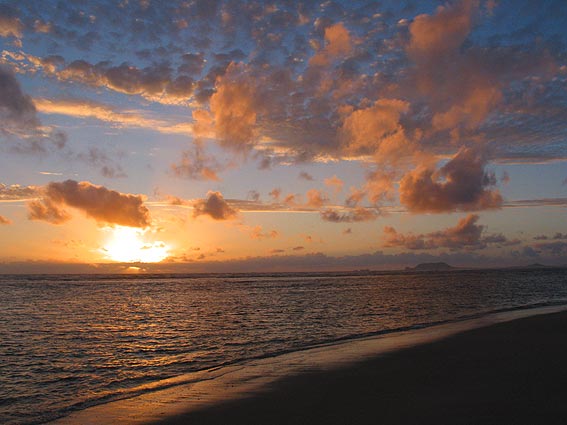
| It's been wet and cloudy most of the week, so I've had to go back to last weekend for a Kaaawa sunrise to brighten up this Friday morning. |
 |
October 24, 2002 - Thursday
In the Gary Rodrigues' trial, it's been two days of testimony about the inner workings of the Royal State group of companies, a web of interlocked insurance-related companies that primarily service public sector unions.
Royal State has always been a bit of a mystery since it was created by island politicos two decades ago using the shell of a failed insurance agency.
Yesterday's main witness was Lilia Yu-Lum, who heads VEBAH, the Voluntary Employees Benefit Association of Hawaii, one of these Royal State companies. A number of the charges in this case relate to a contract awarded to Rodrigues' daughter, Robin Sabatini, for consulting as part of Vebah's servicing of the union's insurance plans. How Robin was selected to do the work, as well as what work she actually performed, are central issues.
Yu-Lum testified that Sabatini was chosen because she was qualified. However, she also testified that no one else was considered. Yu-Lum said she knew at the time that Sabatini was Rodrigues daughter because she was told by her boss, Mel Higa, the central figure in the Royal State companies.
Prosecutors painfully elicited testimony on the makeup of the tight little network of companies, all located at 819 S. Beretania. For years, Rodrigues served as a director of several Royal State companies alongside Higa and Yu-Lum. Both testified that their relation with Rodrigues was not a factor in hiring his daughter, but failed to provide any other rationale to explain why she was the only candidate considered for the UPW-related work.
According to testimony yesterday, Sabatini initially received a percentage of the UPW business which amounted to around $11,000 a month, which was later reduced to a flat monthly fee of $6,000.
Garrett Ing, who heads Management Applied Programming, the Vebah/Royal State affiliate that actually contracted with Sabatini, testified that he had little contact with Sabatini, was not part of her hiring, never received reports from her, and only met her during public meetings held annually to sign up new members for the UPW insurance plans.
Witnesses today will include former Royal State exec Mark Fukuhara, recently named to head up the newly created Hawaii Employer-Union Health Benefits Trust Fund. Also expected to appear today is UPW staffer and former State Labor Department administrator Dayton Nakanelua.
October 23, 2002 - Wednesday
The Star-Bulletin, in a very wise move, has reportedly landed writer Susan Essoyan, who I'm told will be reporting on education issues.
Susan is a talented reporter who has written for the Los Angeles Times and other publications for the last decade, and is a great addition to the S-B staff.
I was pointed to a fine investigative series on police bias in Toronto done by the Toronto Star (minority owners of Black Press). Check it out.
U.S. District Court Judge David Ezra yesterday vigorously defended the public's right to observe federal court trials. Ezra's comments came in an exchange with defense attorney Doron Weinberg, representing UPW chief Gary Rodrigues. After turning down Weinberg's request for a private huddle with the judge on a disputed legal point, Ezra lectured the attorney and the audience.
"As a matter of policy, I believe in a public trial," Ezra said emphatically, stressing the importance of allowing the public and the press to listen in on proceedings, even during legal debate of contentious issues.
Ezra noted that Judge Sam King is known for refusing all requests for so-called side bar conferences. Although Ezra doesn't go that far, he says he does try to keep them at a minimum and to keep most arguments in public view.
October 22, 2002 - Tuesday
It could be interesting today as the trial of UPW director Gary Rodrigues moves into PGMA territory.
Pacific Group Medical Association was a small health insurer that landed a big union contract. After PGMA went belly up, it was discovered that the deal included substantial payments to a company set up by Rodrigues daughter. But there are other lingering allegations of fraud surrounding the failure of PGMA, and there are sure to be echoes of those as the case moves forward.
PGMA's founder and the person most often associated with the fraud allegations, Peter Posang Wong, moved to California and immediately launched a series of unusual insurance products that meant handling a lot of other people's money once again.
Gannett issued a press release today concerning several moves in the area of corporate governance.
I'm told Gannett's Honolulu Advertiser has imposed a moratorium on unpaid leave. What's the point, folks are wondering.
Burl Burlingame reported earlier this week that a severe skin rash has hit a dozen or more people in the Advertiser news room.
Burl wonders: "Environmental or psychological causes?"
October 21, 2002 - Monday
From a Star-Bulletin staffer comes this explanation of the discrepancy noted yesterday concerning the constitutional amendment on felony prosecutions:
This might help. It's Peter Carlisle's piece in the Star-Bulletin. The third paragraph explains.
"In fact, on the mainland, probable cause determinations based exclusively on hearsay are the norm. Thirty-seven states permit exclusively hearsay evidence for a probable cause determination."
Hope this helps clear up any confusion.
Matthew Parrish, writing in the Times of London, makes much needed sense in assessing the weakness of U.S. government allegations of "links" between various groups and events, as well as in the willingness of reporters to adopt the logic of conspiracy.
Watch, in the opening paragraphs of news stories or politicians’ press releases, for those familiar journalistic war-horses: the illusions of novelty, causality, and conspiracy. To imply novelty (and fan alarm) the news is made new by means of key words. Watch out for “yesterday”, “last night”, “just”, “emerged” and “today”. To imply between events a causal link we employ “in the wake of”, “after”, “following”, “on the eve of”, “in the run-up to”. Pinned down, we can protest that we asserted no more than a temporal sequence.
His column is definitely worth a read.
| Yesterday yielded some great cat photos. Mr. Duke continues to be most photogenic--he appears to enjoy posing.
And Mr. Silverman continued his latest round of appearances, this time spending enough time in our yard to engage in some interactions with the other cats. Well, enough time to be bothered and harassed by Leo.
|
 Click here for the latest cat photos
|
October 20, 2002 - Sunday
Here's a breakthrough of sorts--reality television delivers a campaign "survivor".
Forty-two years later (after the Kennedy-Nixon television debates), it has come to this: Rupert Murdoch and FOX's cable channel, FX, are bringing to television American Candidate, an American Idol-like game/talent show in which 100 political hopefuls will strut their stuff in an attempt to be picked by couch potatoes nationwide to run for president
No joke. Here's the story.
I was surprised to read Malia Zimmerman's claim that two-thirds of the states already allow the controversial legal shortcut to felony prosecutions that will be on the November ballot as a constitutional amendment.
According to Zimmerman, writing in her Hawaii Reporter:
The amendment would allow felony prosecutions to be initiated, and a defendant to be charged with a crime, by written information -- also known as a "criminal complaint" or "petition" as more than two-thirds of mainland states already do.
It's a surprising claim because the official state description of the measure, mailed to voters in the last week or so, says the method is used in 10 states. That's quite a few less than the "more than two-thirds" claimed by Zimmerman.
So I backtracked to the conference committee report on SB996 from this past legislative session. Sure enough, it also says it is used in ten other states.
Zimmerman's column doesn't reference any sources, so my working assumption will have to be that she's wrong on this one.
So it goes on a humid Sunday morning in Kaaawa.
Previous week • Other
Search this site,
courtesy of the folks at Atomz.com
\*/.
|