
We now have three papaya plants that sprouted out of a former compost pile on the side of our house. “Volunteers” is the what I’ve heard such unplanned plants called.
I say “plant” rather than “tree” based on what Wikipedia has to say: “The papaya is a large, tree-like plant,” even though I’ve always referred to them as papaya trees.
But back to the papayas. For several years they grew taller but produced nothing. I even cut them down a couple of times, but they grew back from the base. Then, just a few months ago, they went through a wonderful period of development, and now suddenly producing beautiful fruit.
I have to watch the fruit very carefully, making daily checks, watching for the first blush of color to show on the green papayas. I discovered the hard way that letting them stay on the plant a little too long means feasts for the birds, chickens, or rats. I’m not really sure which critters get to them if I fail to catch them in time. But now I pick the fruit as soon as it shows a splash of yellow.
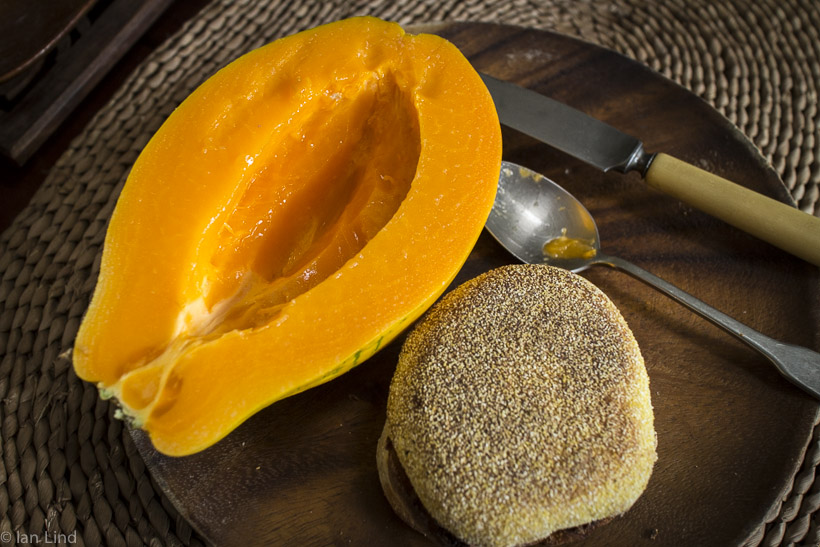
It’s kind of magic. Keep track of the fruit, harvest when ready, let them ripen for a few days, and then…a breakfast like this one.
Going to the grocery store and picking up a nice looking papaya is probably easier. This is a lot more satisfying. And if we had planted and cultivated these plants from the beginning, it would likely be even more rewarding.
Discover more from i L i n d
Subscribe to get the latest posts sent to your email.
You are a GMO supporter. All papayas around the world – even here in Hawai`i – exist because of the (GMO) decision made almost 20 years ago because of the buggers that were killing the papayas everywhere around the world.
Did you know that papaya plants are either male, female, or hermaphrodite? The hermaphrodite is self-pollinating but female need male for pollen. I understand male plants are less common. I read a couple months ago that CTAHR was trying to research what kinds of papaya plants — GMO, nonGMO, variantions of GMO — people were growing in their backyards. If you plant GMO papaya seeds, they do not grow into the same GMO plants. CTAHR wanted backyard samples to test, but I can’t find the article now. If you want to know what kind you have in your yard, you just need to send them a leaf to test. While you’re there, you can even buy 3 lovely varieties of nonGMO papayas for $1.00 a packet (Sunrise, Sunset, Waimanalo) or GMO Rainbow seeds for $3.00 a packet (after you attend a special education session). http://www.ctahr.hawaii.edu/seed/seeds.asp
P.S. CTAHR said they don’t sue people who save their GMO papaya seeds the way Monsanto goes after corn and soy farmers, so don’t worry if you regrew GMOs.
I thought the initial plant was a male. It fruited, sort of, but they were tiny and never matured. So I cut it down. Eventually, three plants grew out of the same root base. And started providing beautiful fruit. Go figure.
Star Advertiser requires a paper subscription to be eligible for the WaPo, not a digital only subscription. bummer.
Some papaya cultivators attempt to change the sex of a male plant by driving a nail into the trunk. Supposedly, this “injury” triggers a hormone reaction that could change it into a female a plant that bears fruit. Sometimes works, sometimes doesn’t. Maybe your earlier action of cutting down the plant set off a similar process for the stalks that grew out of the original root.
Health food stores often have the tastiest papayas, and their seeds produce wonderful papaya “trees” with similar tasting fruit. The birds in my neighborhood love them (and so do I) so I have to be fast with the picker. But not too fast. Solid green papayas don’t ripen that well.
Hi Ian – wonderful to have papaia (Hawn. sp.) for breakfast. Can I give you a little hint – in my family my mother, aunts, etc. always cut off the “nose” of the fruit – makes cleaning out the seeds much simpler since they will stick to the webbing. Just a little trick from the kupuna. Aloha to Meda. Jalna