|
September 11, 2004 - Saturday
A moment of silence. Then we move on.
Saturday morning. A good time for a cup of coffee and Cursor.org's Media Patrol, a once-over of delectable tidbits.
I was up early to get Ms. Miki some food, just in time to rescue a Bulbul that Annie caught and brought into my bathroom to torture. Luckily it was not mortally wounded. I locked Ms. Annie inside, then took the bird out into the front yard and let it fly away. Not necessarily easy to make my way in the dark, without my glasses, and with the landscape strewn with construction materials.
It looks like the Star-Bulletin is having trouble filling an assistant city editor position. At least they've had an ad running for quite some time now. I don't know when it first appeared, but it's becoming a familiar sight along with the perennial solicitation of telemarketers and sales execs. In addition to the normal background in reporting, writing and editing, it seeks candidates with "a strong knowledge of Hawaii". That will certainly narrow the field.
Do you remember little Ms. Piggy who wandered into our yard in January and ended up trapped in one of our cat cages? Maisy, as she is now called, was adopted by a neighbor, and Maisy isn't so little any more. And yesterday morning she broke out just as we were returning home from our morning walk.
With us rushing up the street to the driveway, she strolled over into our yard and started munching on everything in sight, startling a few of the early arriving members of the construction crew, scaring the fur balls out of Toby and slowly making her way towards our hillside, which would take her down to the lower road and off to...well, out into the dangerous world of Kaaawa with roads, dogs, cars, weekend hunters, and other dangers. Her people were off to work/school, and so Meda ran to roust other neighbors who have had more contact with Maisy, while I tried to shoo the contented white pig away from the road and back in the general direction of her house. It eventually took several of us, along with many nice bananas, to herd and/or lure her anywhere close to the gate to her yard. Pigs are pretty smart, and she managed to munch down most of those banana lures without stepping foot back behind the fence. Finally the first team swooped in, Kim with a leash and David with a mid-section grab while the rest of us stood by cheering them on, and we learned the hard way how strong a pig is and how incredibly loud they can scream. I'm sure people on the other side of Kaaawa thought some poor animal was being slaughtered while the trio wrestled their way the 20 feet or so to the gate and safety. Once loose, Maisy immediately quieted down and trotted to the far side of the yard to sulk. Whew. That's a bit of morning exercise you won't get in Manoa.
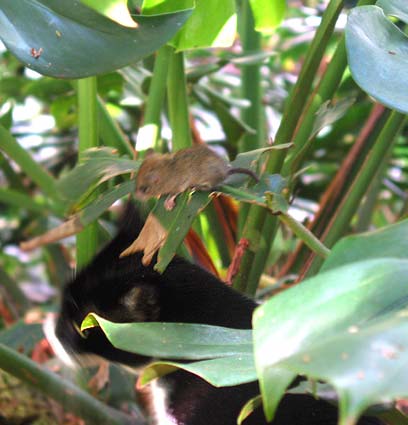
| Then later in the morning I heard a cat crying, and there was Harriet just below our front deck. I thought she wanted an escort into the house, but when I stepped into my slippers and made my way down the stairs, it was something quite different. Let me spare you the details of what turned out to be a traditional cat-and-mouse game. Well, cat and rat. At one point the subject of all the attention tried to climb to freedom. I doubt the ploy worked for long, although I didn't wait around to observe the inevitable ending to the drama. |
 Harriet on the hunt
|
Some might accuse me of inconsistency, rescuing the bird and abandoning the rat. But that's not totally true. It is also situational. If Harry had cornered that small rat in the house, I would probably move it outside and give it a running start. But, yes, I guess I do distinguish between birds and rats. Guilty.
September 10, 2004 - Friday
I was glad to see former president and Nobel peace prize winner Jimmy Carter reply so directly and personally to the tauntings of retiring Georgia Senator Zell Miller, as described the Atlanta Journal-Constitution (with a link to full text of Carter's letter).
But I was not pleased to see Carter objecting to being called a pacifist.
I, myself, served in the Navy from 1942 to 1953, and, as president, greatly strengthened our military forces and protected our nation and its interests in every way. I don't believe this warrants your referring to me as a pacifist.
It's time we stopped acting as if "pacifism" was a four-letter word.
I'm proud to be a pacifist, perhaps not the kind that Miller demonizes so casually, but in the tradition of those who aspire to a way of relating that does not do violence to others, and who see nonviolence as the highest goal.
Why cede the political debate to those who refuse to admit they are caught up in fundamental contradictions, a self- proclaimed Christian piousness coupled with the implicit view that wreaking mechanized death and destruction is our highest human calling? Let's admit that every resort to force, especially to military force, reflects a failing of ourselves and our system of governance, and stop pandering to those who praise violence as long as it's done by us rather than to us.
A few more pacifists in key positions, and a more active pacifist movement, and perhaps we wouldn't be in the mess we're in now. The path of escalating violence certainly hasn't produced results worth cheering about, unless you've had one of those Bushie lobotomies.
It's too early in the morning for a rant like this, but I had to say something.
Our electricity went out with an audible pop about 1:30 p.m. yesterday. No, this time it wasn't Hawaiian Electric. This time it happened when the Bobcat being used to excavate for the walkway alongside our new downstairs room hooked the ground wire from the electric meter and gave the box a good jerk, pulling loose various wires and cutting at least one inside.
With the meter box sparking and smoking, we called the HECO trouble line. While we were waiting, I noticed that much of our power was still on. The refrigerator was running, for example, and lights worked. But several hours later, David from HECO arrived, did a quick survey, and pronounced the situation too dangerous and turned the power off out at the pole. Luckily, though, our contractor was able to get an electrician here to do the emergency repairs, a HECO crew was available to turn everything back on, and by about 7 p.m. we had power again.
The only known casualty so far was an old fan that didn't survive the surge. Surge protectors worked for all the main computer equipment, although an external DVD burner is now acting flakey and could be the second casualty. But it could have been worse.
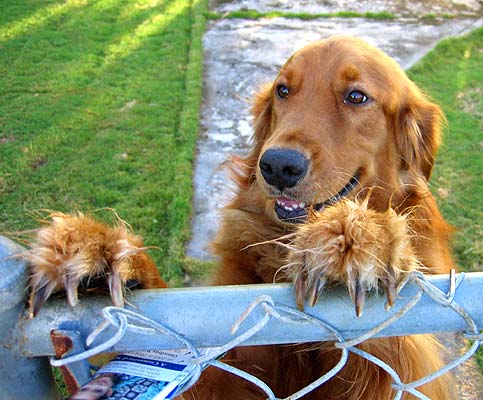
| When the power went out, I had just finished another selection of dogs from our morning walks. With all the construction chaos, I think I ended up the month with more dog pictures than cat pictures. Anyway, just click on Ms. Hoku, to the right.... |
 |
September 9, 2004 - Thursday
The "what islands do we see from Kaawa?" question is generating lots of responses.
Pat, a local pilot, offered this very specific judgement:
After looking at the Hawaii Aeronautical Sectional chart I would assume the following:
If those are the Mokumanu Islands off the N. end of Mokapu (K-Bay) on the right side of the picture, then.
What you are seeing is the 4,607' and 4961' peaks of Kamakou in the Kakahaia Wildlife Refuge of East Molokai.
Off the right is the 5,788' peak of Puu Kukui on West Maui.
The Big Island is too far south for you to see.
I asked where Haleakala would be, and said I would send him a photo with points labelled to see if I've interpreted his information correctly, but then this flu bug intervened and I haven't gotten around to it.
In the meantime, both Dean and Doug offered up versions of the same advice:
Do you have a tripod for your camera? Do you have (or can you borrow) a magnetic compass? Those two items and a paper nautical chart (or a gps) would answer your questions.
In less than an hour of puttering you could determine the direction to prominent features from your location. After two of these bearings (three/more would be better) you could determine your viewing location.*
To establish that point you should use some points closer than the horizon (not the distant unknown points on Molokai and beyond), such as Chinaman's Hat, Pyramid Rock on the Marine Corps Base, and Laie point.
You could then draw a circle from that point representing the horizon (using the formulae you linked to and plugging in the values for your height of eye and Haleakala) and work from there with your compass and/or the paper chart.
* of course, if you use a gps, you'll know your position from the start!
So, how badly do you want to know? ha ha
Of course, given our position, even drawing an accurate line of sight doesn't immediately deliver a solution to the question since from here the islands are stacked in a line, each behind or overlapping the next, but at different distances and varying elevations. It complicates an already complicated matter.
| Then Dianne sent over another photo: "We were camping at Bellows last weekend and were also confused by what outer islands we were seeing. I thought you might like to compare a different view." |
 |
And what a view it is, adding new and important perspectives, possibly more islands. As usual, just click on the photo...oh, and be sure to scroll across the photo for the full view.
September 8, 2004 - Wednesday
Another interesting observation from Bob Jones, this time regarding the Advertiser's "Island Weekly":
I contacted The Advertiser circulation dept. by e-mail, saying I'm a daily and Sunday subscriber but would sure like to be delivered one copy of Island Weekly, just so I could see what it looks like.
I got a phone message today that since I'm a Sunday paper subscriber, no need to ask to look at Island Weekly because "everything that's in it is taken from the Sunday paper, which you already will have seen."
What can you say about that?
And from over at the Star-Bulletin, another perspective on the shifting boundaries between management and Guild staffers:
Managers at the Star-Bulletin have always taken on tasks that, according to strict Guild interpretation, should be done by Guild workers. Every section editor around here does it and always has. This is not something new. It's just that Black got it in writing.
The most significant differences between managers and Guild folks around here is their higher pay and our right to say I'm outta here after the shift is pau.
The biggest difference between our managers and those over at the Advertiser is that most of ours are willing AND ABLE to pitch in and make a newspaper. This is known as teamwork.
(that and the fact that most of our managers have lives outside the newsroom. if all you do is work — with journalists, no less — how can you pretend to know what's going on in your community, especially if you're already fresh off the boat?)
| Here's another update of the Kaaawa Gallery--looking back over August's mornings. The photos reflect a wetter than average August, lots of gray and stormy looking days. Just click on the photo to proceed.... |
 |
And, finally, if you've still got any interest in the question of what islands are visible from Kaaawa, click here to compare the photo from last December with the one taken on Monday. There are differences.
September 7, 2004 - Tuesday
| Despite a layer of dark clouds, we had a clear view of other islands yesterday morning, which has again raised the lingering question of what the heck we're seeing. |
 Click for supersize view
& discussion
|
Just click on the photo to check out my latest round of thinking on the matter. And please chime in with any informed opinion.
[Oops. Early visitors noticed that the link to the "supersize" photo was missing, but that's now been corrected. Thanks for letting me know.]
Give yourself a treat this morning and check out neighbor David's photos of a night blooming cereus in another friend's yard here in Kaaawa. Wow!
September 6, 2004 - Monday
A search for the two volumes of Transatlantic Sessions, outstanding collections of music from the BBC series of the same name, sent me beyond Amazon to MusicScotland.com, based in Tobermory, Isle of Mull, Scotland. I was more than a little hesitant to try an international order, but they promised worldwide delivery at no additional charge. Bottom line--the two discs arrived in Kaaawa yesterday, only ten days after I placed the order. A little glimpse of the world economy, I guess.
So we've been wearing the new off these cd's, both of which are fabulous, by the way. Not a lame track in the bunch.
Here's a long missive from Bob Jones which raises serious issues regarding the right to know, worth quoting at some length:
Some small things from the mediation sessions between lawyers for former UH president Evan Dobelle and the university regents are starting to leak out. Very small things and I'll mention some of them in next week's MidWeek column.
But i think the major question which needs to be addressed right away by media lawyers is why those mediation minutes are being sealed forever?
This wasn't some private session between two private individuals seeking to resolve their private differences. This was a very public spat in which Dobelle relinquished all privacy considerations and which involved close to $2 million dollars in public money in the settlement.
If the news media leave the records sealed with no opposition effort, it will put something in place that will bite us all in the butt later on when other parties go to mediated settlements with taxpayer money and seek to limit the details and even the amount of the settlement (in this case the parties agreed to disclose the amount.)
You'll see in my MidWeek column next week details on another mediated government settlement with public money not reported in the daily press, and one non-mediated settlement with public money for a government mistake.
My point is that every time there is public money involved, there seems to be reason to require government agencies to require full disclosure of the parties involved, the summary of the issues involved, and full disclosure of every cent — including mediation or attorney fees — spent on the settlement. In the case of the government agency, we should require also a reasonable estimate of the cost of the time of the agency attorney used to advise or contest in the settlement. That's easily done by counting the number of hours devoted to that case and dividing that by the attorney's total salary and benefits package.
We still don't know how much Barry Marr charged for what turned out to be for maybe-not-so-great advice on firing Dobelle for cause. He was hired on an hourly basis way before June and his advisory counsel continued through the mediation process. There is a $200,000 fee for Dobelle's team of lawyers and I haven't figured out of that's squirreled away in the UH total settlement or not. Why haven't the dailies asked?
And finally, since the June 15 regents minutes show that UH general counsel Walter Kirimitsu concurred with the Marr-regents opinion that Dobelle should be fired for cause, doesn't that open him up to some media questioning about the quality of his advice -- considering that the mediator found NOTHING in the Dobelle contract that justifies firing for cause unless there was a felony, mental incompetence, or some act so repugnant to the social conscience of the community as to require immediate separation of the parties?
My feeling is that the dailies with their huge staffs and competitive nature did almost nothing on this story except what was handed to them by the parties.
As a result, public opinion at the outset became skewed against the regents and for Dobelle.
It's pretty obvious that even with my few articles on the Dobelle-side failures, letters to the editor seem to have turned around.
My sense is that both dailies wanted to put a political spin on this -- that Lingle detested Dobelle (and she did and even refused to be seated at the same table with him at a public function) and had her new regents fire him. But the facts don't support that. The regents wanted to fire Dobelle back when Democrats clearly dominated the board. But putting a Lingle spin on the story simply played better.
This has been one of those very complicated stories where the lack of big-city aggressiveness by the daily reporters and editors didn't serve the public very well.
I could go for better reporting (which usually means hiring journalists for salaries beyond what Gannett and Black want to pay) and less space devoted to how much bigger your presses are than your competitor's.
Press-size comparison doesn't produce Pulitzer prizes.
Enough said on this Labor Day holiday.
September 5, 2004 - Sunday
The comparison between the Advertiser and Star-Bulletin made by a reader a couple of days ago is still drawing comment.
Does the Bulletin make better use of its talent? Here's one view:
The Bulletin's photogs and designers are not necessarily more skilled, just allowed far more freedom. It's not a question of "outsmarting" anyone, just differences in philosophy. The Advertiser has for years been the more conservatively designed newspaper. Its emphasis on live news in an A.M. production cycle does not allow the kind of feature treatment the Bulletin has used (and honed) for years on its covers. The Bulletin's art in general emphasizes feature to a much greater degree than the Advertiser's, which emphasizes news. So of course you'll often see more aesthetically pleasing photos in the Bulletin. Which is better for a newspaper? I don't think there is a clear answer.
Another question concerned the design work on the football magazine done by assistant editor Mike Rovner. Newspaper Guild contracts usually restrict managers from doing the work of Guild members, and there was a grievance filed over at the Advertiser a few years ago over precisely such a situation. But David Black insisted on and won a loosening of these Guild work rules in the current Star-Bulletin contract. Now, at the Bulletin, photographers can write, reporters can take photos or design graphics, and, it seems, managers can take over design tasks. Or at least that's my understanding.
| I just got around to posting a small batch of photos from February 1976. There are several shots of a very young Dr. Emmett Aluli outside the old federal court, and the rest are from a workshop about Kahoolawe held at Maui Community College in which George Helm was already playing a major role. Just click on the photo.... |
 Kahoolawe workshop
Maui Community College
February 14, 1976
|
Previous week • Other
Search this site,
courtesy of the folks at Atomz.com
|
Please don't hotlink to photos or reuse without permission







|