
Every week or so I take a look at the new appellate decisions issued by the Hawaii Supreme Court and Intermediate Court of Appeals looking for interesting cases. This time around, one caught my eye because it dealt with the limits on state or county liability when someone is injured in the ocean. And then, when I tried to review the court records which are routinely available online, I discovered the case is listed as “confidential” and the documents not available to the public.
While skimming through recent decisions last weekend, I noticed a recent Intermediate Court decision worth checking out. The case involves a local man who was injured while swimming at Shipwreck Beach in Poipu, Kauai, fronting the Grand Hyatt Kauai Resort in November 2011. He was caught by a wave and hit his head on a rock, causing serious injuries. He “became a quadriplegic as a result,” the court’s decision said.
Shipwreck Beach Park, next to the hotel, is a county park. Signs posted at the makai end of the park’s parking lot warn of a dangerous shorebreak and strong currents. However, it seems the victim got to the beach from the hotel property, not the parking lot at the park.
A lawsuit was filed in 2013 on behalf of the man and his family seeking damages from the state, Kauai county, and three private entities, including the Grand Hyatt. The lawsuit apparently alleged the signage was inadequate and the state/county were negligent in their warning of the extremely dangerous ocean conditions. Lawyers for the plaintiffs argued the signs should have been two-sided to be more visible from different directions.
Both the state and county were able to win dismissal of the lawsuit, and the private parties settled before trial.
The family then appealed to the Intermediate Court seeking to overturn the dismissal of the state and county. The court upheld the the dismissals in a decision issued May 8, 2020.
The Intermediate Court found the state and counties have a duty to warn the public about dangerous shorebeak or strong currents in the ocean adjacent to any public beach park “if these conditions are extremely dangerous, typical for the specific beach, and if they pose a risk of serious injury or death.”
However, the court upheld the dismissal of the case against the state because there is no state beach park at Shipwreck Beach, and as a result the state has no duty to provide warnings.
In the case of Kauai County, the court pointed to a law passed in 2010 limiting state and county liability (Section 663-1.56 HRS).
This statute provides warning signs are “conclusively presumed to be legally adequate” if they have been approved by the chair of the board of land and natural resources based on consultations with the governor’s task fore on beach and water safety concerning the design and placement of the signs.
Further, the law provides: “Neither the State nor a county shall have a duty to warn on beach accesses, coastal accesses, or in areas that are not public beach parks of dangerous natural conditions in the ocean,” and, further, “Neither the State nor any county shall have a duty to warn of dangerous natural conditions in the ocean other than as provided in this section,” which is limited to dangerous currents and shorebreaks.
The Intermediate Court concluded that the case against Kauai County had been properly dismissed because the record including documents showing the signs had been approved as required by the law and, therefore, “conclusively presumed to be legally adequate.”
Okay, I found the discussion of the limits of the state and counties duty to warn of dangerous conditions quite interesting, and wanted to look at additional legal documents filed in the case. These are available to the public (for a feee) via the Judiciary’s eCourt Kokua system.
And there’s where I hit an unexpected roadblock. I searched for all cases associated with the plaintiff/victim’s name, and at the top of the list was this case with the same case number as on the Intermediate Court decision, but the case title is redacted and its files said to be confidential and not publicly unavailable.
Even though the lead plaintiff’s name is redacted, the case appears among the results returned when I used his name as the search term.
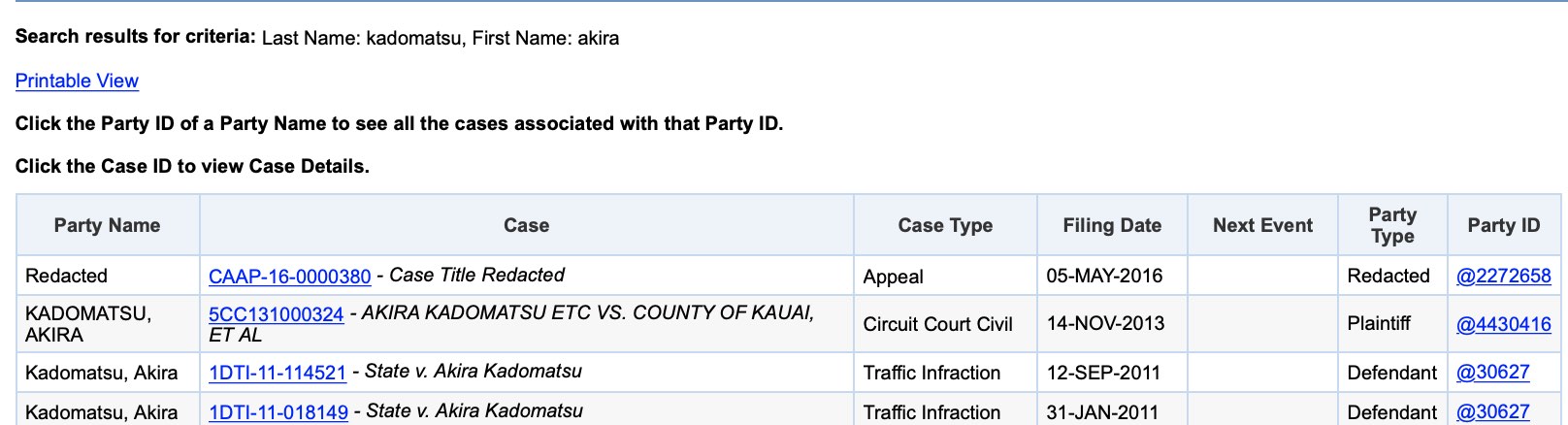

It’s common to run into lawsuits where certain documents, such as medical records, are considered confidential and are not available to the public. But having an entire case removed from the public record is quite unusual, especially what appears to be a pretty run-of-the-mill personal injury case like this one.
So on Monday I emailed Jan Kagehiro, director of the Judiciary’s Communications & Community Relations Office, to inquire whether the “redacted” status is in error. She replied that the Intermediate Court of Appeals was going to contact the court clerk’s office for further information. As of the end of the week, I had not heard further.
So I then contacted the two plaintiffs’ attorneys who handled the case regarding the “confidential” designation.
James Krueger replied first. “I had not noticed the ‘confidential’ notation,” he wrote. “I have no idea. I have never seen that notation on any of my cases in decades.”
Cynthia Wong suggested any “confidential” notation might result from minor children being included among the plaintiffs, although she did not indicate having requested the case files be marked confidential. And minors or other dependents are routinely involved in litigation without those cases disappearing in full from the public record.
So it’s one of those little mysteries that I’ll keep picking away at. Mistaken designation? If not, who requested that the case be hidden from the public? I’ll keep you posted if and when I’m able to get the answer.
Discover more from i L i n d
Subscribe to get the latest posts sent to your email.
Thank you for catching this aberration and for tracking it!