
U.S. District Court Judge Derrick Watson heard in-person arguments Thursday morning on a motion to unseal the plea agreement between a defendant in the Mike Miske racketeering case and government prosecutors.
Ron Richards, a veteran defense attorney based in Beverly Hills, California, represents Norman Akau, a co-defendant in the Miske case who pleaded guilty in June. Richards told Judge Watson that making the document public could place Akau in physical danger of retaliation because of disclosures it apparently contains.
Akau had appeared before Watson in a June 9 hearing via video and telephone to plead guilty to a single count of racketeering conspiracy based on a written plea agreement signed by all parties and approved by the judge, but not made public at that time.
During that hearing, Akau admitted he had accepted an offer of $50,000 to murder a union official, a plot which was called off at the very last minute. He also admitted to having a role in drug sales, and in at least one armed robbery of another drug dealer in which five pounds of methamphetamine was taken from the victim’s car at gunpoint, although he is not charged separately with those substantive offenses.
When the June hearing concluded, Richards asked for the plea itself to remain confidential, and when prosecutors were not opposed, his request was granted.
“At the request of Defendant and no objection by the Govt., Memorandum of Plea Agreement is filed UNDER SEAL,” according to the minutes of the hearing contained in the court record.
The Civil Beat Law Center entered the case by filing a motion on July 23 asking the court to reverse its decision and unseal the motion. The Law Center is a nonprofit law corporation with the primary purpose of promoting openness, transparency, and responsiveness in government, and it has filed a number of court challenges when secrecy has become an issue in judicial proceedings.
R. Brian Black, executive director, argued the public has a presumed First Amendment right of access to criminal court proceedings, and to the records of those proceedings, and that the decision to seal Akau’s plea agreement did not comply with legal prerequisites to justify continued secrecy.
During Thursday’s hearing, Black argued that even if the safety of a defendant is said to be at issue, the court is required to consider whether there is enough evidence of a threat to support the need to seal a record in its entirety, and if there is, to consider less restrictive alternatives before ordering an entire document removed from the public record. Alternatives could include simply redacting parts of the document, or potentially placing the defendant in protective custody to maintain their safety.
Meanwhile, Richards said it is common in other jurisdictions where he practices for courts to seal similar plea agreements, especially in racketeering cases. When told this is not the practice in Hawaii’s US District Court, Richards referred to this court as “an outlier.”
Judge Watson, who said he had reviewed the plea agreement prior to the hearing, took the matter under advisement and indicated that an opinion will follow. However, Watson left little uncertainty about his inclination in the matter.
“These provisions are ordinary,” Watson said. “There is nothing unusual about them. I have seen identical language in this court hundreds of times.”
“And how many times have they been sealed? None, except in this case,” he said.
Further, Watson noted several defendants in or related to the Miske case have also entered plea agreements with what he said was “exactly the same language,” and these have been filed in open court without objection or incident.
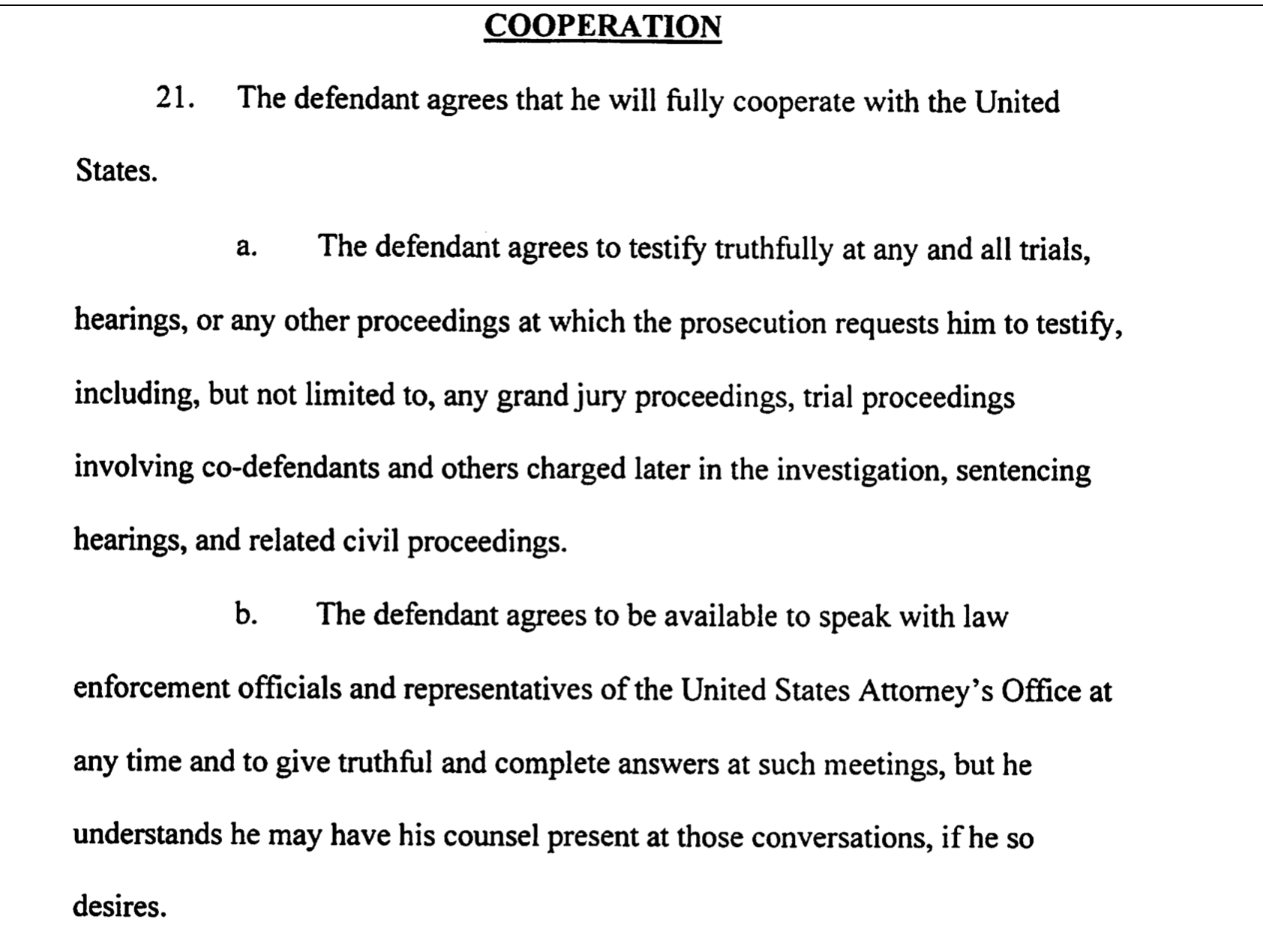
Watson and Richards appear to be referring to the section of the plea agreement providing that the defendant will cooperate with prosectors and “testify truthfully” when speaking with investigators or when testifying in future proceedings.
Here is part of that section contained in the plea agreement of Hunter Wilson, who pleaded guilt in the same case just a month before Akau.
In light of Watson’s statement describing the disputed sections as “ordinary,” Richards then asked the judge to delay any ruling that orders the document unsealed, allowing time for an appeal to be filed. Watson indicated he would do so, but advised that any stay on the proceedings would only be for a very short time.
The hearing in a nearly empty courtroom lasted under twenty minutes. A decision is pending.
Discover more from i L i n d
Subscribe to get the latest posts sent to your email.
Regarless of ones stance on sealing or not, this is fascinating stuff to see the workings of our legal system. Thank you Ian.
I am a retired criminal defense attorney. I spent my last 20 years working exclusively in federal courts.
During a past governor’s administration, I represented a client who entered into a plea agreement that was sealed at the request of the U.S. Attorney’s Office My client, who lived outside of the United States, had hacked into the office e-mail of that governor’s first assistant. The married first assistant happened to be interested in the same woman in the Philippines as my client was. My client was charged with hacking. (He wanted to know more about his competition for the Filipina girl who needed help getting through nursing school.) The plea agreement laid out details that would have embarrassed the governor’s office, in part because the employee was working for the state while flirting using his government computer during government hours. He was never charged, but he was fired.
I truly wanted the contents of that plea agreement released, but not for any noble reason. I thought everybody should know about these shenanigans. The press asked that the plea agreement be opened and the federal court denied it, saying it was protocol to keep such agreements sealed. I guess “protocol” has changed.
A couple of years ago I ran into that wonderful Advertiser courtroom reporter, Ken Kobayashi. He asked me about that plea agreement and rued that he hadn’t been able to see it. I told him it would have been good fun if it had been released.
In the Miske case, I think that plea agreement should stay sealed. Miske and his gang are soulless sociopaths with wide reach. I would put the safety of the guy helping the government ahead of the public’s right to know, at least for the time being., Plus, it puts a chilling effect on others who might cooperate but fear everyone will find out. . . . Ordinarily I am for free press and open hearings, but not when it puts a man’s life in danger.