
A paid post on the NY Times website this morning by Ancestry.com advertised its new collection of records from the US Freedmen’s Bureau, the post-Civil War United States Bureau of Refugees, Freedmen, and Abandoned Lands. Although the Ancestry post makes it sound like this is an exclusive from their service, a quick online search shows many other services are also offering the same collection.
And the Ancestry collection is free and apparently bypasses their pay wall.
This is how the National Archives describes the Freedmen’s Bureau:
In the years following the Civil War, the Bureau of Refugees, Freedmen, and Abandoned Lands (the Freedmen’s Bureau) provided assistance to tens of thousands of former slaves and impoverished whites in the Southern States and the District of Columbia. The war had liberated nearly four million slaves and destroyed the region’s cities, towns, and plantation-based economy. It left former slaves and many whites dislocated from their homes, facing starvation, and owning only the clothes they wore. The challenge of establishing a new social order, founded on freedom and racial equality, was enormous.
The Bureau was established in the War Department in 1865 to undertake the relief effort and the unprecedented social reconstruction that would bring freedpeople to full citizenship. It issued food and clothing, operated hospitals and temporary camps, helped locate family members, promoted education, helped freedmen legalize marriages, provided employment, supervised labor contracts, provided legal representation, investigated racial confrontations, settled freedmen on abandoned or confiscated lands, and worked with African American soldiers and sailors and their heirs to secure back pay, bounty payments, and pensions.
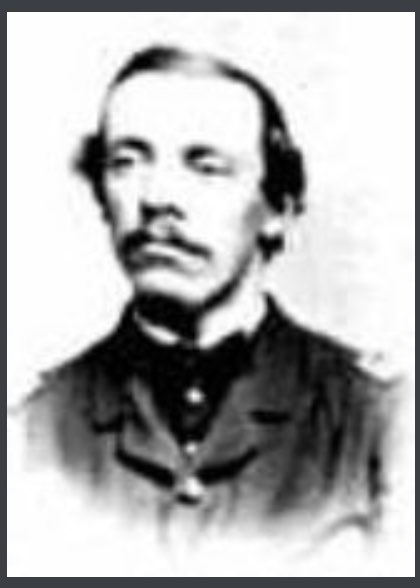 This all caught my eye because Meda’s great-great-grandfather, Bryon Porter, had joined the Freedmen’s Bureau after suffering a bullet wound through his right lung in the 1864 Battle of Petersburg, Virginia, and mustering out of the Army. One of his early assignments was to escort a group of teachers who had come west to Texas. One of those teachers was Elizabeth “Lizzie” Clay, who was about 18 at the time.
Apparently one thing led to another, and the young teacher and the war vet were married. She became Lizzie Porter, and was Meda’s great-great-grandmother.
Of course, I had to dive into the records looking for Byron Porter, and found numerous links to documents in the Freedmen’s Bureau database. Then I checked and found at least one Freedmen’s document mentioning Lizzie. It was a dispute over a debt which was referred to “civil authorities.” Her name was carefully annotated, “Elizabeth Clay (white)”. Now I’ll have to dig through to look for more of these documentary records that tie us to the past.
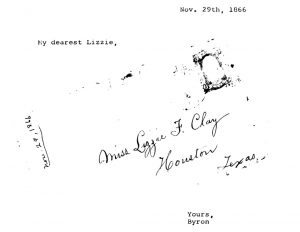
A collection of Byron Porter’s love letters to Lizzie Clay survived in the family, and were transcribed by Meda’s mother, Margaret Renton Chesney, in 1982. You can read, or browse, the letters by clicking the cover photo below. Little bits of life in Texas in 1866 or so.
Discover more from i L i n d
Subscribe to get the latest posts sent to your email.
I’m reading the correspondence with great interest. It wasn’t until late in life that I discovered my great…great grandfather and uncle were abolitionists, and my uncle was a captain in the USAA(colored) cavalry, and in Sherman’s army. I think there is value in these family stories because it seems that racism has periods when it rises and others when it falls. Should we consider whites in the Freedman’s bureau anti racist? I would encourage you to look further back, such as his military service, and the families religious and political views, and how these were formed. I say this because with the dominance of “Lost cause” ideology these stories have been lost. I know it was a revelation to my relatives that their ancestors were fervent abolitionists, it sort of soured some on Fox News. More importantly though is how they came to those ideas, and what happened later.
A leading member of the Freedman’s Bureau was Samuel Armstrong, a son of missionaries, a graduate of Punahou, and leader of African-American troops in the Civil War. While working with the Bureau, he founded what is now Hampton University as a way of empowering African-Americans.
Judging by the uniform, it looks like Byron was an officer in the Union Army. Good to find out your family fought on the right side, huh? 😉
Whew….
Thanks for sharing Meda’s side of the family.