
Here’s another dose of history, personal/family history that also reveals a lot about life in a long-gone period of Hawaii history.
I ran into it yesterday, a three-part oral history interview with my mother, Helen Yonge Lind. These were recorded in November and December 2000, when she was 86.
I’ve been digesting part 1, in which she is asked about her family background and early life. She describes her life as a young girl, living in Waipahu, as a student at St. Andrew’s Priory, then public school while living for two years in Haleiwa, and then at Kamehameha School for Girls. I’ve learned things here that I didn’t know about that part of her life.
In part 2, she talks her time at the University of Hawaii between 1931, when she entered, to about 1942, when she “retired” from a position in Home Economics. And I haven’t checked out part 3 yet, so can’t give you a preview.
If you’re interested in what it was like growing up in the 1920s and 1930s in Hawaii, you might want to wade through these interviews.
A few tidbits…
She describes her father’s mother as “the only American grandparent I had…”
Her paternal grandfather was from England, and on her mother’s side, her grandmother was Hawaiian, and her grandfather was from North Ireland.
Then, in response to a question about her grandparents, she went on.
Well my father’s father was from a very old, old family in Plymouth, England and his father was a doctor and was studying medicine in Germany. [He] was already married, and he was studying medicine in Koblenz. And that’s where my grandfather was born, but he was not German. So he lived there until about the age of six or seven, maybe. Then they went back to Plymouth and he was educated, I guess in what would be equivalent to our high school, in France. I don’t know where in France, but he spoke both German and French fluently. He went to Australia to visit his cousins about 1863, or thereabouts, and he was on his way home. He didn’t like it in Australia, and this was the time of the industrial revolution, and he was looking for something else to do, some other profession or occupation. He didn’t like it in Australia, so he was on his way home and he came across-sailed in a ship–across the Pacific. And in San Francisco his brother had come from England, and was living in California. And so he went there and while he was there, about the first couple of years he met a young girl, an American girl. She was only sixteen and her mother wouldn’t Jet her get married. He waited two years and married her, and she was American about oh, four or five generations back. Her ancestors were in Virginia before the American Revolution. They all participated in some way building America. They moved down into North and South Carolina, and to Tennessee. This was when everybody was migrating someplace, to new land. And her parents were married in Missouri and then they came in a wagon train across the plains to California (in 1857 when she was only three months old).
The sweep of history in one long answer!
Her father served as station agent for the OR&L Railroad, first an Puuloa, and later at Waipahu. The family lived up stairs in the station. She was asked what was nearby, and mentions an opium den, which was a place of mystery for the children.
Across the street was a Japanese store and then there was another place where I have this vague memory of seeing men lying down. It was a dark room, a small room, and dark and I learned later that it was an opium den. Men went to smoke opium, and there were like benches in two layers and they were lying down there smoking opium. That was on one side (of the railroad station), and then on the other, the makai side, there were a number of stores. And oh, there was a rice mill. That whole area was rice. Everywhere you looked there was rice. And every once in a while was a rice mill, so there was a rice mill across the railroad tracks from the station. My sister and I spent a lot of time with the girls in the rice mill.
And at another point, she described her parents as “sharecroppers.” They lived on a lot that was part of Kalakaua Homesteads, established long before the Hawaiian Homelands program was established, and were able to purchase the 4-acre parcel. They built a house on about a half-acre, and Ewa Plantation grew sugar on the rest of the property.
He was a sharecropper and that was what-the money that came from the harvest of the cane is what put us through the university. I’m not exactly sure how much the tuition was then, but it was only like maybe a hundred dollars or something. And we paid also, I’m quite sure we paid, to go to Kamehameha.
She said her father “was the only haole in the neighborhood for a long time,” until the Adams family moved in to a cottage owned by Mutual Telephone Company. Mrs. Adams was pure Hawaiian, but her husband was haole. “So we had (another) haole there,” she commented.
About the Adams family, she added:
Now you read about Marie McDonald, the lei maker that published the book [Ka Lei], that’s her family. They were there before, when she was about a youngster they moved to Moloka’i, so she tells more about living on Moloka’i than in Waipahu, but that’s where they were from.
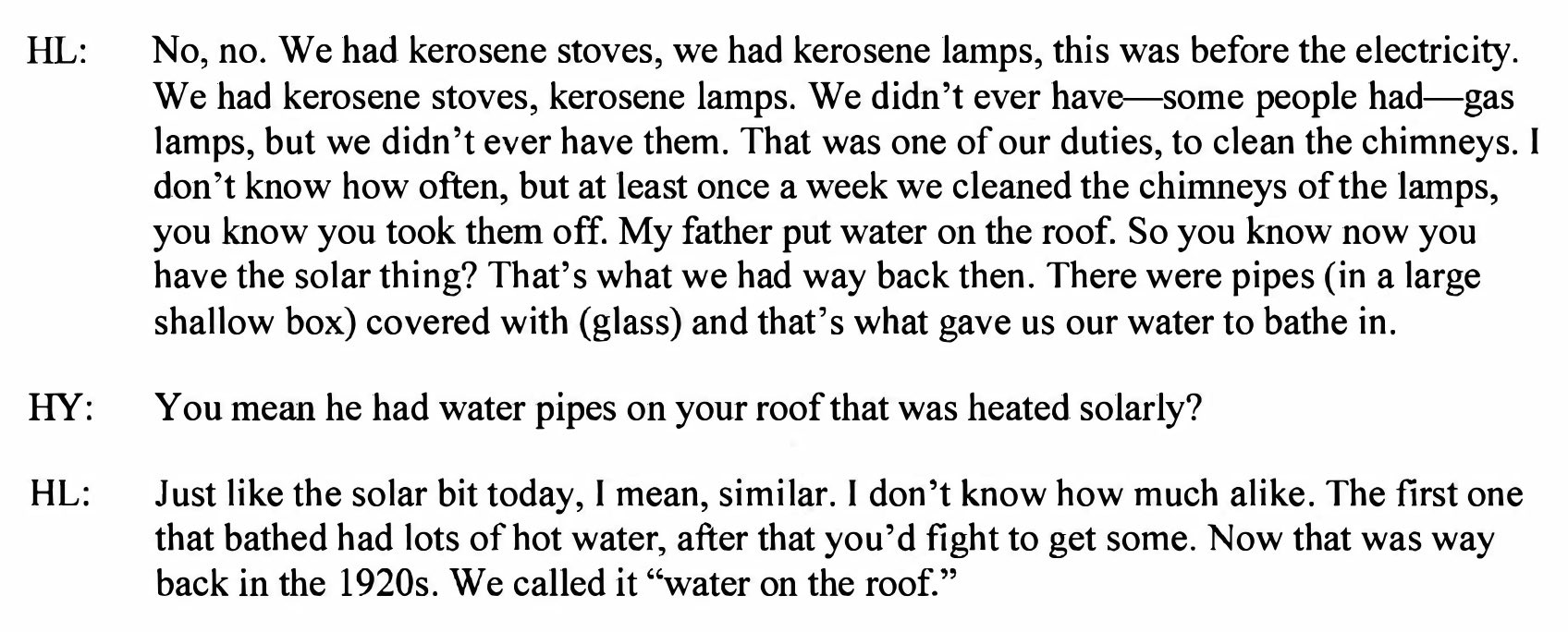
She describes living off the grid, growing all of their own vegetables except watercress, which they purchased from the Sumida watercress farm, which still appears to be our main source of watercress. They didn’t have electricity, but had an icebox, and believes they purchased blocks of ice from the Sumida family as well. They and other homesteaders had water pumped from a well about a mile away. They had kerosene lamps and a kerosene stove, and even had solar hot water.
In any case, there’s a lot more here, and I know many of you will find it very interesting. Lots of tidbits to discover.
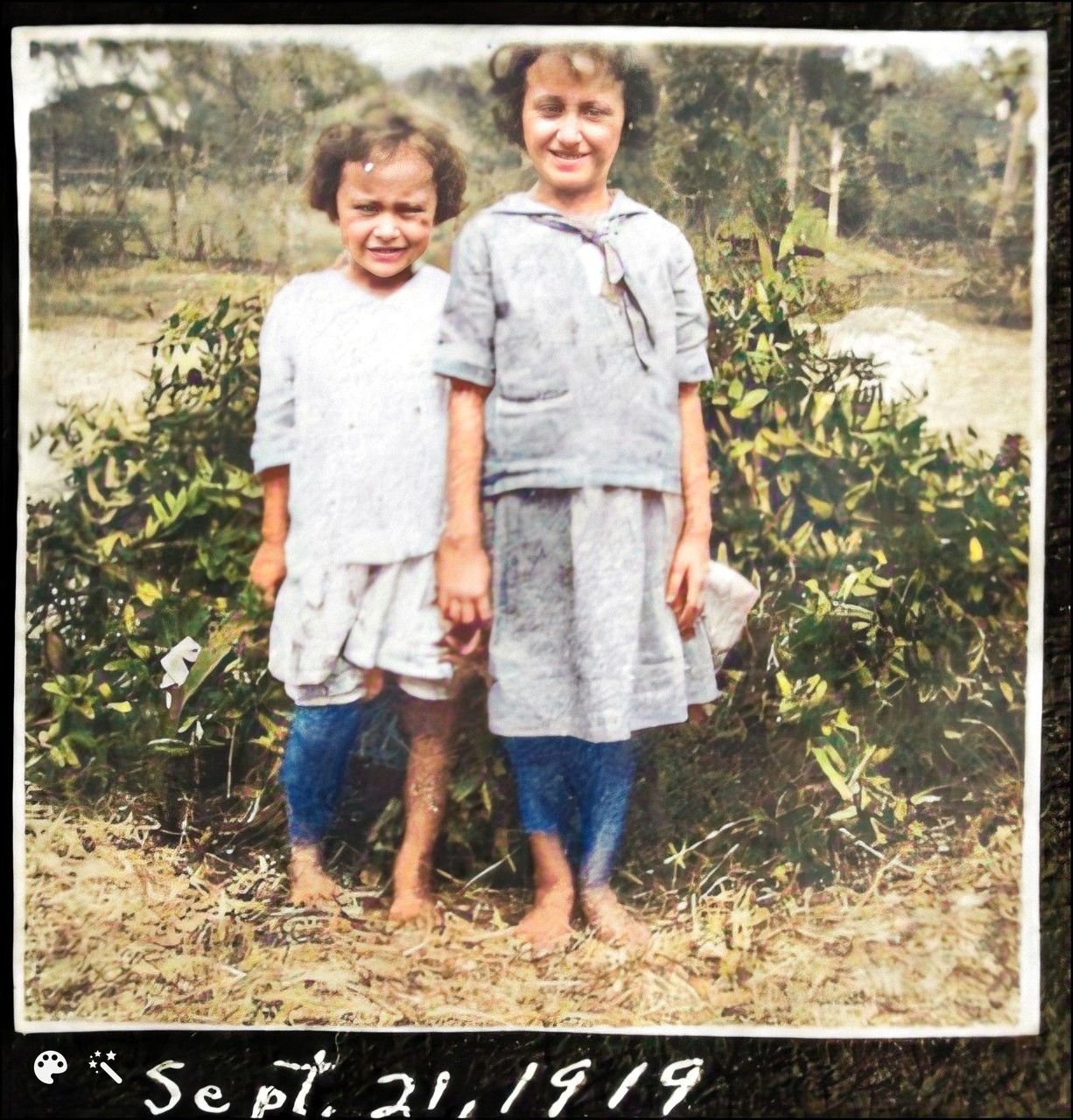
By the way, here’s a photo of my mother and her older sister, Marguerite, in 1919. It’s been colorized and enhanced by the genealogy website, myheritage.com. [I just noticed that what appear to be blue jeans are not there in the original B&W photo, their legs are bare. So this is apparently an artifact of the colorization software.]
Discover more from i L i n d
Subscribe to get the latest posts sent to your email.
Wonderful Ian. Thank you. My mother was born in 1922; the family lived in Manoa. They too had solar water heating!
Please make a compilation of all your wonderful family stories. I would love to read your book!
Mahalo for sharing this, Ian. It harkens back to a time when Hawaii was largely self-sufficient and consumed very little hydrocarbon energy–exactly the goal of today. Interestingly (at least to me), the closest we ever got to this very low-consumption, self-sufficient lifestyle was the Counterculture “back to the land” era. I hauled water from the Kohala Ditch in North Kohala in 5-gallon buckets to a garden in the 1970s, and we had the “hippie” equivalent of your Mom’s family’s solar water heater–a long coiled black hose on the roof. Dexter Cate had told me about a roofing sealant which we used on the plywood roofing of our shack. I believe he used it on his leaky WW2-era Quonset home in Manoa.
As recently as the early 1960s, the Big island was largely self-sufficient in food. My wife attended Mountain View School in the late 1950s and early 1960s and there was a small dairy adjacent to the school. A truck would stop by each household selling vegetables and a few candies for the keikis.
Maybe we don’t need a super-high tech future that requires stripmining the developing world of cobalt, lithium, etc. Maybe we just need to pay attention to how people lived very good lives here a few generations ago.
Blue jeans were invented to capture the natural blue look of our ancestors’ legs.