
I was thinking of my late uncle, James Peterson Yonge, “Jimi” to family and friends, after running into a couple of my photos of him while browsing my photo archive.
He was my mom’s brother, seven years younger, born in 1921.
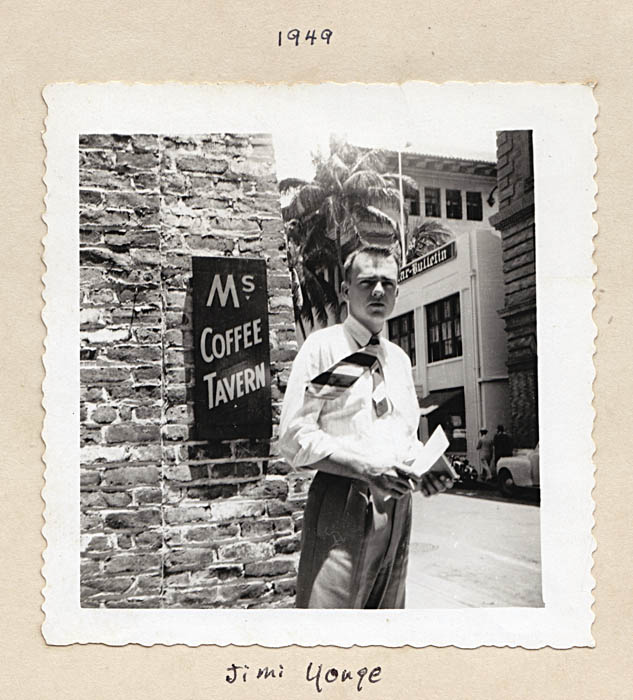
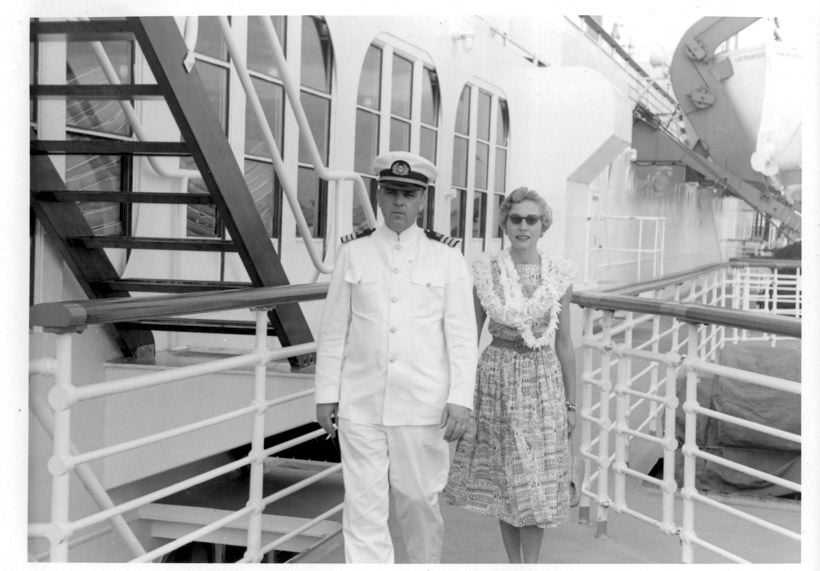
Enlisted in the navy at the beginning of WWII, hoping to go to sea, but ended up assigned to shore duty in Hawaii. After the war, he went to work for Matson, initially on freighters between Hawaii and Long Beach, and later on one or another of the Matson “White Ships,” the cruise ships that roamed the Pacific for several decades, eventually becoming chief purser on the SS Mariposa, which he always referred to as the Mary P. He continued for a while after the cruise ships were sold to Pacific Far East Lines. Since the Pacific cruises would all pass through Honolulu, I saw him often growing up when he came to visit my parents, and later, after Meda and I got married, when he was known to occasionally drink us kids under the table.
He disliked living ashore, and spent most of his time on the ships, although his wife lived in San Francisco, and they remained married, and personally close, through their lives. He even retired on his own, near Portola, California, where he bought a small house not far from his oldest sister, Marguerite.
He was a real character, a world-class storyteller and my favorite relative, who unfortunately died in 1994 at 72.
This led to a family mystery. I distinctly recall my mother telling me that he was named after the longtime president of United Airlines, who was born in Waipahu, where my grandparents lived and where my mom and her two siblings grew up.
So I went to check if that Waipahu connection was true, and yes, indeed, he was president of United from 1934 until 1966. Except that his name was William Patterson, not Peterson. So I’m left with a mystery. Did I just conflate two stories, one about a Patterson family in Waipahu that Uncle Jimmy was named after, and the other about the Patterson from Waipahu who became president of United. I seem to remember there was a United 747 named “Waipahu.”
In any case, I also remembered my uncle talking about a humorist he met, who had taken several cruises with him, and later mentioned him in several of his books.
I found the full text of one book available online and, sure enough, there are several passages about Uncle Jimi. I’ve copied two of them below, out of context.
One issue: I have no idea where he got the idea our family was Dutch.
Excerpts from “Two thirds of a coconut tree,” H. Allen Smith, Published 1963.
November 27
There was a lecture about Tahiti in the lounge today. The ship’s tour
director, Joe Boyd, touched lightly on the island history and nobody in
his audience seemed interested, though there were snickers when he said
the tomb of the last king is surmounted by a giant-sized Benedictine
bottle, this being the beverage the monarch used in drinking himself to
death. Mr. Boyd said that we would he docking on a Sunday morning and
that very likely all the stores would he closed. This intelligence was
greeted by a great chorus of groans and protests. The primary purpose of
travel is to shop. Nuts to history. Nuts to the scenic glories of the South
Pacific. Piddle on the natives of Polynesia. Accumulating junk is the thing
to do.We have a celebrity on this trip, The Congressman. He is young and
handsome and affable and comes from a state in the central part of the
country. I sat with him today in the theater where they were showing
movies of Tahiti and he revealed himself as a great enthusiast for all the
Isles of the Pacific. If and when the people bounce him out of office,
he’d enjoy living in the South Seas.We eat at the table of the Chief Purser, Jim Yonge, whose name sounds
Chinese but who is of Dutch ancestry, born in Hawaii, resident now of
San Francisco. Also at our table is Miss Hibiscus, a dark-haired thing out
of Fiji, where she won the annual beauty contest. Her name is Laurayne
Thurley, she is eighteen, and I would guess that one of the reasons
she was crowned Miss Hibiscus was her shape. It is provocative.Also present is Freddie Field, a young New Zealand travel agent, and his
mother, known to one and all as Mums. Freddie is alert and well
informed. He said that in Los Angeles a waitress who talked like a TV
cawmick listened to his New Zealand speech and then said, “Where you
folks from?” Freddie replied, “New Zealand.” And the waitress
exclaimed, “My! And you speak such good English.”At dinner when the wine is poured Freddie warns Mums to take it easy,
explaining to the rest of us, “One wine biscuit and a glawss of water —
that gets the old girl shickered as a bat.”I asked Mums how many children she had and she said, “I brought forth
six but I’ve buried two.”Freddie: “I’m one of the two she buried.”
Mums: “You’ve heard the saying – only a mother could love ’im.”
Mr. Yonge: “But it doesn’t necessarily mean his mother.”
Miss Hibiscus: “Here’s the wawtuh.”————
December 3
Later we roamed around town with Chief Purser Jim Yonge, watching the
preparations for a big street carnival scheduled for downtown Papeete
tomorrow. Jim, who is a sort of Mother Superior to all cruise passengers,
is having his problems as usual. Among a multitude of other duties,
he conducts the Protestant service in the ship’s theater each Sunday
morning. Soon after leaving San Francisco on the present cruise a woman
from a Midwestern city came to him and said she is a soloist in a
Christian Science church back home, and she would like to sing a solo at
the ship’s services. Jim agreed to this and the woman decided that she
would sing “Put More Loving in Your Living.” Now came the real trouble.
There is also on board a lady from the hill country of Kentucky who is a
pucker whistler. There are two kinds of professional whistlers — pucker
and finger. This pucker whistler heard that the Christian Science woman
is going to sing at Divine Services, and so she came charging down on
Jim Yonge and said that she wants to whistle at Divine Services. ‘Whistle
what?” asked Jim. “Oh,” she said, “I can whistle anything. I do all the
standard bird calls, and I whistle at Divine Services back in Kentucky ah-
wull the tahm.”The chief purser picked up the schedule for the coming Sunday and noted
the musical numbers that had been listed, over and above the soloist’s
piece. They were “Come Thou Almighty King,” “My Faith Looks Up to
Thee,” and “Eternal Father, Strong to Save.” In his own mind he
decided against having any of these hymns whistled. He didn’t think it
would set well with his little congregation. You can never tell about
church congregations — they are capable of violent action. So Jim put the
pucker whistler off for the time being with the firm intention of telling
her later that he cannot accommodate her. I told him I thought he was
wrong, that this Kentucky woman might eventually become world-
famous, traveling the Chautauqua circuit with Bird Calls for God, and
then Jim could always say that he knew her when, and even helped her
along her way.“If,” I argued, “you will let her whistle a couple of hymns next Sunday, I
promise you that I will attend Divine Services.”“That settles it,” said Jim. “I don’t want you there. No whistling.”
Discover more from i L i n d
Subscribe to get the latest posts sent to your email.