Category Archives: Law

The latest defendant from the Trump enemies’ list

This is an excerpt from a Lawfare column by Olivia Manes and Ben Wittes, “Thoughts on the John Bolton Indictment.”

I highly recommend the full column, as well as Lawfare’s other reporting and analysis.

…there is real cause for caution here. All criminal defendants are presumed innocent until proven guilty. For a variety of reasons, that presumption deserves a certain emphasis in this case.

Because one thing we know for sure is that President Trump hates John Bolton.

And whether or not this indictment is justified—in whole or in part—it is just as surely a product of that hatred. That hatred has no legitimate role to play in prosecutorial decisions about Bolton’s conduct. And one doesn’t have to assert that Bolton is innocent to observe that it has clearly played some significant role here. The task of the court here is thus not merely to assess Bolton’s conduct but to assess the corrupting force of Trump’s hatred and vengeance.

The history of Trump’s statements and actions with respect to Bolton provide almost, though not quite, as strong a prima facie case for motion to dismiss for a vindictive prosecution motion as we can expect from Comey or James.

Trump’s ire for Bolton dates back to policy disagreements during Trump’s first term. After Bolton resigned as national security adviser (or, according to Trump, was fired) in 2019, Bolton flirted with testifying in the impeachment proceedings against the president. Even though Bolton played hard to get with the House and Senate and never ended up testifying, media reports suggested that Trump was planning reprisals against his adversaries—including Bolton.

The final paragraph sums it up: “It is to say that the presumption of innocence should never be stronger than when one knows beyond a shadow of a doubt that the prosecution and its investigators are playing dirty—and doing so for nakedly political reasons. It is possible, in other words, that Bolton is both a scoundrel and a victim.”

As noted above, I highly recommend the full column.

Retired miltary officials point out dangers of sending troops into urban areas

A group of retired defense officials filed an amicus curiae or “friend of the court” brief this week in the case of State of Illinois v. Trump, 25-cv-12174, Federal District Court for the Northern District of Illinois.

Although the group does not take a position on the lawsuit itself, their brief spells out their common concerns about the deployment of National Guard members to American cities.

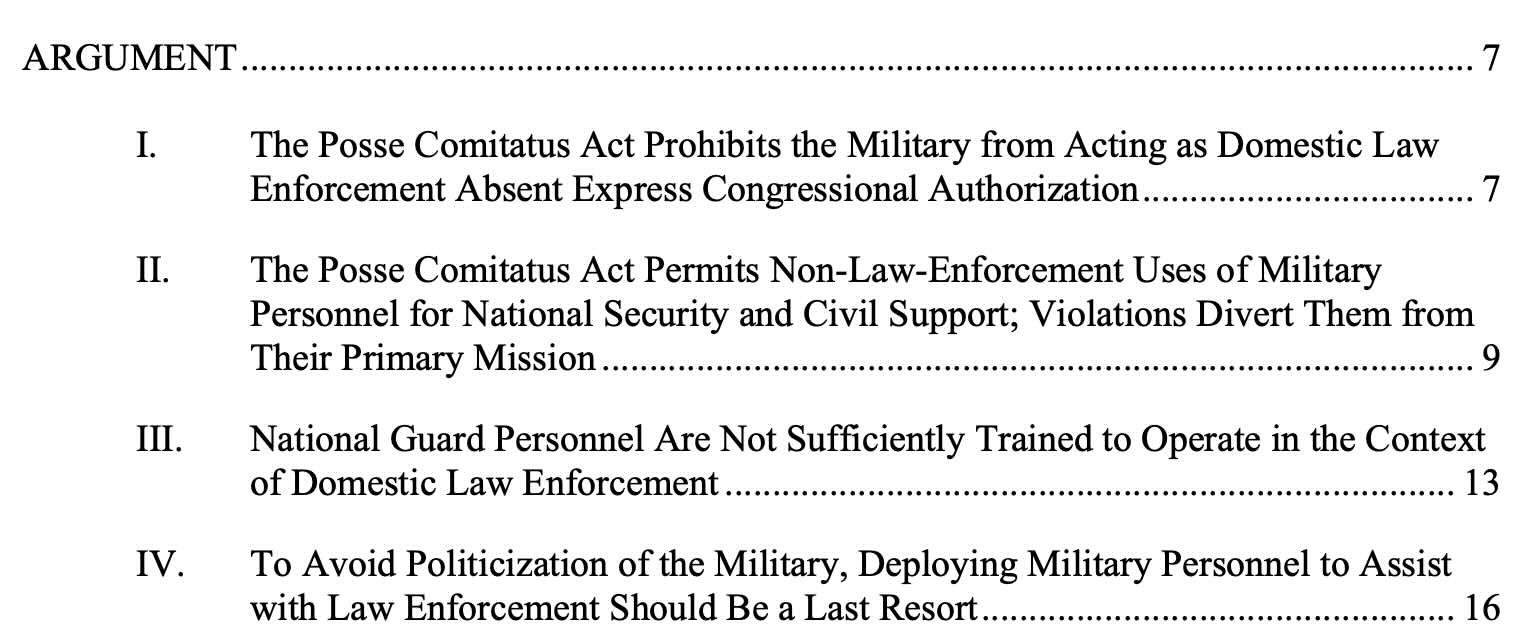
Here’s the introductory section spelling out their interest in the case, along with the major point they make (from the document’s table of contents), followed by the full document.

INTEREST OF AMICI CURIAE

Amici are former secretaries of the Army and Navy and retired four-star admirals and generals. Collectively, they served under each president from John F. Kennedy to Barack Obama. Amici are acutely interested in this case because presidential deployment of the National Guard to perform local law enforcement should be a rare and carefully considered occurrence that strictly complies with the Posse Comitatus Act. Domestic deployments that fail to adhere to these long-established guardrails threaten the Guard’s core national security and disaster relief missions; place deployed personnel in fraught situations for which they lack specific training, thus posing safety concerns for servicemembers and the public alike; and risk inappropriately politicizing the military, creating additional risks to recruitment, retention, morale, and cohesion of the force.

This submission is based on amici’s collective experience serving in and leading our military, their direct experience commanding active-duty service personnel, and their interest in preserving our military’s apolitical role in safeguarding national security.

Screenshot

The legal history of terms like “insurrection,” “rebellion,” and “uprising”

In law, history, precedent, and facts matter. For those who want more than headlines, this court filing provides easy access to a wealth of insight into the current controversy over President Trump’s attempt to send troops into American cities.

This amicus brief was filed by attorneys for Citizens For Responsibility And Ethics In Washington on behalf of Mark Graber in support of the motion for a TRO blocking deployment of federalized National Guard troops in Portland, Oregon. It was downloaded from the Federal Court’s PACER document system.

Graber is the Regents Professor in the University System of Maryland, a Distinguished University Professor, University of Maryland, Baltimore, and a Professor of Law at the University of Maryland Francis King Carey School of Law.

Here’s the summary provided in the first section of the brief.

SUMMARY OF ARGUMENT

The Militia Act of 1903–the statutory predecessor of 10 U.S.C. § 12406–was historically understood to authorize the president to federalize state militias only in response to a war or warlike conditions. The law permits the president to call state militias into federal service only when a large armed force is engaged in an invasion, a rebellion, or a substantial uprising that cannot be contained by ordinary forces under the president’s command and that prevents federal courts from operating. The Militia Act of 1903, was designed to respond to that level of crisis. Nothing in the Act’s text or history allows the president to federalize a state national guard in response to sporadic violence during otherwise peaceful protests that do not incapacitate the courts or the execution of federal laws as a whole.

Historical and judicial precedents make clear that courts are empowered-and indeed obligated to review whether the predicate conditions for the president to federalize state militias exist. Supreme Court decisions from the 19th century emphatically rejected the notion of unreviewable presidential discretion to deploy the military on American soil, dismissing the argument as repugnant to our founding principles. As the Court explained, accepting that the military could be used for regular law enforcement would mean “republican government is a failure” and would mark the “end of liberty regulated by law.” Those words ring just as true today as they did in 1866.

The document can be downloaded or displayed in full-screen mode using the links at the bottom right of the document window.

Seeking the lowest common denominator

“This historical tradition boils down to a simple proposition: this is a nation of Constitutional law, not martial law.”

That’s the way Federal Judge Karin Immergut, a Trump appointee, summarized the issue when she granted a temporary restraining order blocking the National Guard Deployment.

Is that something we can agree on?

For those seeking for information on her legal reasoning, here’s Immergut’s initial decision granting the plaintiff’s motion for a temporary restraining order (issued before California and Texas Guard units were being told to deploy).