Category Archives: Politics

The collapse of the Trump administration’s lies about the Reflecting Pool damage

For those interested in primary documents, here is the full 20-page motion filed Friday by federal attorneys in Washington, D.C., requesting the dismissal of all charges against a former Olympian accused of vandalizing the pool’s recently replaced lining. The motion blames the failure of the pool lining on botched installation by a new contractor who had been awarded a non-bid contract to do the work.

It’s one of those rare admissions that a Trump-backed prosecution was wholly unsupported by the facts.

Who Gives Together? Mapping Hawaii’s Political Contributors

The recent bribery indictments that included two former powerful legislative committee chairs raised a familiar question: Who really holds the levers of power in Hawaii politics?

To find out, I turned to a massive dataset: nearly 128,000 campaign contributions made to state and local candidates across Hawaii from 2015 to 2026.

By feeding this decade of data from the Campaign Spending Commission nto ChatGPT to perform network co-giving analysis, one clear conclusion emerged:

Hawaii’s donor class doesn’t invest in ideology. They invest relationship building and institutional access.

The pattern is consistent with relationship-building and institutional access rather than strong ideological alignment.

Mapping “Portfolio Similarity”

When analyzing campaign finance, looking at who cuts checks on the exact same day is rarely where the real story lies. The strongest evidence of donor alignment comes from persistent portfolio similarity—donors who repeatedly back the same slate of viable candidates cycle after cycle.

By filtering for donors who appeared in at least ten election cycles and shared eight or more candidate selections, the AI analysis isolated a core network of 577 recurring donors connected by 1,415 strong co-giving relationships, falling into 55 distinct statistical communities.

These recurring donors generally fall into three key categories:

Small Household/Partner Circles: Near-identical small portfolios, typically representing families, partners, or close business associates.

Large Institutional Networks: PACs, registered lobbyists, and government-relations executives who give broadly to viable, winning candidates.

Cross-County Executive Networks: Individuals and organizations that repeatedly support winning county mayors across different islands.

The third category is particularly telling: the common denominator isn’t shared geography or partisan ideology—it is executive governmental authority.

The Central Donor Networks

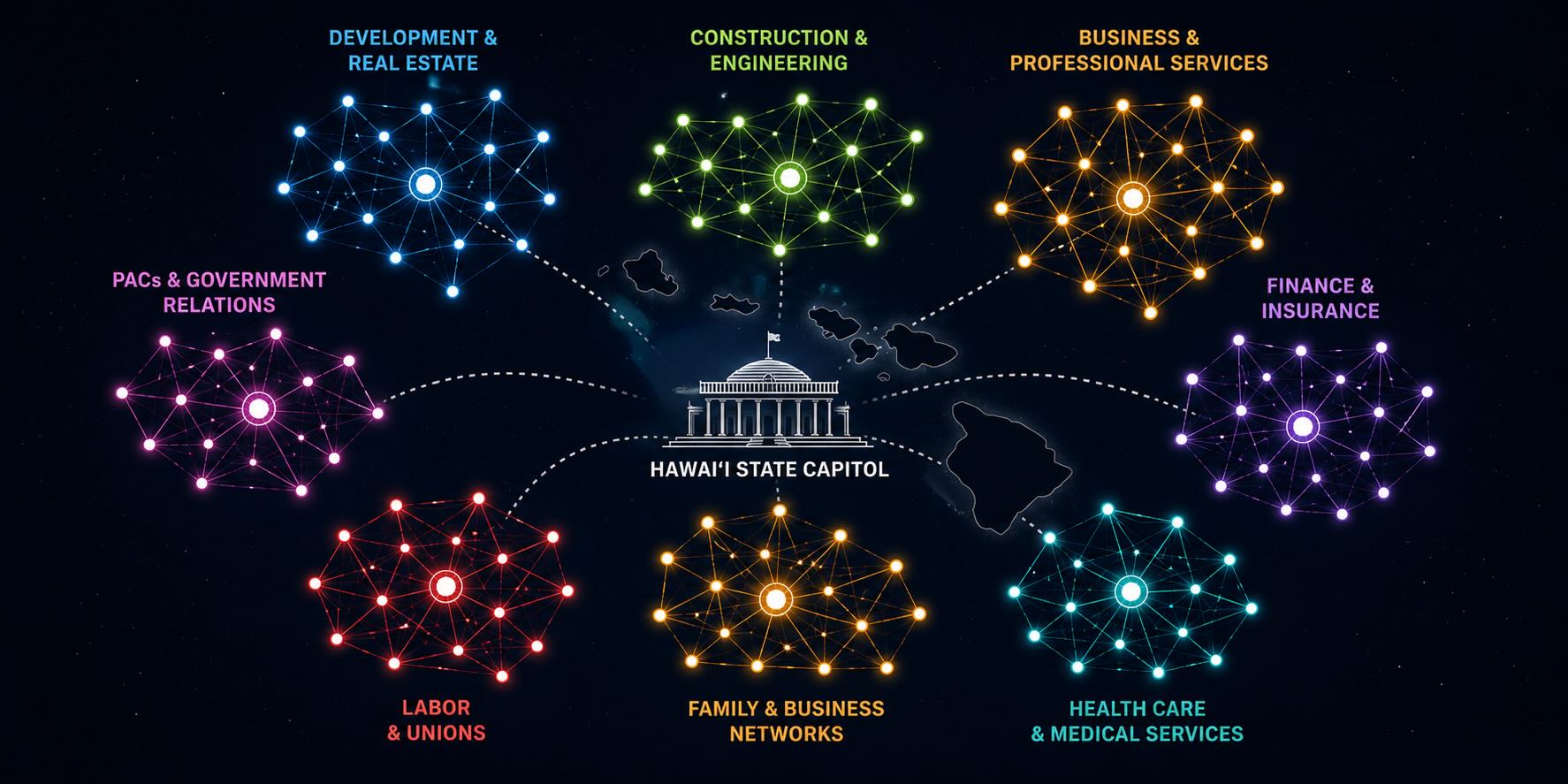
Rather than functioning in isolated industry silos, Hawaii’s donor landscape is best understood as a web of interlocking political communities.

Donor Cluster Core Participants & Sectors Primary Focus & Leverage Points
The Institutional Core Insurers, Utilities, Corporate PACs, Major Unions, Government Relations Firms Access to legislative leadership, incumbent committee chairs, and regulatory policy across Democratic factions.
Development & Infrastructure Engineering firms, Land-use attorneys, Contractors, Planning consultants County-level zoning, permitting, capital improvement projects (CIP), and procurement contracts.
Organized Labor Public-employee unions (HGEA, UPW), Building trades (Carpenters, Laborers, IBEW), Teachers Incumbent relationships, department budgets, collective bargaining, and legislative leadership support.

The Institutional Core

The most influential cluster consists of major corporate PACs, labor unions, top government relations executives, and active individual donors.

Key players in this broad access network include Island Insurance PAC, Alexander & Baldwin’s HIPAC, Local 1186 IBEW PAC, Nareit Hawaii, Hawaiian Telcom Good Government Club, Matson Navigation, HGEA, UPW, Hawaii Laborers PAC, Hawaii Regional Council of Carpenters, and General Contractors Association of Hawaii PAC. Active individuals and lobbyists appearing in this space include Bruce Coppa, Blake Oshiro, Jennifer Sabas, Ross Yamasaki, Bert Kobayashi, and Stanley Kuriyama.

Their connection isn’t necessarily about giving identical amounts on the same day—it’s about repeatedly selecting the exact same set of key decision-makers across election periods to ensure a seat at the table regardless of which faction holds power.

Development, Engineering & Professional Services

A second major cluster centers on individuals in the built environment: developers, civil engineers, land-use attorneys, and contractors.

Prominent figures in this recurring co-giving group include Patrick Kobayashi, Greg Hiyakumoto, David Tanoue, Dexter Kubota, James Yamamoto, Richard Asato, Leonard Leong, Ken Hayashida, Susan Kobayashi, and Collins Lam.

This group’s portfolio overlaps heavily around county-level governance where critical decisions on land use, infrastructure, permitting, and construction contracts are made.

Organized Labor: Overlapping, Not Monolithic

While labor unions are among the most active political donors in the state, the data shows they do not act as a single, indivisible bloc. Instead, distinct sub-networks exist—public employees (HGEA, UPW), construction trades (Laborers, Carpenters, Operating Engineers), education (HSTA), and utilities (IBEW). They converge most heavily around viable incumbents and leadership figures who control committee assignments and budget allocations.

A Note on Network Analysis & Legal Context

Co-giving patterns reflect persistent portfolio similarity—meaning these donors consistently back many of the same viable candidates over time. While this methodology identifies the institutional relationships most worth examining through public records, co-giving does not, by itself, establish improper coordination, illegal straw contributions, or undue influence.

Next Steps: Building the Full Investigative Map

Mapping campaign contribution records is just step one. To turn this donor network map into actionable investigative reporting, the next phase requires integrating six additional public datasets:

Employer Normalization: Standardizing name variations across thousands of entries (e.g., matching “A&B” with “Alexander & Baldwin”).

Corporate & Non-Profit Boards: Cross-referencing top donor clusters against DCCA corporate filings and IRS Form 990 board rosters.
Government Boards & Commissions: Overlaying recurring donor lists against state and county board appointments (e.g., Land Use Commission, HART, Planning Commissions).

Lobbying & Procurement: Matching contribution timing against registered lobbying clients, government contracts, and contested land-use proceedings.

By layering these datasets, we can move from simple campaign finance tallies to a clear, multidimensional map of how institutional influence operates across Hawaii.

But whether these data are available in a form that can be accessed for such an analysis remains to be seen.

Have a specific donor cluster, contractor, or board you’d like to see analyzed in the next phase? Leave a comment below or drop a tip.

[Original post revised at 6:33 a.m. with assistance from ChatGPT and Gemini.]

A High Bar: Why Prosecuting Sylvia Luke for bribery will be an uphill battle

Prosecutors face steep legal hurdles to secure a criminal bribery conviction against Hawaii Lt. Gov. Sylvia Luke. The difficulty doesn’t just rest on the specific facts of the case—it stems from nearly 50 years of robust constitutional protection established by the U.S. Supreme Court.

luke and three others, including former Rep. Ryan Yamane, as well as former Gov. David Ige’s one-time chief of staff, were indictd on charges that included bribery and conspiracy to commit bribery. A fifth was charged with obstruction of justice and falsifying campaign spending records. The bribery charges carry a maximum penalty of 10 years imprisonment plus a fine on each count.

But convicting Luke is likely to be an uphill slog for prosecutors. The Supreme Court has consistently held that the right of citizens and political candidates to give and accept campaign contributions falls under the protections of free speech and association provided by the First Amendment. To breach those protections and prove illegal bribery, prosecutors must prove the existence of an explicit, mutual “quid pro quo” agreement between the donor and the recipient.

This for That

As explained by the League of Women Voters:

“Quid pro quo” (Latin for “this for that”) refers to an exchange between a candidate and donor in which the candidate receives a personal gain (a contribution for election or re-election to office) from the “sale” of public power (a vote or other action that benefits the donor).

This is often framed as a conflict of interest because an officeholder has a duty to act in the best interests of constituents, which overrides any agreement to follow the preferences of a donor. The Supreme Court specifically mentioned quid pro quo corruption as well as the appearance of quid pro quo in the Buckley v. Valeo (1976) decision, which supported restrictions on direct campaign contributions but not on campaign expenditures.

Because the Hawaii Supreme Court has not issued a definitive ruling establishing where a legal political contribution ends and an illegal quid pro quo begins, Hawaii courts must look to federal case law for guidance.

The Legal Standard: Explicit Agreements and “Official Acts”

Federal precedent sets an exceptionally high bar for converting a political contribution into a federal or state crime.

To prove criminal bribery, prosecutors must demonstrate two crucial elements:

• An Explicit Agreement: The campaign contribution must be part of an explicit quid pro quo deal. A political donor giving money to a candidate whose views or legislative goals align with their interests is completely legal; prosecutors must prove a direct, unambiguous agreement that the money was given strictly in exchange for specific action.

• An “Official Act”: The promised exchange must involve an “official act”—a formal exercise of governmental power.

Crucially, routine political and legislative actions—such as setting up meetings, hosting public events, making introductions, or speaking with other state officials—do not, by themselves, constitute corrupt agreements under federal law.

Routine Constituent Work Isn’t Bribery

The reality of modern campaign finance means political candidates routinely take actions that benefit donors who support them. In the landmark case McCormick v. United States (500 U.S. 257), the U.S. Supreme Court acknowledged this reality and cautioned against overcriminalizing everyday politics.

“Serving constituents and supporting legislation that will benefit the district and individuals and groups therein is the everyday business of a legislator. It is also true that campaigns must be run and financed. Money is constantly being solicited on behalf of candidates, who run on platforms and who claim support on the basis of their views and what they intend to do or have done.

Whatever ethical considerations and appearances may indicate, to hold that legislators commit the federal crime of extortion when they act for the benefit of constituents or support legislation furthering the interests of some of their constituents, shortly before or after campaign contributions are solicited and received from those beneficiaries, is an unrealistic assessment of what Congress could have meant… To hold otherwise would open to prosecution not only conduct that has long been thought to be well within the law, but also conduct that, in a very real sense, is unavoidable so long as election campaigns are financed by private contributions…”

The Road Ahead for Prosecutors

While public optics surrounding campaign donations can often look questionable, unfavorable ethics or bad appearances are generally not enough to support a conviction.

To overcome Lt. Gov. Luke’s First Amendment protections, prosecutors cannot simply show a timeline where contributions were made around the same time legislative assistance was provided. They must produce concrete evidence—such as wiretaps, written correspondence, or insider testimony—proving a clear, explicit “this-for-that” demand was made. However, courts have held that criminal intent and agreement can be inferred from the totality of the circumstances, such as a pattern of reciprocal benefits, coordinated actions, and suspicious timing, even if the parties never explicitly speak the words “bribe” or “agreement.”

But circumstantial evidence and possibly unsightly context is precisely what fifty years of First Amendment jurisprudence was built to protect. Unless prosecutors in Luke’s case can produce concrete evidence that transforms a suspicious sequence of events into an explicit quid pro quo, they will struggle to cross the threshold from bad optics to criminal guilt.

* Graphic produced by Gemini AI.

The Councilman, the Crime Boss, and the “Hostage” Trees

Tree at Joe Lukela park claimed by Mike Miske

Now that Trevor Ozawa is again a candidate running to take back his former seat on the Honolulu City Council, voters should examine his past misuse of his political position to benefit the late racketeering boss Mike Miske.

As a voter in his district, I haven’t forgotten how Ozawa—who served on the council from 2014 to 2018—aggressively used his legislative power to muscle the Department of Parks and Recreation into giving Miske special treatment.

In a nutshell

In 2016, Miske took over a tree in a park along Maunalua Bay in Hawaii Kai and wrapped it tightly with lights. The city Department of Parks and Recreation eventually received complaints and directed Miske to remove the lights. He belatedly complied, but wanted to repeat the tree lighting in 2017 over the department’s objections.

Miske turned to the Honolulu City Council member from his district, Trevor Ozawa, who became his rather enthusiastic advocate, eventually resorting to legislative threats and insider political muscle to get Miske what he wanted. Ozawa successfully forced the city to approve Miske’s lights despite substantive opposition from the parks department that cited the danger to tree health, the administrative problems posed by privatizing park trees, the precedent affecting 200,000 other trees, and the placement of bright lights along the shoreline, which posed a threat to seabirds and appeared to violate environmental laws.
Continue reading