
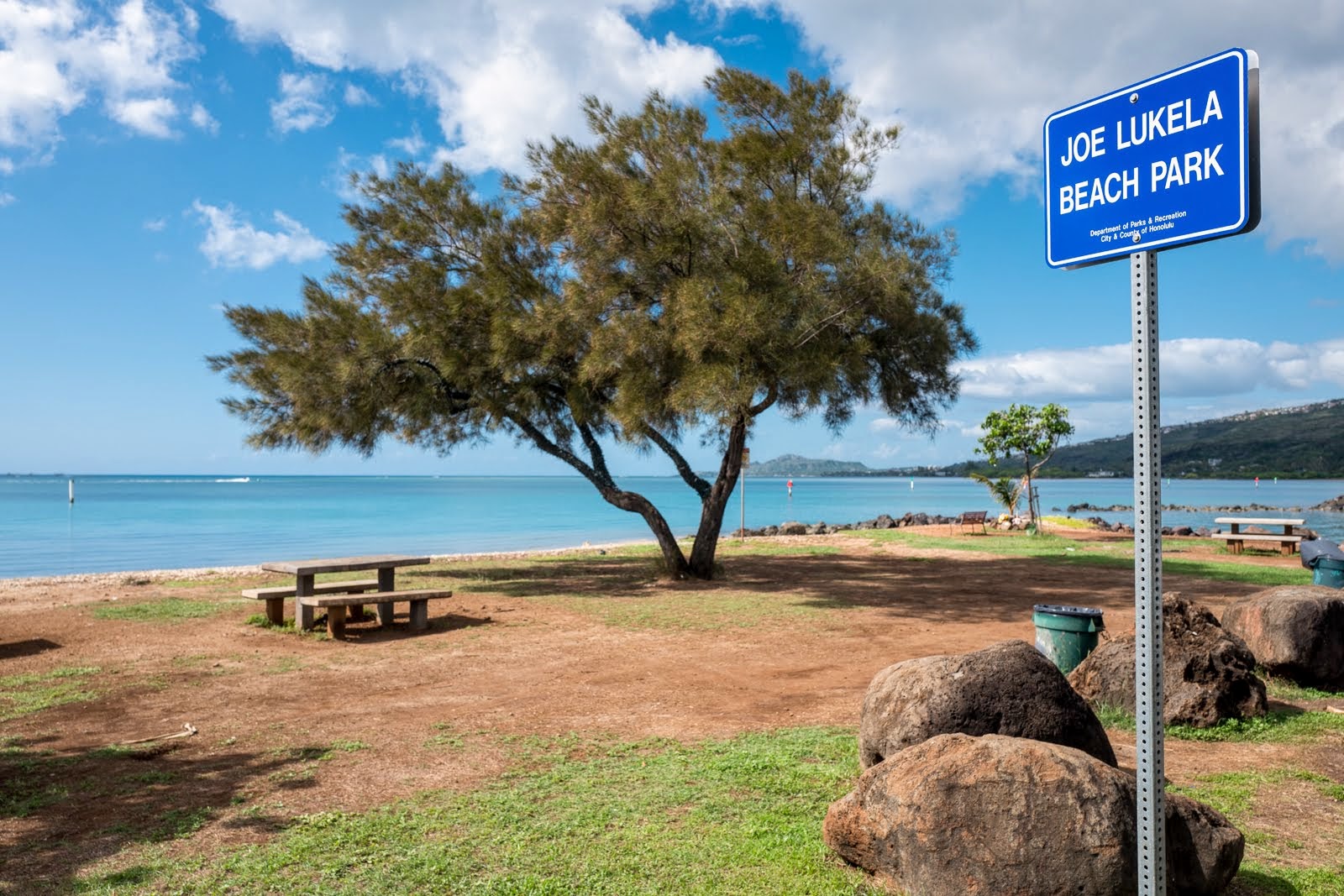
Tree at Joe Lukela park claimed by Mike Miske
Now that Trevor Ozawa is again a candidate running to take back his former seat on the Honolulu City Council, voters should examine his past misuse of his political position to benefit the late racketeering boss Mike Miske.
As a voter in his district, I haven’t forgotten how Ozawa—who served on the council from 2014 to 2018—aggressively used his legislative power to muscle the Department of Parks and Recreation into giving Miske special treatment.
In a nutshell
In 2016, Miske took over a tree in a park along Maunalua Bay in Hawaii Kai and wrapped it tightly with lights. The city Department of Parks and Recreation eventually received complaints and directed Miske to remove the lights. He belatedly complied, but wanted to repeat the tree lighting in 2017 over the department’s objections.
Miske turned to the Honolulu City Council member from his district, Trevor Ozawa, who became his rather enthusiastic advocate, eventually resorting to legislative threats and insider political muscle to get Miske what he wanted. Ozawa successfully forced the city to approve Miske’s lights despite substantive opposition from the parks department that cited the danger to tree health, the administrative problems posed by privatizing park trees, the precedent affecting 200,000 other trees, and the placement of bright lights along the shoreline, which posed a threat to seabirds and appeared to violate environmental laws.
At the time, Ozawa ignored my direct requests for comment. Instead, a staff member called to explain it away—denying special treatment, claiming Miske was “just another constituent,” and denying they had drafted the bill designed to silence parks officials. But the public record shows Ozawa, then vice-chair of the Council’s Committee on Parks and Recreation, was the chief advocate behind the effort to ensure Miske got his way.
Miske, for those who aren’t familiar with his name, controlled a sprawling criminal organization behind the facade of several seemingly legitimate businesses over a 20-year period. He was convicted by a federal jury in July 2024 on 13 counts including murder in aid of racketeering, racketeering conspiracy, and kidnapping.
On December 1, 2024, Miske was found dead in his cell at the Federal Detention Center from a drug overdose. Because his appeal was pending at the time of his death, a legal technicality required his conviction to be vacated. However, federal prosecutors alleged Miske conspired to obtain lethal drugs specifically to void the jury’s $20 million asset forfeiture ruling, creating a loophole so his sole heir might inherit his estate rather than forfeiting it to the government.
The story as I reported at the time.
Miske first came to my attention when I received inquiries from several east Honolulu neighborhood activists about lights that had been installed on a tree in Joe Lukela Beach Park in Hawaii Kai without city authorization. Miske initially called it a tribute to his late son, Caleb, who died earlier that year as a result of injuries received in a high speed crash in Kaneohe. Later, when challenged, he said it was actually in honor of all those whose remains were scattered on the waters of Maunalua Bay.
The city eventually directed Miske to remove the unapproved decorations, and he reluctantly complied, but then turned to Ozawa, who proceeded to intervene forcefully on Miske’s behalf.
Ozawa initially set up a meeting with the parks director to discuss Miske’s request for a special permit allowing him to string the same tree with lights again during the 2017 holiday season. However, the department balked, citing the administrative, logistical, and maintenance burdens it would create.
Parks Department opposed Miske’s request
Parks Director Michele Nekota said allowing private individuals to install lights on city trees could damage the trees and interfere with their regular maintenance.
She emphasized that the city manages an inventory of over 200,000 trees using a mix of in-house crews and private contractors. Because of this, Nekota noted, it would be impractical to contact and coordinate the maintenance for individually decorated trees, and the program would simply exceed the administrative resources the department had available.
In testimony submitted for the record, Nekota said her department was “concerned that decorations added to adopted trees will interfere with maintenance of the trees. For example, a tree with lights wrapped loosely around the tree trunk can inhibit our ability to inspect the health of the tree,” and “installation or removal of decorations could cause damage to the trees such as broken branches, bark damage, or the installer could be injured during the process.”
Additionally, community complaints highlighted that the tree was in a highly visible area near the ocean, and installing lights that close to the ocean could violate laws restricting shoreline lighting, and run counter to efforts to protect the dark night sky from light pollution.
Instead of explaining to Miske why the city couldn’t permit the takeover, Ozawa effectively took Honolulu’s 200,000+ city trees hostage to force the department’s compliance.
In March 2017, Ozawa introduced Bill 40, which would create an “Adopt a tree” program that would have allowed private individuals to place lights and decorations on any of the 200,000 trees managed by the city. Ozawa or his representatives became the bill’s advocates within the council, as well as within the community in appearances at the neighborhood board and other settings.
It wasn’t really a legislative proposal. It was an ultimatum to the parks department. The message was clear: Give Mike Miske what he wants in this case, despite your substantive objections, or I’ll tear down the protections for all city trees.
It was pure political leverage. Ozawa presented the Parks Department with a stark choice: authorize Miske’s tree lights, or face the passage of Bill 40 and the resulting managerial problems and potential tree damage across the department’s parks.
In an email exchange with the parks department, Miske said he intended to keep the lights on year-round, despite terms to the contrary included in the permit.
In one internal exchange, Miske even threatened to cut the tree down entirely if he didn’t get his way.
He referred to Ozawa’s Bill 40 as “our bill,” adding that if it passed, he would allocate funds and use his best marketing efforts on social media to encourage the public to apply for similar projects, which would multiply the department’s managerial and tree care headaches.
Faced with the threat of the new law, the Parks Department relented and a political workaround was created. Miske’s lights and required electrical improvements were classified as a $40,000 “gift” to the city from one of Miske’s companies, Makana Pacific Development.
The gift was to include installation of the lights on the tree along the ocean at the beach park, along with electrical work necessary to run power from a restroom several hundred feet away to a spot adjacent to the tree.
Miske quickly reneged on the promised gift to the city
The council approved the gift resolution on November 1, 2017, through political sleight of hand—adding it to the agenda at the last minute as a “sunshine item” to bypass standard public notice and community testimony. And Ozawa had failed to notify the neighborhood board or community organizations in the district of the issue, unlike his standard practice of flagging such matters for their review before moving forward with them.
But Miske didn’t wait for the permit to be approved and issued. He immediately had the lights installed. And he also immediately reneged on the promised improvements to bring electricity to the site.
First, he asked the city to revert to a different design that had involved installing solar panels on a portable trellis near the tree, a gift valued at $58,000. But Miske quickly abandoned that idea as well, and instead turned to what he called a “portable power source”. In reality, he had a van park in front of the tree, which then used batteries or a portable generator to power the lights. Both the $40,000 and $58,000 pledges were simply ignored and the city never received those promised benefits.
As violations of the tree permit conditions were noted by the parks department, Miske alternately stonewalled, threatened, and bullied his way forward without complying with the permit terms. Internal parks department emails obtained via a public records request show Miske refused to comply with the terms and conditions of the temporary permit, insisting that he would not remove the lights when the permit expired and threatening to retaliate if action was taken against him.
In one internal exchange, Miske even threatened to have the tree cut down if he didn’t get his way.
See:
Ian Lind: Why A Tree In Hawaii Kai Is Raising Questions Of Favoritism, Civil Beat, November 27, 2017
Ian Lind: Playing Hardball Paid Off For Hawaii Kai Tree Lights, Civil Beat, March 23, 2018
Behind the scenes of the permit for the lighted tree in Hawaii Kai, iLind.net, March 23, 2018
Kealoha not alone in doing special favors for local businessman, iLind.net, March 6, 2019
What part of “sunshine” does the Honolulu City Council not understand? iLind.net, May 18, 2020
Discover more from i L i n d
Subscribe to get the latest posts sent to your email.
That guy was a real piece of work on so many fronts. Not missed.
Same goes for Ozawa. Haven’t missed him at all either!
Excellent reminder of influence pressure on top-down gvmnt (taxpayer funded) employees.
Thanks, Ian, this reminder is worth a repeat in Civil Beat.
Thank you for the reminder Ian. You’re the best!
Mahalo for refreshing our memories. I hope this post goes viral in a big way!
Do your part by forwarding to friends!
I don’t know how many local subscribers you have, but I’d suggest that you find a way to publicize this more broadly. Perhaps suggesting that Civil Beat republish your previous articles. Or sending this article to them.
Thanks for publishing this here!
Send it out to your friends and perhaps it will catch on!
Aloha Ian ,
Hope you are doing well! Since Miske came up, two questions the first maybe the subject of a future blog post?
Were you ever in fear for your life while reporting on Miske? Were you ever threatened? You live a very public life and often wondered how you wrote fearlessly!
Secondly, what’s the official story on what happened to Johnny Fraser? Boat? House in Kalihi ? Seemed like quite a few things suggested by the feds, did they ever decide which was accurate?
I’ll circle around later and try to answer your questions.
A man of questionable character.
Ozawa harassed a council member’s aide in 2019.
https://www.hawaiinewsnow.com/2019/02/19/investigation-found-ozawas-behavior-toward-staffer-was-disrespectful-unprofessional/
He also falsely implied in ads in 2019 that he was endorsed by Civil Beat.
I have been reminding people about Ozawa……they forget……but they won’t now.
I sorta knew how shady Mixke was, and you were fillling me in. Did NOT know Ozawa was as shady as he is. As always, thanks for the reporting.