Category Archives: Campaigns

What about the First Amendment?

Civil Beat’s “Sunshine Blog” threw it’s weight behind House Bill 371, proposed legislation described as “the measure that would ban the owners, officers and close family members of government contractors and organizations that receive state grants in aid from donating to political campaigns.”

Apparently CB sees it as a way to put an end to pay-to-play politics.

A worthy goal.

However, in my view, CB and the Sunshine Blog are making a grave error in not taking into account the First Amendment implications of this bill.

The sweeping scope of this bill and its restrictions on First Amendment political speech is breathtaking. Despite this, the legal issues surrounding free speech in the context of political campaigns and campaign finance were not mentioned in any of the testimony during hearings on this bill.

That’s a huge omission because, if passed into law, HB371 would not simply “chill” free speech of corporations, it would eliminate the First Amendment rights of an large but as-yet-undetermined number of individuals associated with , and would trample on long-accepted legal precedents.

These issues are so glaring that the bill appears written to invite a successful First Amendment legal challenge.

Back to Basics

What happens when there’s a direct conflict between the First Amendment right to free speech during an election campaign, and the public’s interest in combatting corruption?

Political speech and expression are at the heart of the First Amendment. After all, the First Amendment’s primary purpose was to protect open discourse about government affairs. Thus, political speech usually receives the strongest protection.

This means that courts tend to apply strict scrutiny to test the constitutionality of restrictions on political speech or expression. Strict scrutiny is the most difficult standard to meet. It requires a restriction to serve a compelling government interest in the least restrictive manner.

A compelling government interest, implemented in the least restrictive manner, or at least in a narrowly targeted manner.

So let’s take a look at HB371.

It would prohibit contributions by state or county contractors, as well as state or county grantees, along with their officers or immediate family members, whether or not they have any role in the contracts or grants, or even any contact with the family member directly involved.

And immediate family members, according to the bill, includes any child, parent, grandparent, brother, or sister, and the spouses or reciprocal beneficiaries of those officers.

I haven’t seen any discussion of the loss of rights for officers of state grantees, along with their family members.

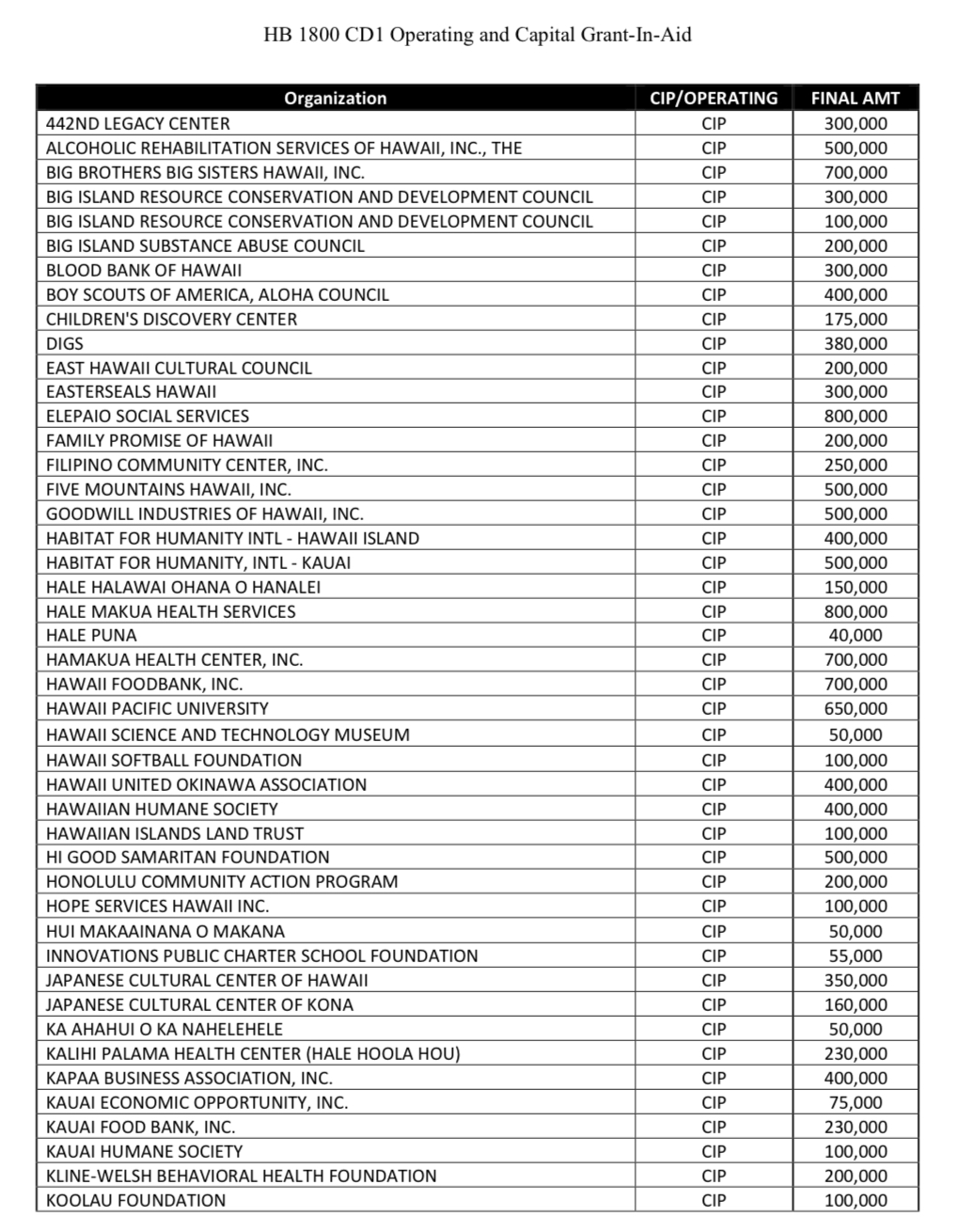
Check this list of organizations that received state grants in aid during the 2024 legislative session.

Here’s page 1 of the 4-page list of grant-in-aid recipients, just to provide a sense of the bill’s broad impact.

Somewhere about 150 community nonprofit organizations are on the list. And all of their officers, along with their parents, grandparents, siblings, and their spouses or partners, will not only be prohibited from contributing to the candidates of their choice, but from contributing to “any political committee,” or to “any person for any political purpose,” or to solicit any contribution “for any purpose.”

One glaring omission is the lack of any nexus between these sweeping prohibitions, the contracts or grants that trigger them, and any actual potential for corruption stemming from those contracts or grants.

For example, an argument can be made that a corporate contractor or grantee, and its officers, should be prohibited from making campaign contributions to the level of government that originates the contract or grant. So you get a state contract, and you shouldn’t then contribute to the governor. But why should that state contract limit your ability to contribute to the mayor’s race, or a city council race, when those positions play no role whatsoever in awarding the contracts or grants?

At one point, my father’s small restaurant supply company competed for contracts to equip school kitchens. If he had landed any of those contracts, my political rights would have been eliminated, along with those of my wife, despite there being no crossover between my dad’s Republican leanings and my own political views.

It seems to me that this is classic overreach, and far from the targeted restrictions that First Amendment analysis requires.

There are already plenty of laws prohibiting pay-to-play corruption. It’s illegal to enter into explicit or implicit quid-pro-quo understandings linking campaign contributions to discretionary action by an elected official. It’s illegal to structure campaign contributions in order to evade contribution limits, by giving money to others (employees, relatives, friends, customers, etc) that they would then contribute in their own names.

Obviously, a narrowly-targeted approach to clamping down on pay-to-play would be to substantially increase the budget for investigation and prosecution of these crimes, and they are crimes, or perhaps to prohibit all contributions by corporations to state and local candidates, as is done at the federal level.

Those are approaches which do not get into the thorny area of restricting constitutionally protected rights.

In any case, this is a discussion that hasn’t happened during the consideration of HB371.

There is also a broader issue. How do we see the political arena? Is it a system in which conflicting special-interest groups clash in a complex dance of deals, accommodations, and tradeoffs, or one in which the goal is to eliminate actual “interests” and leave decisions to neutral arbiters of the “public” interest?

But that is necessarily a discussion for another day.

Judge Alan Kay remembered

I was very sorry to learn of the recent death of retired Federal Judge Alan C. Kay, who served from 1986 to 2000 before moving to senior status.

I remember Kay quite well as the author of a lengthy April 1993 opinion invalidating a state law limiting the disclosure of information about complaints filed with the Campaign Spending Commission. Kay ruled the law was a clear violation of First Amendment rights.

The law made it a criminal misdemeanor for “any person” to disclose information about a complaint unless the commission first found “probable cause” that a violation had occurred. A violation was punishable by up to a month in jail and a fine of up to $1,000.

Kay’s decision was a strong affirmation of the First Amendment and a rather scathing comment on the state’s defense of what he saw as a clearly unconstitutional law.

Here’s a short version of the story.

At that time, I was publishing a monthly newsletter, Hawaii Monitor. An article in the June 1992 issue described a complaint I had filed with the Campaign Spending Commission that accused the University of Hawaii Professional Assembly (UHPA), the union whch represents faculty in the UH system, of failing to properly disclose expenditures in support of Gov. John Waihee’s 1990 reelection bid (“Commission sets hearing on UHPA complaint/UH faculty union PAC belatedly reports cost of Waihee ad“).

That short article prompted UHPA to complain to the commission that I had violated the confidentiality provision of the law. In an attempt to head off further commission action, my lawsuit was filed asking for the law to be declared unconstitutional and an injunction issued to prevent its enforcement. I was represented by Honolulu attorney Clayton Ikei, who recently passed away.

• Read Judge Kay’s 1993 decision in the case of Lind v. Grimmer on Justia.com

Kay’s decision was upheld by the 9th Circuit Court in a decision still cited in First Amendment cases.

• Read the 9th Circuit Court’s decision filed July 22, 1994.

Using campaign funds to support other candidates

I haven’t written about campaign finance issues for a while. But now that election season is in full swing, I recalled that a friend recently asked me a question about candidates, often elected officials, who use their campaign funds to contribute to other candidates.

By law, campaign funds can only be spent for limited purposes, primarily for the election of the candidate whose campaign committee received the contribution. Passing that money on to another candidate appears to be contrary to the law.

But…there’s an exception allowing for the purchase of “not more than two tickets for each event held by another candidate or committee,” whether it is technically a fundraiser or not.

I hadn’t previously thought about this much, so I took a quick look at contributions to candidates during this election cycle up through June 30, the latest data available for download. This probably isn’t complete, because I searched for contributions from any committee named “friends of…”. There could be other candidate committee names that I missed.

How much money was transferred from one candidate to another so far during 2023-2024, through the end of June?

I really didn’t know what to expect, but I was surprised–shocked, perhaps–by the answer.

By my quick count, the total was $189,194 and a few cents.

Here’s a summary.

First, here is a list of candidates who have spent $5,000 or more buying tickets for other candidate’s events.

Screenshot

Gil Keith-Agaran, who served as Judiciary chair in the House and Senate, and later as vice-chair of the powerful Senante Ways and Means Committee, spent far more than any other candidate supporting others. He resigned from the Senate a year ago to concentrate on his role as a Maui attorney involved in Lahaina fire litigation.

He used campaign funds to buy tickets to other candidate’s events for years, often spending $1,000-$2,000 at a time, and spreading his money around to numerous candidates. He has continued since leaving office, as he liquidates his campaign committee’s accumulated bank balance.

Rep. Nadine Nakamura, who appears to have her eye on the position of House Speaker, spent less money on other candidates but spread her influence just as far, parceling out $300-$500 to a couple of dozen campaigns.

Then here are the candidates who received a total of $5,000 or more from other candidates.

If you want to look at the full lists, here are links to donors and recipients

My conclusion is simple. The legislature created a simple but significant loophole that, in part, has been applied in a manner that nullifies a fundamental tenet of Hawaii’s campaign spending law.

It works like this.

Continue reading

More on the prohibition on fundraising during the legislative session

Yesterday’s post drew some lively comments and interesting issues, so I’m going to prolong that discussion with this post.

First, I appreciate Dan Foley’s clarification that it was an amendment to the law passed last year (SB555 SD1 HD1) that prohibited fundraising events by state or county officials while the legislature is in session. I made the mistake of consulting the version of the statute posted on the Campaign Spending Commission’s website, which does not include the 2022 amendments, which only took effect at the beginning of this year. So this year’s bill merely adds a prohibition on soliciting or accepting contributions during the same period, extending the prohibition beyond fundraising events to all fundraising activities.

But while I stand corrected, it doesn’t change my view of this law and the proposed amendment. I still see it as unwise, unnecessary, and open to challenge on constitutional grounds, based on any absence of any reasonable nexus between fundraising by county officials or OHA trustees, and the public’s perception of the honesty of state legislators.

In comments on yesterday’s post, there were several references to the Citizens United decision. While I agree that the U.S. Supreme Court’s 2010 decision in the case of Citizens United v. Federal Election Commission, inflicted considerable damage on our democracy, the main damage wasn’t caused by its view that raising and spending money in political campaigns are exercises of the First Amendment right to free speech, in this case free political speech, which has long been recognized as constitutionally protected.

That had been relationship had been firmly established in the case of Buckley v Valeo, a decision issued back in 1976.

Here’s a summary of the Buckley decision from the Constitutional Law Reporter.

The classic Supreme Court decision on this issue is the 1976 case Buckley v. Valeo, which controlled the law on this topic for decades.

The law at issue in the case is the 1974 Amendments to the Federal Election Campaign Act, which had been enacted after the Watergate investigations revealed serious campaign finance misdeeds in the 1972 presidential elections. The 1974 Amendments limited contributions, limited personal expenditures, created disclosure requirements, and created public funding for presidential elections.

The Court began the opinion by determining that unlike other symbolic speech, which would normally be analyzed through the O’Brien test, the giving or spending of money can be either speech alone, conduct, or both. This is because “virtually every means of communicating ideas in today’s mass society requires the expenditure of money.” Therefore, the Amendments would be analyzed under strict scrutiny as restrictions on political speech.

Under this analysis, the Court upheld the restrictions on contributions. Unlimited monetary contributions can cause corruption or the appearance of it, such as a “quid pro qou” deal where a candidate does a favor in exchange for a contribution. The Court felt that the government preventing this was essential to a functioning democracy. Limiting a contribution still allows someone to make a statement or message with their allowed contribution, so speech was not overly restricted.

Similarly, the Court upheld financial disclosure requirements, using the same anti-corruption rationale. Limits on expenditures, however, were struck down as unconstitutional. The Court determined that limiting independent expenditures did not have the same anti-corruption impact – there being less danger of a quid pro quo deal if the individual isn’t directly contributing. Additionally, the Court rejected the argument that these limits were necessary to make candidates equal, stating the idea of restricting some speech to enhance the speech of others was “wholly foreign to the First Amendment.”

Following a similar line of reasoning, the Court struck down total limits a candidate could spend on themselves, stating that it was the role of the individual – not the government – to determine how much one could spend to promote their own views.The last portion of the decision upheld the public financing of elections because it did not restrict speech. By allowing for public financing of candidates who met the requirements, speech could be expanded to a broader pool of candidates and electors.

What the decision in Citizens United v FEC added was the extension of the political freedom of speech to fictional entities such as corporations and unions, and providing that the free speech rationale allows unlimited spending by wealthy individuals, corporations, and so-called “Super Pacs” as long as their election-related activities are “independent” of candidates and their campaigns.

In my view, those are the damaging parts of the Citizens United decision, not the idea that we have a right to be able to contribute to the candidates of our choice, and that spending by candidates, and by extension their ability to raise campaign funds, implicates that same right to free speech.

Here’s the Brennan Center for Justice on Citizens United:

In the court’s opinion, Justice Anthony Kennedy wrote that limiting “independent political spending” from corporations and other groups violates the First Amendment right to free speech. The justices who voted with the majority assumed that independent spending cannot be corrupt and that the spending would be transparent, but both assumptions have proven to be incorrect.

With its decision, the Supreme Court overturned election spending restrictions that date back more than 100 years. Previously, the court had upheld certain spending restrictions, arguing that the government had a role in preventing corruption. But in Citizens United, a bare majority of the justices held that “independent political spending” did not present a substantive threat of corruption, provided it was not coordinated with a candidate’s campaign.

As a result, corporations can now spend unlimited funds on campaign advertising if they are not formally “coordinating” with a candidate or political party.

Worrying about whether a neighbor island county official holds a fundraiser or solicits campaign funds while the legislature is in session hundreds of miles away is nothing more than political theater that impinges unnecessarily on their rights of political speech. At least that’s my view of the situation.