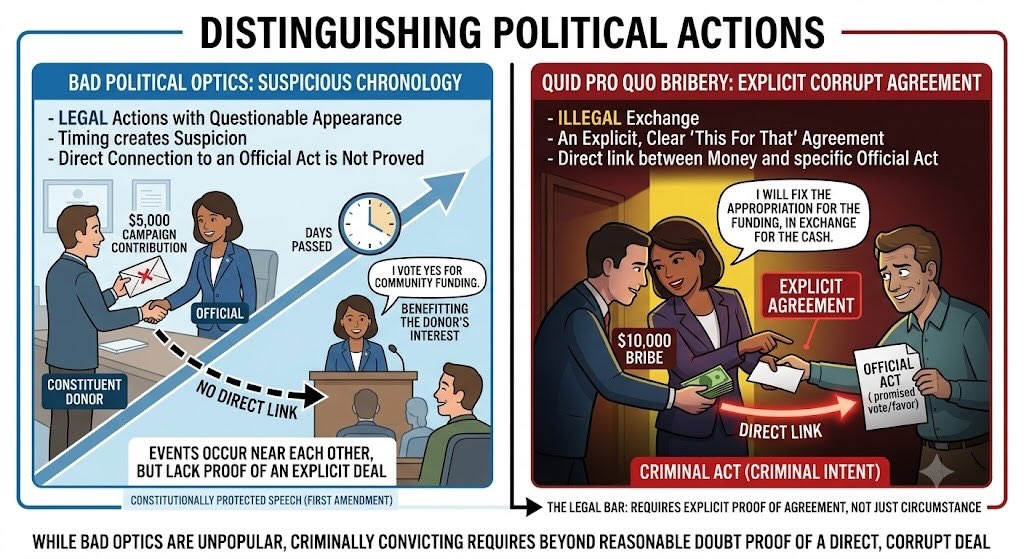
Prosecutors face steep legal hurdles to secure a criminal bribery conviction against Hawaii Lt. Gov. Sylvia Luke. The difficulty doesn’t just rest on the specific facts of the case—it stems from nearly 50 years of robust constitutional protection established by the U.S. Supreme Court.
luke and three others, including former Rep. Ryan Yamane, as well as former Gov. David Ige’s one-time chief of staff, were indictd on charges that included bribery and conspiracy to commit bribery. A fifth was charged with obstruction of justice and falsifying campaign spending records. The bribery charges carry a maximum penalty of 10 years imprisonment plus a fine on each count.
But convicting Luke is likely to be an uphill slog for prosecutors. The Supreme Court has consistently held that the right of citizens and political candidates to give and accept campaign contributions falls under the protections of free speech and association provided by the First Amendment. To breach those protections and prove illegal bribery, prosecutors must prove the existence of an explicit, mutual “quid pro quo” agreement between the donor and the recipient.
This for That
As explained by the League of Women Voters:
“Quid pro quo” (Latin for “this for that”) refers to an exchange between a candidate and donor in which the candidate receives a personal gain (a contribution for election or re-election to office) from the “sale” of public power (a vote or other action that benefits the donor).
This is often framed as a conflict of interest because an officeholder has a duty to act in the best interests of constituents, which overrides any agreement to follow the preferences of a donor. The Supreme Court specifically mentioned quid pro quo corruption as well as the appearance of quid pro quo in the Buckley v. Valeo (1976) decision, which supported restrictions on direct campaign contributions but not on campaign expenditures.
Because the Hawaii Supreme Court has not issued a definitive ruling establishing where a legal political contribution ends and an illegal quid pro quo begins, Hawaii courts must look to federal case law for guidance.
The Legal Standard: Explicit Agreements and “Official Acts”
Federal precedent sets an exceptionally high bar for converting a political contribution into a federal or state crime.
To prove criminal bribery, prosecutors must demonstrate two crucial elements:
• An Explicit Agreement: The campaign contribution must be part of an explicit quid pro quo deal. A political donor giving money to a candidate whose views or legislative goals align with their interests is completely legal; prosecutors must prove a direct, unambiguous agreement that the money was given strictly in exchange for specific action.
• An “Official Act”: The promised exchange must involve an “official act”—a formal exercise of governmental power.
Crucially, routine political and legislative actions—such as setting up meetings, hosting public events, making introductions, or speaking with other state officials—do not, by themselves, constitute corrupt agreements under federal law.
Routine Constituent Work Isn’t Bribery
The reality of modern campaign finance means political candidates routinely take actions that benefit donors who support them. In the landmark case McCormick v. United States (500 U.S. 257), the U.S. Supreme Court acknowledged this reality and cautioned against overcriminalizing everyday politics.
“Serving constituents and supporting legislation that will benefit the district and individuals and groups therein is the everyday business of a legislator. It is also true that campaigns must be run and financed. Money is constantly being solicited on behalf of candidates, who run on platforms and who claim support on the basis of their views and what they intend to do or have done.
Whatever ethical considerations and appearances may indicate, to hold that legislators commit the federal crime of extortion when they act for the benefit of constituents or support legislation furthering the interests of some of their constituents, shortly before or after campaign contributions are solicited and received from those beneficiaries, is an unrealistic assessment of what Congress could have meant… To hold otherwise would open to prosecution not only conduct that has long been thought to be well within the law, but also conduct that, in a very real sense, is unavoidable so long as election campaigns are financed by private contributions…”
The Road Ahead for Prosecutors
While public optics surrounding campaign donations can often look questionable, unfavorable ethics or bad appearances are generally not enough to support a conviction.
To overcome Lt. Gov. Luke’s First Amendment protections, prosecutors cannot simply show a timeline where contributions were made around the same time legislative assistance was provided. They must produce concrete evidence—such as wiretaps, written correspondence, or insider testimony—proving a clear, explicit “this-for-that” demand was made. However, courts have held that criminal intent and agreement can be inferred from the totality of the circumstances, such as a pattern of reciprocal benefits, coordinated actions, and suspicious timing, even if the parties never explicitly speak the words “bribe” or “agreement.”
But circumstantial evidence and possibly unsightly context is precisely what fifty years of First Amendment jurisprudence was built to protect. Unless prosecutors in Luke’s case can produce concrete evidence that transforms a suspicious sequence of events into an explicit quid pro quo, they will struggle to cross the threshold from bad optics to criminal guilt.