Category Archives: Health

The Chemo Chronicles: A weighty matter

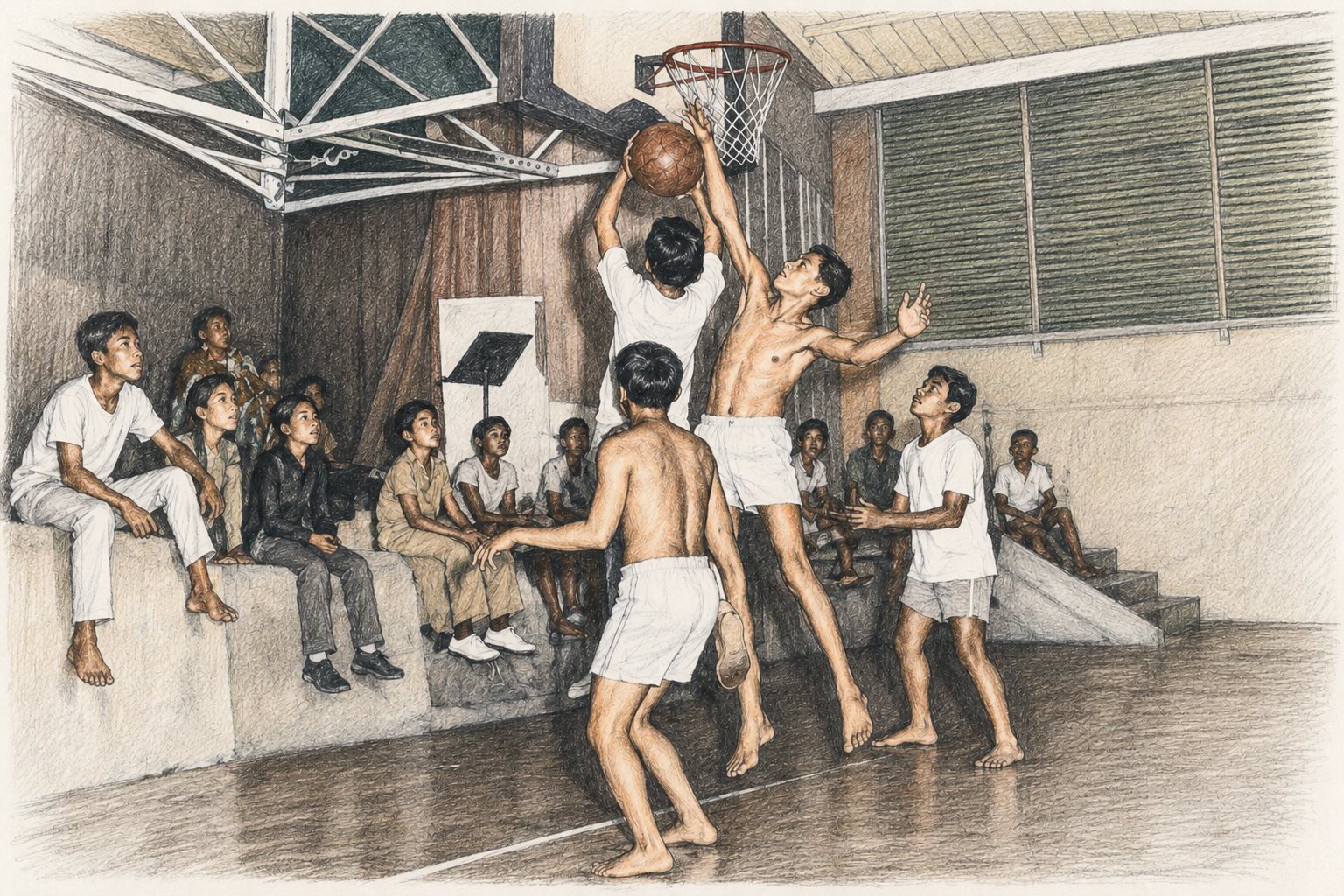
University High School c. 1961 [formatted and colorized by ChatGPT]

I’m the scarecrow-skinny kid facing the camera and trying to block the shot in this barefoot shirts-vs-skins basketball game in our rickety old University High School gym. I remember it was a cold, concrete floor, and the area was quite a bit smaller than a regulation basketball court. The photo was taken was sometime during the 1960-1961 school year, and appeared in the school annual, Uniki, in the Spring of 1961.

It may have been the last time in my life I weighed less than I do right now.

Being an active, energetic but skinny kid felt very different than I feel today as a skinny 79-year old cancer patient running on empty much of the time.

Glimpses of myself in the mirror these days are unsettling. Gaunt is the word that comes first to mind. A friend in my weekly “Poi Posse” shopping group, friends who make sure I’ve got enough poi, recently suggested cadaverous. From my own perspective, neither is an exaggeration.

This weight loss wasn’t intentional. There was no new diet, no exercise program, no health milestone I was trying to reach.

The cause is simple. The Big C.

Cancer.

Continue reading

The Chemo Chronicles: An overview

I was curious and asked Google’s Gemini to summarize the series of posts here under the banner, “The Chemo Chronicles.”

Here’s Gemini’s overview. Just click to see a larger version.

Perhaps this is the time to solicit your suggestions of matters you would like to see me deal with in the months ahead. If you don’t want to leave a comment, then feel free to email ian(at)ilind.net.

Screenshot

Coming Tuesday in The Chemo Chronicles: “A weighty matter”

The Chemo Chronicles: “Chemo Brain”

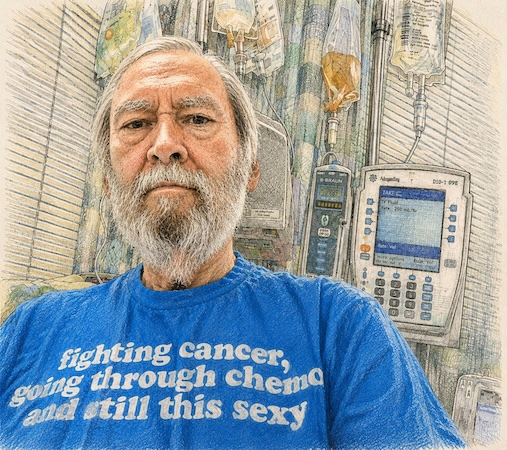
I had to laugh when a gift recently arrived from Laura, a cousin on my mom’s side who lives in Colorado and is a cancer survivor. We’re 2nd cousins, as our grandmothers were sisters. Laura was, by all accounts, a cancer patient with a fierce attitude, determined to defeat her cancer, and she gave no quarter during her treatments. She wore a shirt like this proudly, and sent one to me along with a lot of useful advice based on her own experience during chemo. Now that I’ve finished chuckling over its message, I’ll be looking for opportunities to show it off.

It was from Laura that I first heard the term “chemo brain.”

Lately, I think I’m beginning to understand what she meant, based on my own limited experience with the layer of brain fog that settles in on certain days. On good days, I’ve described it as something like a cap wrapping the top 15% of my brain, leaving me a little unsteady but fully able to function. On bad days, I find myself just wanting to go back to bed, unable to muster the energy and focus to do much reading or writing, much less anything more demanding.

What I’m learning is that physical fatigue acts as a real multiplier for this fog. The mental sluggishness rarely stays static throughout the day—it hits hardest when energy wanes, or after a period of sustained mental effort. Managing it often comes down to simple energy management. Learning to tackle writing or important thinking during peak morning hours, taking micro-breaks, and not trying to push through when brain fatigue sets in.

The term “chemo brain” was originally coined by patients—particularly breast cancer survivors in the 1980s and 1990s to describe persistent cognitive issues like memory loss and mental fog after treatment. Early reports were often dismissed by doctors as mere stress or fatigue, but persistent patient advocacy eventually led to formal clinical research and recognition by the mid-1990s.

As it turns out, “chemo brain” is something of a misnomer. The medical world often refers to it now as cancer-related cognitive impairment because it isn’t caused by chemotherapy alone. According to the American Cancer Society, these cognitive changes can also stem from radiation, surgery, immunotherapy, hormone treatments, or even medications like steroids and anti-nausea drugs. In some cases, changes happen before treatment even starts.

So far, my experience has been limited to the “fog” and varying degrees of dizziness, rather than major memory loss or confusion.

I’m able to live with a touch of brain fog for now, pacing myself and hoping it won’t get any worse.

And on the off days, having Laura’s shirt around is a needed reminder of the importance of her positive attitude, as well as my deep appreciation of her support, and that of all the readers of this blog.

The Chemo Chronicles: Setback!

I had a blood test Thursday morning at the Queen’s Cancer Center at Kuakini. Instead of searching for an elusive vein in my hand or arm—a process that has left my arms feeling like pin cushions lately—the blood was drawn through the port installed earlier in my chest. It’s the same two-way port used for chemotherapy infusions, accessible only by registered nurses with special training. So instead of just having blood drawn at one of the many available Diagnostic Laboratories locations, such as the one just a few blocks from home, I went across town where Nurse Pattie was able to use the port for access.

Afterward, I met briefly with my oncologist. Everything appeared on track for my next chemotherapy session on Friday.

Then came the 3:10 p.m. phone call. Chemo was cancelled and postponed until next Friday. The morning lab results showed my white blood cell count was simply too low to proceed.

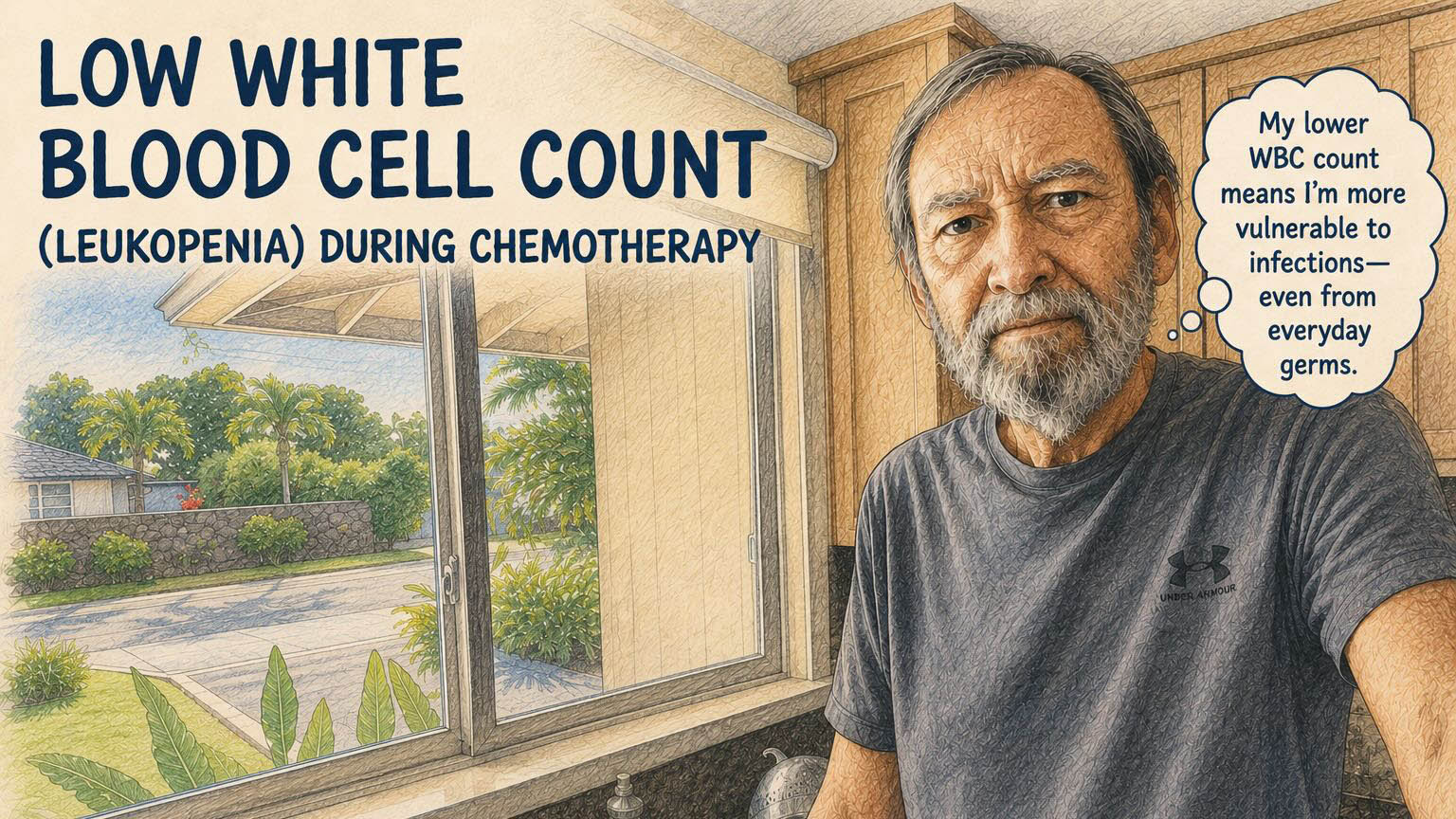
Chemotherapy works by slowing or stopping fast-growing cancer cells, but it also impacts the immune system by reducing infection-fighting white blood cells. As the Mayo Clinic notes, low counts significantly raise the risk of infection, often forcing doctors to delay treatments or adjust dosages until the body has time to rebuild its defenses.

Given the numbers, my oncologist called off this week’s treatment.

It also means that I need to take special precautions to avoid infections. Stay away from groups, or people who might be sick. Wash hands frequently, even here at home. For us, that appears to require staying out of restaurants for a while, and being sure to wear a mask on any other outings.

And my oncologist also noted another option for moving forward: shifting the schedule.

The original plan was two consecutive weeks of chemotherapy followed by a week off. Switching to a treatment every two weeks would give my white blood cell count more time to recover between rounds.

There’s a lot of trial and error at this stage of cancer treatment, it seems.