Category Archives: Cancer

Chemo Chronicles: Testing the waters

Am I about to turn a corner? I really don’t know, but the experiment to test whether I will benefit from receiving additional IV fluids during the week after a chemotherapy session is now officially underway.

Following the previous chemo session, I was knocked out of commission for most of the next two weeks. This little fluid experiment is a test to see whether addressing apparent dehydration will reduce side effects.

It began at the end of a 5-1/2 hour chemotherapy session on Friday, September 25, which ends with a one-hour IV infusion of fluid that starts the process of washing excess chemo drugs out of my system.

Early Saturday morning, I caught an Uber to the infusion center at Queen’s Hospital in downtown Honolulu for another 1-hour fluid infusion. I have selected to have my chemotherapy at the small Cancer Clinic Queen’s operates in the medical office building adjacent to Kuakini Hospital, but it’s not open for business on weekends.

I was leery about having this done at the main Queen’s infusion center, but my experience was quite good, at least at that early weekend hour. It is about twice the size of the Kuakini clinic, which has only six chairs where patients sit while receiving infusions. The larger Queen’s Hospital center offers six beds for those who will be there for an hour or more, and another five chairs (if I recall correctly) for short-timers.

After arrival, I was shown around a corner to the last cubicle. It had a standard hospital bed capable of all kinds of contortions, a rack holding a bag of saline solution waiting for me, and a couple of pumps to control the drip. My nurse was pleasant, helpful, and efficient. No complaints there. Being able to stretch out on the bed was a different experience than leaning back in the chair at Kuakini, but unfortunately it didn’t make the time pass any more quickly.

So that was Saturday. Monday afternoon I returned to Kuakini for another round of fluid. It times out at almost exactly 1-hour from start to finish, plus a couple of minutes to flush the connection to the chest port, remove the various bits of chemo paraphernalia, button my shirt, test my sea legs, pick up my cane, and get on my way.

To be honest, I didn’t experience a quick pick-me-up, but then I remember that two weeks ago, a few days after the prior infusion, I was in bed, too exhausted and dizzy to do much of anything. And that went on for a full week.

Although I’m still dizzy, and having to take extra care moving around the house, this week is a definite improvement. And I’ll do one more fluid session on Thursday afternoon to see if it can extend this winning streak.

I’m still making sense of my experience, and have identified several factors that can vary independently of each other.

Appetite. Some days I have zero appetite, and food is almost aversive. Other days, I can eat a small meal, although it does require extra effort.

Dizziness or lightheadedness. Sometimes when I get up the world starts spinning. It’s something that comes and goes.

Chemo brain, or what I’ve been calling brain fog. It feels like I need to just wipe some cobwebs aside in order to function close to normally.

Constipation. A constant threat that is a known side-effect of at least two of the drugs used during chemotherapy to prevent nausea.

Exhaustion. Some days I have a bit of energy, mental and physical, while on other days I’m just exhausted from the time I awake and eventually have to give in and go back to bed.

I don’t know if identifying these different factors will help me understand how I’m doing on a given day, but hopefully at least naming them gives me something more to work with.

So I’m not ready to declare the experiment a success. There are too many moving parts, and I’m only a few days into it.

But compared with where I was at this point two weeks ago, I’ll take it.

Recalibration: Brain fog, fluids, and moving forward

After being reminded of my absence on these pages for most of the week, I’m posting this informal update. Not thought out and edited line my more ambitious Chemo Chronicles, but just something to explain what’s going on.

My most recent chemo infusion was September 11, a Friday. Unfortunately, this has been the worst post-chemo experience to date, with the major side effects, dizziness, brain fog, and lack of appetite, knocking me out most of last week.

This Tuesday, 12 days after the chemo treatment, I was still having sudden dizzy spells when just walking across the room, and as a result have spent too much time in bed (that’s my editorial voice feeling guilty about not being more “productive” during this time. Usually these symptoms recede by day 7 (the Thursday after chemo). This time, not so much. I was still wobbly when I reported this past Tuesday for a blood test and meeting with the Advanced Practice Registered Nurse (APRN) in my oncologist’s office.

I like her. She listens hard. Takes copious notes. She’s looking for clues about why the dizziness is lingering. I think she was drifting toward sending me to have my heart examined when she asked about hydration.

“Are you drinking enough?”

I pointed out that I’ve flagged my failure to drink anything near the recommended amount daily of fluid. I can’t seem to sit down and chug a glass of water. Back in the day, I be able to down a beer or two with just a small burp at the end. Those days are long gone. Besides swearing off alcohol since this all started at the end of February, I just can’t drink fast. I get a glass of water, add some ice cubes, then sit down with my computer to follow by own lead wherever it takes me. I find that it takes at leasts 45 minutes to finish the water, sip by sip.

And then there are cautionary warnings that I continuously run across. They warn against drinking with an hour of a meal, since the water displaces space that food could be used by food. Map out a day of small but frequent meals, and it’s hard to find the time for another drink.

Here’s the bottom line for now. We decided test the “Blame it on insufficient hydration” with a test run. After finish with the APRN, I walked into the next room sat down for an hour for an infusion of a normal saline solution, then went downstairs and called an Uber.

It only took about 90 minutes after getting home for the brain fog and dizziness to start receding. Within a couple of hours, I was feeling okay (remember, in this context OK is relative).

I believe the plan is for me to have the next chemo treatment this Friday, return to the main Queen’s downtown for another hour of fluid on Saturday, and repeat that on Monday or so, site to be determined. Maybe even one more infusion at the end of next week.

If I feel better, then we’ve finally landed on at least one of the culprits knocking me out. If these infusions fail to make a difference, then it’s back to the drawing boards.

Disclosure–I did have the energy early in the week to start writing a another substantive update about an issue in the Miske civil forfeiture case, but not enough energy to push through and finish the writing and editing. But it’s coming soon.

Although, fair warning. Like OK, “soon” is proving to be a very relative term.

The Chemo Chronicles:
Making sense of conflicting advice

As I wrap up the second round of my chemotherapy and immunotherapy, I’ve found that tracking the calendar—counting the days from infusion—is more than just a way to mark time. It’s given me a pretty good idea of which days will likey be “lost” to the side effects of the treatments, which now usually includes days 3 through 6 (Sunday through Thursday). It’s grown over the first four chemotherapy sessions, and I’m now getting used to just realizing I won’t  have the energy to get much of anything done.

But now I find myself caught squarely between two opposing camps advising me on what’s needed to get through the post-chemo period. The problem is that the two approaches appear to be to be in direct conflict.

Advice from one side is to “listen to your body,” and being unusually tired during the first days after a chemo infusion is a natural result of the hours spent dripping  powerful drugs into my system. So just go back to bed, although a continue to experience a tinge of guilt when I retreat to bed to read, rest, or sleep away the majority of a day.

The other side says, rightly, that long periods flat in bed speed up muscle wasting and the best response is to push back against the unnatural fatigue with simple exercises like walking around the house.

In one corner is a cousin who has been through her own demanding bout with cancer and chemo. Her perspective is clear and uncompromising: Listen to your body, surrender to the fatigue, and stay in bed. When the exhaustion hits, she insists, you don’t bargain with it or fight back. You yield to it.

In the other corner is a lifelong friend who was a second-grade classmate in Kahala Elementary School more than seventy years ago. Her advice comes from the exact opposite pole: Defy the fatigue, use force of will, and keep walking several times a day. From this vantage point, letting the bed claim you is surrendering ground that becomes harder and harder to later reclaim.

At first glance, they seem entirely irreconcilable. One urges total retreat; the other demands a steady march through the fog. Sitting in the middle of it, feeling the cumulative weight of the drugs doing their work, it’s easy to wonder which instinct to trust—or whether listening to one means sabotaging the other.

I finally went online in an attempt to resolve the conflict. Turns out this isn’t a moral debate between discipline and surrender.

It’s really a matter of biology, timing, and safety.

Continue reading →

The Chemo Chronicles: Counting the days


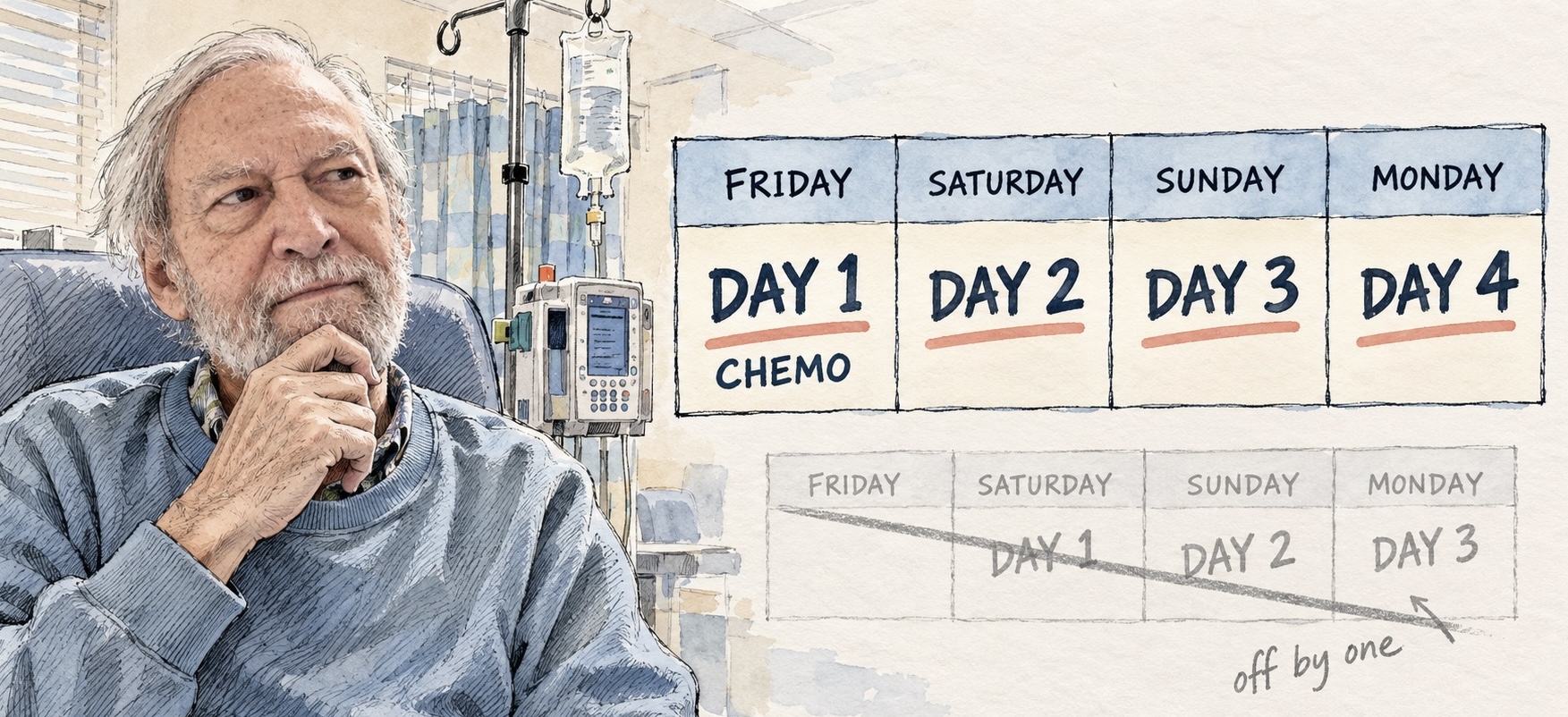
[Illustration by ChatGPT]
Or, perhaps, miscounting.

Since starting The Chemo Chronicles, I’ve fallen into a particular way of referring to the post-chemo period when the negative side effects rock my days.

My regular schedule has been chemo infusion on Friday. I then have referred to Saturday as the first full day after chemo, or Day 1. Sunday as the second full day, or Day 2, and so on.

But when I started trying to compare notes on just when the side effects hit, I realized that I might be counting differently than others. When I referred to Sunday through Wednesday as days 2-5, was that what others also meant by days 2-5?

Faced with this ambiguity, I did an online search for the generally accepted method of counting.

And, sure enough, I was wrong. Here’s what I learned.

In standard oncology schedules, Saturday is Day 2.

Chemotherapy cycle protocols count the day of infusion as Day 1:

Friday: Day 1 (infusion day)
Saturday: Day 2
Sunday: Day 3

This numbering matters most when timing at-home medications (such as anti-nausea pills, steroids, or white-blood-cell booster injections like Neulasta or Zarxio) and tracking expected side-effect timelines.

To add to the confusion, I was also cautioned that oncologists often refer to first day after infusion, second day after infusion, etc.

But, lacking that qualifier, the count of days most commonly includes infusion day as Day 1.

In my own case, this means that the side effects are worst on days 3-6 following a Friday chemo treatment, Sunday through Wednesday.

So from here forward, I’ll use this as the standard manner of counting, hopefully making comparisons to the experience of others a little easier.

By that count, this is Day 6. Wednesday. I’m still feeling the side effects, although I expect they’ll be subsiding as the day goes on.

But, as usual, we’ll see.