Category Archives: Elections

Yes, the state does have a voter guide to General Election candidates and ballot issues

Office of Elections

I couldn’t have been more surprised to stumble across the state’s election voter guide yesterday while trying to answer questions about ballot issues from a couple of friends.

Just click on the cover graphic to browse the guide.

This 91-page voter guide was prepared by the Office of Elections, and has been available at least since July.

It’s well done and full of useful information about candidates, ballot issues, and the election process.

But where has it been hiding?

It apparently only exists in online form, as far as I can tell. PDF version is available so that it can be downloaded and printed.

It’s featured prominently on the Office of Elections website, but that’s not exactly a “must read” for more people.

A look back shows it received only minimal news coverage. The Honolulu Star-Advertiser mentioned it in a brief August 4th “Kokua Line” column. And it received one earlier mention on July 18, buried at the bottom of page A10 as an “Off the News” item, right below two paragraphs about the appointment of a new acting director for Honolulu’s Ocean Safety Department. Not exactly front and center news.

I reviewed prior minutes of the Election Commission, but couldn’t find any mention of the voter guide, its content or distribution plan, during any meeting this year. I hope I just overlooked it.

There apparently is no printed version available, and the digital version is only useful if you know it’s there. However, the state does not appear to have promoted its availability through a public service advertising campaign. And there’s no mention of the voter guide in news releases distributed by the Office of Elections this year that are available on the website.

At one time these voter guides were printed and mailed to registered voters. Expensive? Yes. But it more effectively put the inforation in the hands of those who needed it. It would be interesting to see data on the number of visits or downloads of this latest version.

So despite being a useful resource, this year’s General Election Voter Guide was only minimally supported and distributed.

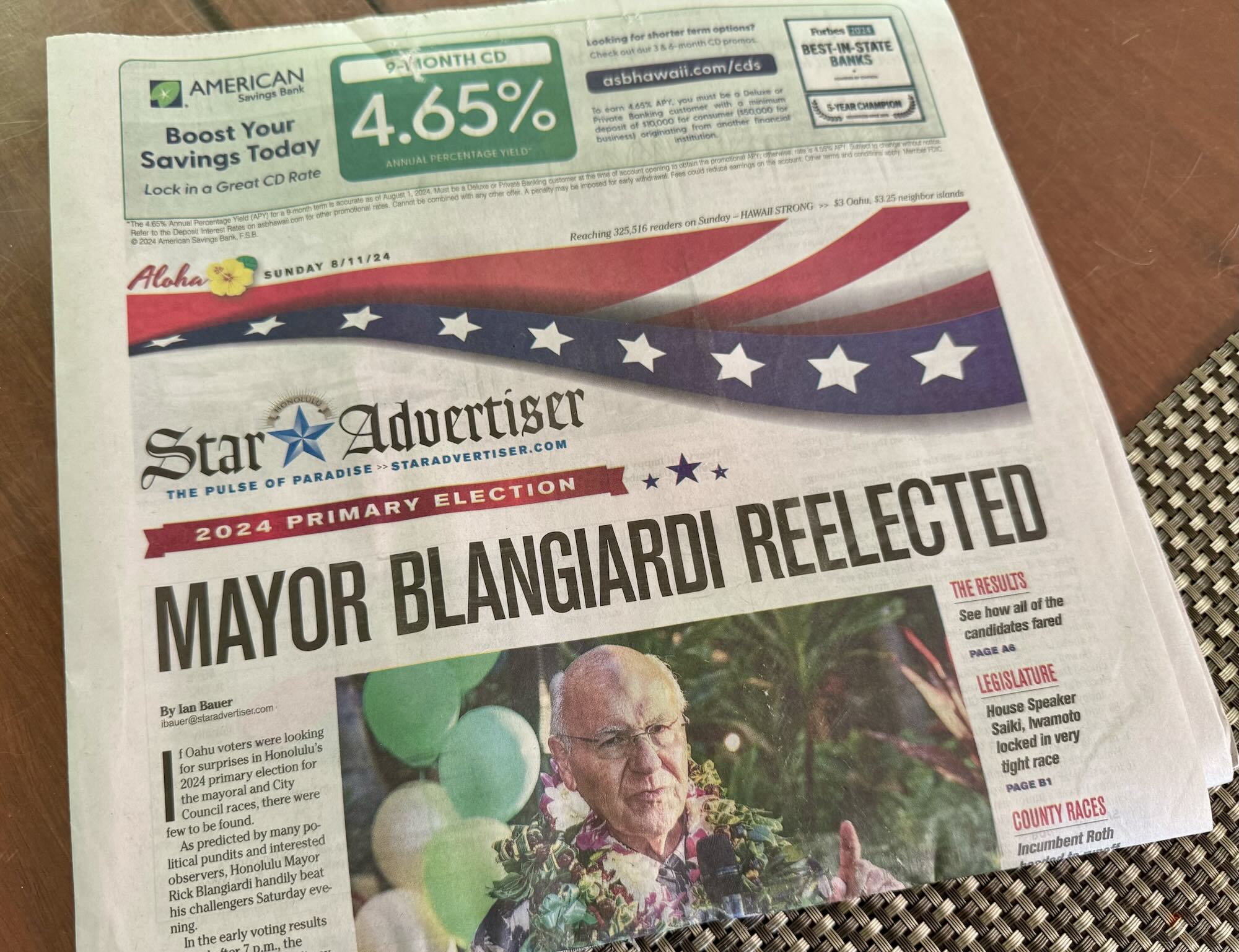
Star-Advertiser headline: “Mayor Blangiardi Reelected”

What? Why is this the headline in this morning’s newspaper?

This was, quite simply, not “news.” Mayor Blangiardi had no serious opponent, and his reelection was a foregone conclusion.

Meanwhile, House Speaker Scott Saiki was being knocked off by transgender activist Kim Coco Iwamoto, in what appears to be the first time a sitting speaker has lost a reelection bid since Tadao Beppu was beaten by a Republican in 1974, and the first time a speaker was ousted in the Democratic Primary. It’s historic in that sense, and sets off an internal struggle to fill the power vacuum in the House.

That’s news.

The fact that the Blangiardi story remained as the headline in the Star-Advertiser delivered to homes this morning reflects incredibly badly on the newspaper’s judgment, and their advanced planning for election day coverage.

A head-shaking decision, for sure.

Here’s why I don’t support prohibiting campaign contributions during legislative sessions

Back in November 2017, I took a position against any ban on political fundraising during Hawaii’s legislative session (“Don’t Ban Campaign Fundraising During Legislative Sessions“).

My main point was pretty simple. Raising money to fund a political campaign involves the First Amendment issue of free speech. In the modern world, without money, a candidate has only limited opportunities to get their message out to voters.

Let’s also be clear on another thing. A candidate’s right to raise funds to enable their own political speech is protected by the First Amendment. In fact, political speech is considered the most important form of protected speech. Attempts to restrict such a right by prohibiting fundraising will almost certainly be subject to “strict scrutiny” by the courts and will not be allowed to go forward unless they meet several legal conditions.

Any proposed restriction must be justified by a “compelling” government interest. The restriction must be narrowly tailored to achieve the desired goal. And the proposal must be the least restrictive way to achieve the stated government interest.

Fast forward to this year. HB89 unanimously passed the House early in this session and crossed over to the Senate. that would ban elected officials from soliciting or accepting campaign contributions while the legislature is in session, and in a short period before and after any session. And SB1493 has been passed by the Senate Judiciary Committee and is awaiting a full Senate vote. Neither the version of the bill as amended by the Judiciary committee, nor the committee report, are posted yet on the legislative website, but the original senate bill was narrower than HB89 and applied only to contributions by lobbbyists, using the same definition of lobbyist as Chapter 97 HRS, the state’s Lobbyist law. Under this definition, a lobbyist is someone who engages in lobbying, which in turn is defined as involving attempts to influence legislative action or executive branch rulemaking.

HB89 is the first bill in play. My concern is that this bill is far broader than it needs to be to have the intended impact on the public perception of legislators, and that makes it constitutionally questionable.

According to House Standing Committee Report 79:

Your Committee finds that this measure implements one of the recommendations made by the Commission to Improve Standards of Conduct established pursuant to House Resolution No. 9, Regular Session of 2022. If enacted, this measure would reduce the negative perception of legislators soliciting or accepting contributions from individuals or organizations that have an interest in matters pending before the Legislature during session.

HB89 seems pretty simple. It adds a brief section (c) to Section 11-257 regarding prohibited contributions.

(c) No elected official as defined in section 11-342(d) shall solicit or accept campaign contributions during any regular session or special session of the legislature, including any extension of any regular session or special session and any legislative recess day, holiday, or weekend.”

And, in turn, Section 11-342(d) provides: “Elected official” means an individual who currently holds an elected state or county office, including the governor, lieutenant governor, state senator, state representative, trustee of the office of Hawaiian affairs, county mayor, county council member, county prosecuting attorney, and any individual appointed to serve in any of the aforementioned offices.

So here’s the problem. The intent of the bill, as expressed by the committee report, is to “reduce the negative perception of legislators” who solicit contributions while the legislature is in session.

But how does a fundraiser for a Kauai County Council member, for example, possibly reflect on “the negative perception of legislators”? There doesn’t appear to be enough of a nexus between contributions to non-legislators and public perception of legislators to warrant this blanket prohibition during legislative sessions. Remember that infringing on the rights of candidates to further their “free speech” requires a compelling government interest. It seems to me that there is arguably a compelling interest in reducing opportunities for corruption by limiting contributions to legislators during the session. But what’s the compelling interest in restricting fundraising by other elected officials during the legislative session? And without such a compelling interest, it seems to me clear that this bill is on very, very shaky ground.

In addition, by prohibiting elected officials from soliciting or accepting contributions while the legislature is in session, the house bill infringes on the rights of voters in counties far from the State Capitol from exercising their right to contribute to a county official of their choice, even during an election year.

And the impact of the bill would, at best, be cosmetic. It might reduce the negative perceptions held by some, but it would not realistically do anyting to reduce the overall impact of big money on politics.

Would restricting the bill’s reach to lobbyists, as the senate bill would do, make any meaningful difference? It would still appear to prevent someone who is registered to provide lobbying services at the legislature from contributing to a county council member’s campaign during a legislative session that doesn’t involve the council member. So, again, what’s the compelling purpose?

In any case, just my two cents worth.

It looks like “Aloha” to the Aloha Aina Party

It appears the Aloha Aina Party, which was certified to have candidates on the ballot for the first time in 2020, will soon be notified that it will be decertified after failing capture the minimum number of votes to remain on the ballot.

The party hoped its expressed commitment to Hawaiian values would naturally attract Hawaiian voters.

“The AAP is founded on and promotes traditional Hawaiian values such as living aloha and being pono. It is inclusive, and nurturing, and it will celebrate diversity and address the needs and concerns of all the people of Hawaii,” Pua Ishibashi, a founding member of the party, wrote in a Civil Beat column in March 2020. “The AAP will recognize the divine, aloha the people, malama the aina, demand government accountability and transparency, advocate for hooponopono and restore what was lost as it relates to the overthrow of the Kingdom of Hawaii in 1893.”

Well, long story short, that did not happen.

In 2022, the party fielded just five candidates. One for U.S. Senate, one for a state senate seat, along with candidates in three House districts.

The AAP’s candidate drew a total of 6,766 votes.

Dan Decker was the party’s leading vote-getter, with 2,208 votes, ending a distant 5th (and last) place behind U.S. Senator Brian Schatz, who garnered 290,894 votes.

To assure the party’s continued place on the ballot, Decker would have needed to capture over 40,000 votes. The other criteria for recertification appear to equally unattainable.

The requirements to remain a certified political party are set by law. Any party that fails to receive the required number of votes “shall be subject to decertification.”

(2) The party received at least ten per cent of all votes cast:
(A) For any of the offices voted upon by all the voters in the State; or
(B) In at least fifty per cent of the congressional districts; or
(3) The party received at least four per cent of all the votes cast for all the offices of state senator statewide; or
(4) The party received at least four per cent of all the votes cast for all the offices of state representative statewide; or
(5) The party received at least two per cent of all the votes cast for all the offices of state senate and all the offices of state representative combined statewide.

The law requires parties to receive a notice of decertification within 120 days of the election.