Category Archives: Media

Another example of an AI hallucination

This is an example of Google’s Gemini AI assistant fabricating a totally fictitious transcript of a recorded interview.

The transcript didn’t just make some mistakes. It had no relation to the original recorded interview. It was completely made up.

Here’s the story. I was interviewed via Zoom by Neal Milner for a Civil Beat project he is working on. Milner is Professor Emeritus of Political Science at the University of Hawaii after teaching for decades, and is now a regular columnist for Civil Beat.

He was at his new home in Portland, Oregon, while I was here at our house in Honolulu. I set up the Zoom call at his request, and he asked if I would record it and send a transcript so that he didn’t have to take notes. That sounded simple, and I immediately agreed. We ended up talking for about 90 minutes.

When our call was finished, Zoom made it simple to download a zipped copy of the recording. From there, I thought that preparing a transcript would be simple.

I was very, very wrong.
Continue reading

NLRB files for contempt charges against Pittsburgh newspaper

Press Release | Newspaper Guild of Pittsburgh

Posted Wednesday, January 21, 2026 11:20 am

On Jan. 20, the National Labor Relations Board (NLRB) filed contempt charges against the Pittsburgh Post-Gazette for defying court orders to restore editorial workers’ contractual, collectively bargained health care plan. The company illegally scrapped that plan in July of 2020.

Editorial workers at the Post-Gazette — members of the Newspaper Guild of Pittsburgh (TNG-CWA Local 38061) — went out on strike on Oct. 18, 2022, demanding the company restore the terms of the entire union contract it illegally discarded, including dignified health care. Following other legal defeats, in March of 2025 the U.S. 3rd Circuit Court of Appeals enjoined the PG to restore the bargained health care.

Company lawyers falsely claimed, both in court and to employees, that the health care plan no longer existed. It did, and does. On Nov. 10, 2025, the U.S. 3rd Circuit Court ordered the company to restore all the requested terms of the contract while also updating its March injunction on health care

The company requested an emergency stay of that injunction from the U.S. Supreme Court in late December. After receiving written arguments against a stay from the NLRB, the Newspaper Guild of Pittsburgh and the U.S. Solicitor General, that request was denied. Within hours of that denial, PG employees were called to an emergency meeting and shown a prerecorded video of a Block Communications Inc. exec telling them the paper was closing on May 3, which is World Press Freedom Day. The PG has continued to not offer the health care plan.

“Over the past several years, we repeatedly warned top Post-Gazette officials that their actions were illegal and were having a detrimental impact on the newspaper. Actions have consequences.” said Andrew Goldstein, Post-Gazette education reporter and president of the Newspaper Guild of Pittsburgh. “Pittsburgh deserves much better than a company that will violate the rights of their employees, spend millions of dollars doing so, cry poor, then skip town.”

If the 3rd Circuit finds the PG in contempt, then it has 14 days from that ruling to comply. If it does not, it will be fined $100,000, and an additional $5,000 for each additional day it flouts the order. On the same timeline, Post-Gazette General Manager Tracey DeAngelo or any officer, agent, attorney or company representative who knowingly violates the order would be fined $10,000 after 14 days, and an additional $1,000 for every additional day.

Due to the retaliatory nature of the company’s decision to close the newspaper, the PG is also risking further liabilities for its violation of federal law.

Following the corporate announcement to close the paper, workers and community members began meeting to advance a vision and plans for an alternative to the Block-owned Post-Gazette that engages more effectively and sustainably as a source of communication and connection to reflect the concerns of working-class people in the region.

Newspaper JOAs are now only history

The last of the joint operating agreements between two daily newspapers was quietly dissolved at the end of 2025, closing a half-century era in which newspapers in 28 cities, including Honolulu, were granted exemptions from anti-trust laws to allow merging their business operations while maintaining separate newsrooms.

The last of the JOAs between the Detroit Free Press and the Detroit News, was voluntarily dissolved on December 28, 2025. Both newspapers have continuing publishing after the dissolution of their JOA.

In Hawaii, the Honolulu Star-Bulletin and the Honolulu Advertiser formed a joint operating agreement in May 1962 after a determination that the Advertiser was a “failing newspaper” and was unlikely to survive without the cost savings brought about by a merger with the Star-Bulletin. At that time, the Star-Bulletin, the evening newspaper, was much larger and financially healthy, while the morning Advertiser was struggling.

A separate company, the Hawaii Newspaper Agency, was formed to operate the joint printing, distribution, and business side of the merged newspapers.

But in 1969, the U.S. Supreme Court found a similar JOA in Arizona violated federal anti-trust laws, a blow to newspapers across the country.

In response, Hawaii’s senior senator, Daniel K. Inouye, introduced S 1520, the Newspaper Preservation Act, which was quickly passed into law. At the time, there were 22 JOAs involving 44 daily newspapers.

One of the joint agreements covered by Inouye’s bill was between the Honolulu Star-Bulletin and the Honolulu Advertiser dated back to May 1962. Both newspapers were locally owned at that time. The Star-Builletin was the evening newspaper, and public reading habits at the time meant it had a considerably larger circulation than its morning rival, the Advertiser.

About a year after passage of the Newspaper Preservation Act, the Star-Bulletin was purchased by Gannett, a large national newspaper chain.

During the heyday of the Hawaii JOA, the two newspapers were reportedly sharing about $50 million per year in profit.

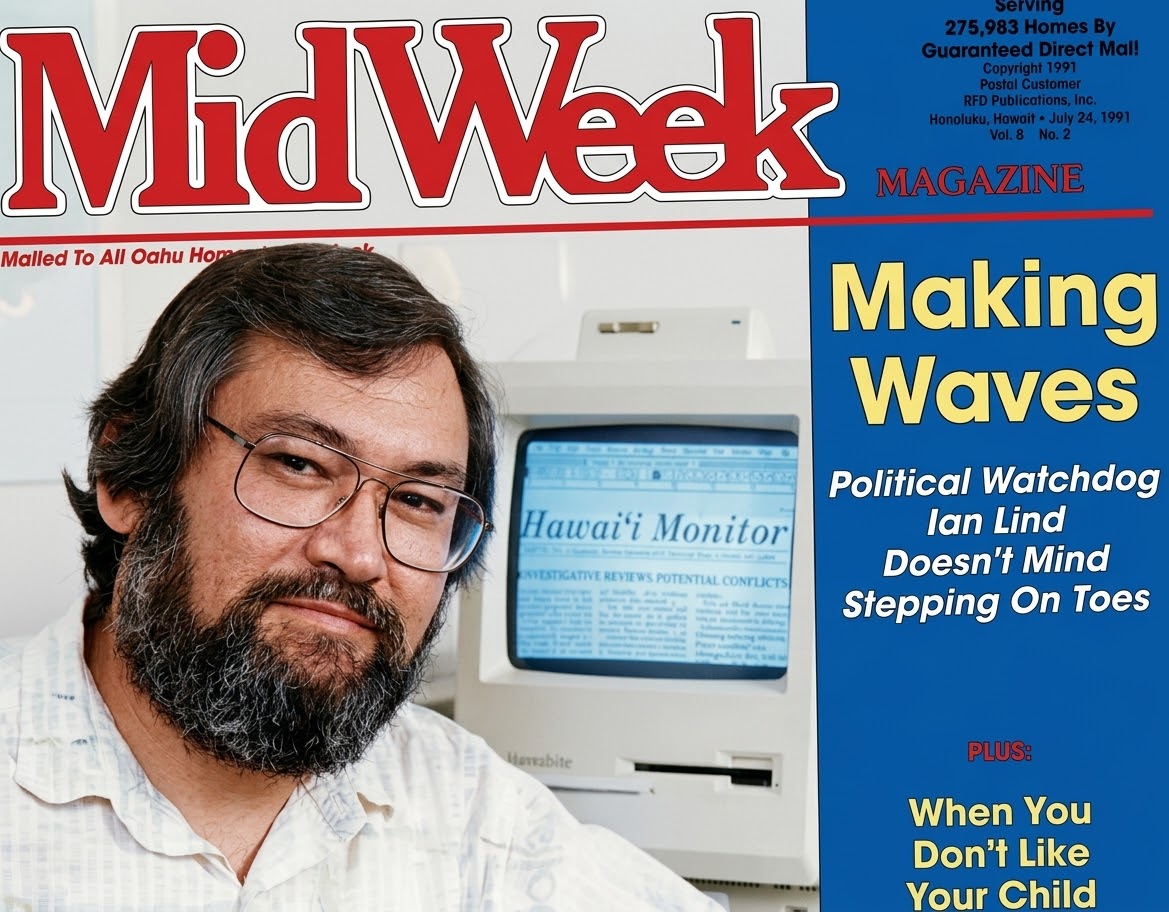
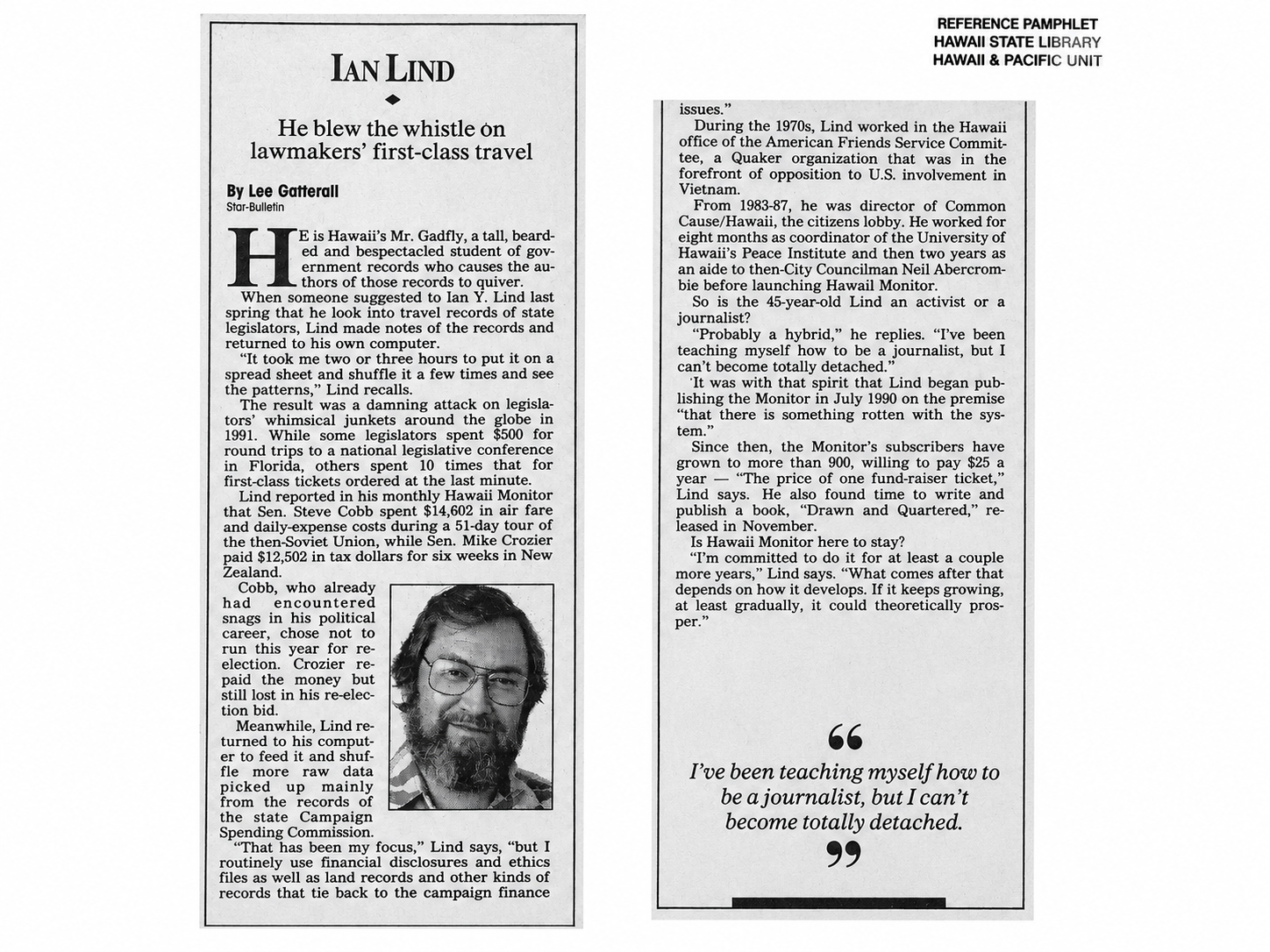
I was recruited to join the Star-Bulletin staff as an investigative reporter in 1992, after publishing my own newsletter about Hawaii politics for two years.

But at the same time, public habits were changing and readers moving toward morning newspapers, prompting Gannett to buy the Advertiser, which had become the larger newspaper, in 1992, soon after I received the offer to join the SB. At the same time, Gannett sold the Star-Bulletin to Liberty Newspapers, a Tennessee-based chain owned by publisher Rupert Phillips.

In early 1993, when it became clear that the Star-Bulletin would survive the transition, I belatedly accepted the offer and started as a Star-Bulletin reporter about March 1993.

The Honolulu JOA ended with the sale of the Star-Bulletin to Black Press, owned by Canadian publisher David Black. The first issue of the “new” Star-Bulletin was published on March 15, 2001.

According to Wikipedia:

The Newspaper Preservation Act was touted as a relief measure to allow multiple newspapers competing in the same market to cut costs, thus ensuring that no one paper could have supremacy in the market by driving the other(s) out of business. However, mounting evidence suggests the passage of the Act was less about protecting editorial diversity within community newspaper markets than about inflating the profit margins of national newspaper chains.[3] Large newspaper chains were able to sustain high profits while driving independent newspapers out of business, or forcing them to sell their stake to a chain.[3] In fact, President Richard M. Nixon initially opposed the passage of the act (as had his predecessor, Lyndon B. Johnson) as being antithetical to the essential practices and character of free market capitalism.

He reversed himself upon receiving a letter from Richard E. Berlin, CEO of the Hearst chain of newspapers and magazines.[4] In the 1969 letter, Berlin intimated that failure of the law to pass would carry political consequences and hinted that support from Nixon would conversely help the President and his allies. The Nixon Administration supported the Act’s passage, and in the 1972 Presidential Campaign, every Hearst newspaper endorsed Nixon for reelection.

From public official to mystery writer

For more than 30 years, Orlando “Dan” Davidson was a familiar figure in Honolulu development and planning circles.

He started as a private attorney, served as general counsel and later executive director and lobbyist for the development-oriented Land Use Research Foundation, then was named executive director of the Hawaii Housing Finance and Development Corporation, and eventually took over the reins as executive director of the state Land Use Commission.

After he retired from that last post in 2012, he and his wife moved to the mainland. She passed away a couple of years ago, and he now live in Portland, Oregon.

From Davidson’s website

Now Davidson has made a bit of a shift, resurfacing as a mystery writer with a pair of books.

His first book, Baseline Road, was published in January 2023 by Artemesia Publishing, LLC. A second volume, North of Foothill, is scheduled for release in March. You can find more information on Davidson’s website.

Here’s the publisher’s blurb for Baseline Road.

Southern California, May 1970.

In the turmoil following Nixon’ s Cambodia invasion and the Kent State killings, a young economics professor is killed in a campus bombing. Authorities conclude she was an unintended victim and arrest a known radical. Case closed.

Nearly two years have passed when an old hippie says, ” The Claremont bombings, the FBI pigs got it all wrong.” to Jimmy Sommes, a San Bernardino County homicide investigator, and country-rock fiddler, at one of Jimmy’ s gigs. Sommes and Claremont Detective Carol Loomis, look into the case and realize that things are not as they seem. Shadowy figures emerge, including Collins, a vicious but troubled hitman.

Was it a cleverly disguised murder? Jimmy and Carol, both enmeshed in improbable romantic relationships with characters who are possible suspects, believe the answer may be found on Baseline Road, a lonely stretch of highway that time has forgotten.

I recently reread Baseline Road. Davidson is a fine narrator whose main character, Jimmy Sommes, spins this yarn with snappy dialog, rich descriptions of places and people, and a complex plot grounded in actual events of the day.

It’s a good combo, and I’m looking forward to reading the upcoming release.

But neither book draws on Davidson’s years immersed in Hawaii’s inner politics close to the decision-making circles of power and influence. Lots of mysteries to be written grounded in this experience I’m sure. So I’m looking forward to another book set in the islands and drawing on this rich background in a similar fashion to the way Davidson painted a portrait of Claremont in an earlier day.