Category Archives: Elections

The lunar eclipse was more entertaining than yesterday’s General Election

A friend’s comment this morning pretty much sums up my feeling about the local elections.

He said simply: “This is the most boring election ever in Hawaii!”

It seems to me that the August primary just drained almost all the interest and energy out of the general election, and the results reflected the dominance of things as they are. Perhaps I’m just getting older and jaded, but the election stats seem to support this view.

Here’a a link to the statewide summary of votes.

Above all, Hawaii remains a safe Democratic stronghold, as a quick scan of the results shows.

In a sign of the continuing status quo, it apepars the Republican presence in the State Senate is a lonely caucus of one.

In the House, it’s only marginally different.

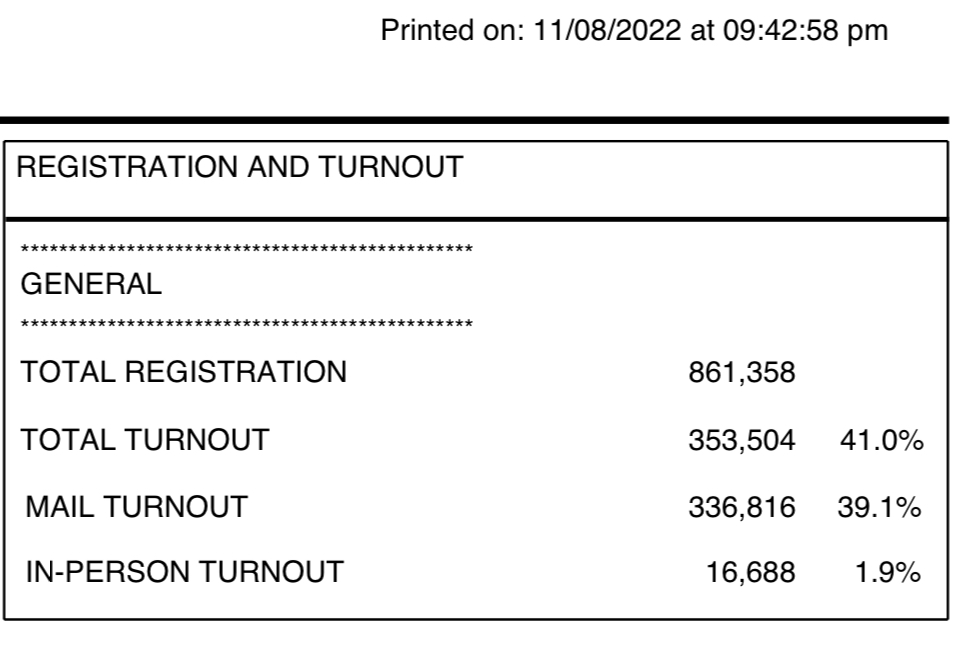
The lack of excitment shows in the low voter turnout.

Statewide, Republican voters appear to represent from 25-30% of the those casting ballots, although in the few districts where GOP candidates won, they appeared to draw votes beyond the party base.

If Democrats retain their majority in the U.S. Senate, Hawaii’s Senator Brian Schatz will be in a position to continue to accrue both seniority and influence, from which the state will benefit.

And after the unfortunate Congressional careers of Tulsi Gabbard and Kai Kahele, Jill Tokuda’s election to represent the 2nd Congressional District strikes a high note!

Although it was mostly yawns in local races, I’m sure that I’m far from alone in nervously following the results in hotly contested Senate races on the mainland which will have a huge impact on our next few years.

Here’s an election challenge you probably didn’t hear about

I just never know what I’m going to run across while going through the periodic ritual of checking the regular spots for possible news.

Yesterday I took a look at recent opinions from the Hawaii Supreme Court and Intermediate Court of Appeals, which included several election-related cases that had been disposed of, and one caught my eye.

It seems that Richard Y. Kim, one of the “minor” candidates for governor in the Democratic primary, believes he actually won the primary but was robbed of the victory by misconduct and errors on the part of the Office of Elections.

This isn’t his first time around the block, as he was also on the Democratic primary ballot in 2018, garnered just 1,576 votes, and responded with several election-related lawsuits against the Office of Elections and Gov. David Ige.

Kim he is a dentist and graduate of Columbia University in New York. He reported receiving two campaign contributions for a total of $450, and spent a total of $973.82 on his campaign. The candidate financial disclosure filed with the State Ethics Commission reported Kim had no earned income in the past year, owns no property, has an Ameritrade account worth between $10,000 and $25,000, and has debts of at least $45,000 but less than $100,000.

Kim, in his 2022 complaint filed with the Hawaii Supreme Court, said it was “impossible” that he received only the 985 votes statewide reported by the Office of Elections, and went on to cite “many facts and evidence” to support his position. I’m afraid these were not made with tongue firmly in cheek.

• Kim said his campaign website “has attracted 8,967 people, with over 32,000 views on my 706 posts, since 2017,” and that his Facebook account has “almost 1,500” followers.

• He argues that pre-election media polls would have had different results if his name had not been omitted. He insinuates he was overlooked in the polls because he has called for “media reform.”

• Kim says he “heavily invested his campaign in sign waving in the last two months of the primary election,” and “believes he has thrown ‘Shaka’ blessings to tens of thousands passing cars, probably at more than 100,000 people. Each time, he received roughly 5-30% honking (on average), and many more numerous hands waving, Shakas back, and head lights turned on and off, from the passing cars.

• Kim complained he had been blocked from commenting on Josh Green’s official Lt. Gov page on Facebook, and blocked by the Star-Advertiser from commenting on their “Spotlight Hawaii” live program, which he described as examples of “voter suppressions.”

Kim blames computer manipulation of the results for his loss, and said he believes “the vote counting by the computer must have been compromised due to such simple computer programming manipulation on his name on the democratic ballots, for example, by having moved the decimal to 0.01 or 1/100 and only counted as if he received 1% of the actual votes that he received on the ballots.”

He then alleges additional computer misdeeds shifted 99% of his vote to Lt. Gov. Josh Green, which left Green the runaway winner in the primary.

Without the alleged computer misdeeds, Kim says he would have received 985,000 votes, 38.7% of the Democratic votes, with Green tallying just 23.2%.

It took the Hawaii Supreme Court just a few days to review Kim’s complaint. The court’s 10-page Findings Of Fact, Conclusions Of Law, And Judgment conclude it was “based on speculation or unreasonable inferences from the evidence submitted in support,” and raised “no genuine issue of material fact related to Kim’s election contest.”

The court’s opinion provides a concise review of the laws governing election challenges and what standards must be met for such a challenge to be successful. Short version–it’s a high bar.

And so goes the democratic process.

Hawaii voters mostly stick with experience over talk

Well, Hawaii’s primary election has come and gone. And the Democratic primaries were where the action was.

The official results are available on the Office of Elections website, and Civil Beat has good primary election coverage of all the major races this morning (freely available without a paywall),

I haven’t dug into the data yet, but keyed on a few races.

The biggest losers were the big money political action committees and Super PACs, from the carpenters union’s “Be Change Now” Super Pac that spend millions in an ultimately unsuccessful attempt to torpedo Sylvia Luke’s campaign for lieutenant governor in the Democratic primary, while favoring former Honolulu City Council chairman Ikaika Anderson, to the string of mainland dark money outfits that tried to boost Pat Branco in Hawaii’s 2nd congressional district by viciously attacking his Democratic opponent, former state senator Jill Tokuda.

Luke prevailed by a comfortable margin, with 34.8% of the vote, compared to Anderson’s 25.4%. Keith Amemiya ran third, with 21.7%. None of the other three LG candidates were in double figures statewide.

And Tokuda had more than a 2-1 lead over Branco, 49.8% to Branco’s 20.9%.

In the governor’s race, U.S. Representative Kai Kahele placed a distant third, with just 13.3% of the vote, well behind Vicky Cayetano, who finishd with 20.6%. Not surprisingly, Lt. Gov. Josh Green pulled 61.5%, validating early poll results that showed him well out in front of the field.

It looks like Green led in every county, including Kahele’s Big Island base.

Kahele’s late entry into the gubernatorial race, after he largely abandoned the seat in Congress he won just two years ago, appeared to shake up the race, but in the end he failed to gain traction as a candidate.

In a few other closely watched races, Sen. Lorraine Inouye (53.2%) crushed Sen. Laura Acasio (27.4%) in the 1st Senatorial District after reapportionment dropped the two incumbents into the same district.

House Speaker Scott Saiki appears to have survived another strong challenge by Kim Coco Iwamoto by just over 200 votes out of over 5,000 cast.

Molokai activist Walter Ritte failed in his effort to oust incumbent Senator Lynn Decoite, who drew 58.7% to Ritte’s 26.5% in the 7th Senatorial District race.

Longtime legislator Roy Takumi was easily beaten by Rep. Gregg Takayama (62.3% to 31%) after reapportionment tossed the incumbents into a runoff.

Links to the Supreme Court briefs in Texas election lawsuit

A CNN story today describes the strongly-worded responses by the states of George, Pennsylvania, Michigan and Wisconsin to a rather bizarre Texas appeal to the U.S. Supreme Court to overturn the election results in those states (“Battleground states issue blistering rebukes to Texas’ lawsuit to invalidate millions of votes“).

At the end of the story are important links to each of the filings.

Read the court filings

Read the responses Thursday from Georgia, Michigan, Pennsylvania and Wisconsin, as well as amicus briefs from 106 House Republicans and 22 Democratic-led states and territories.

Hawaii is among the 22 states joining in that Amicus brief.