Senator Donna Kim has proposed cuts of 121 positions and supporting general funds from the University of Hawaii at Manoa’s budget. These cuts are included in the Senate version of the state budget, which was approved by the full Senate and returned to the House this past week.
I understand that the proposed budget and position cuts would impact important research units, including the College of Tropical Agriculture and Human Resources, the School of Ocean and Earth Science and Technology (SOEST), the UH Cancer Center, and the Department of Astronomy. These are, of course, key drivers of the university’s success at obtaining hundreds of millions of dollars in outside research funding.
The cuts would likely spill over to impact the federal grants being worked on by any of those terminated as a result of Kim’s cuts.
It’s unclear when the faculty layoffs Kim proposes would go into effect. What is clear is that with the loss of the positions, these faculty could not be replaced or rehired.
In the event the Legislature were to approve Kim’s proposed cuts, it would certainly start a long and bitter legal battle in which the rest of the university faculty and administration would end up as collateral damage.
Continued accreditation of the university and its programs would quickly be called into question. Questions of academic freedom, or the lack of academic freedom, would create a large red flag that would potentially threaten outside funding to the university and its programs, and make it difficult to recruit new faculty. The implications are quite staggering.
So, first question: Is it legal?
The Hawaii State Constitution now provides that the university is a semi-autonomous organization managed by the Board of Regents.
The constitution provides, in part:
The board shall also have exclusive jurisdiction over the internal structure, management, and operation of the university. This section shall not limit the power of the legislature to enact laws of statewide concern.
Kim’s proposed micromanaging appears to go far beyond the bounds of constitutionality.
And then there’s the question of the labor contract between the University and UHPA, which represents the university faculty.
The contract has a section dealing with “retrenchment.”
Retrenchment refers to the termination of the employment of any Faculty Member during any appointment as a result of lack of work or other legitimate reason in accordance with §89-9(d), H.R.S., such as fiscal exigency; reallocation of resources; reorganization of degree or curriculum requirements; reorganization of academic or administrative structures or programs; curtailment of one (1) or more programs.
My understanding of “fiscal exigency” refers to a situation in which the state is just plumb out of money and, as a result of its financial crisis, is unable to meet its obligations under the UHPA contract.
And, if that were to occur, the contract spells out the required “order of retrenchment” as follows:
1. Part-time Faculty, including Lecturers
2. Non-tenured Faculty
3. Tenured Faculty
Kim’s targeted cuts of 121 specific faculty department seems to completely ignore these legal obligations and would leave the university’s administration in an untenable legal situation.
A legislatively-imposed set of budget and position cuts that bypass the Board of Regents in order to target specific faculty members protected by the UHPA contract would seem to be ripe for legal challenge. And what happens to the university during the years that such a challenge is working its way through the labor board and the courts?
And how is it that we’ve gotten to this point without the benefit of public debate and open scrutiny? Senator Kim should be held accountable, it appears.
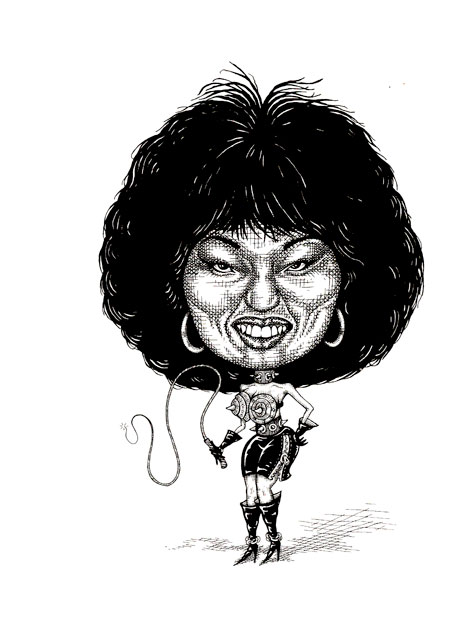
 After posting yesterday concerning Senator Kim’s budget cut, I edited my original version to remove this caricature of Kim drawn by John Pritchett back in 1992.
On reflection, I was worried that its inclusion would detract from the reporting about Kim’s move. So I cut it from the original post.
Now, however, I think it appropriate to share it more generally, as it shows that the image she had built a quarter-century ago pretty much sums up the way she continues to act today.
The drawing appeared in a slim volume Pritchet and I published in the months before the 1992 election. “Drawn & Quartered” featured Pritchett’s drawings of local political figures accompanied by my brief political essays. At that time, Kim was a member of the Honolulu City Council.
I wrote at that time:
“Kim has a combative, aggressive, and sometimes sarcastic style as well as a sharp tongue, often attacking those presenting public testimony or tangling with her fellow Council members.”
Not much seems to have changed.