Category Archives: Legislature

Misinformation abounds about the bail reform bill

There are a lot of things being said by opponents of the bail reform bill awaiting Gov. Ige’s signature (HB1567) that are just plain wrong.

Yesterday’s post here about the bill drew a quick comment that began with one of the basic errors.

A frequent commenter, who used the name “Bert” for this comment, wrote: “The defenders of Bail Reform have failed to incorporate victims of crime, who live in daily fear. Many beneficiaries of Bail Reform will be repeat offenders.

No, that’s just plain wrong. The bill as proposed excludes most repeat offenders, and lots of others.

Here’s the section from the bill itself listing the types of offenses that will not be covered by the bill. Anyone charged with assault, abuse of a family member, burglary, violating a TRO, sexual assault, DUI, and others listed will not be eligible for release under the bill. Neither will repeat offenders, anyone charged and awaiting trial or sentencing, or with any misdemeanor conviction within the last year, or a felony conviction within eight years.

Quoted directly from the bill:

(b) This section shall not apply if:

(1) The offense involves:

(A) Assault;
(B) Terroristic threatening;
(C) Sexual assault;
(D) Abuse of family or household members;
(E) Violation of a temporary restraining order;
(F) Violation of an order for protection;
(G) Violation of a restraining order or injunction;
(H) Operating a vehicle under the influence of an intoxicant;
(I) Negligent homicide;
(J) A minor;
(K) Unauthorized entry into a dwelling;
(L) Promoting a dangerous drug in the third degree;
(M) Habitual property crime; or
(N) Any other crime of violence; or

(2) One or more of the following apply:

(A) The defendant has a history of non-appearance in the last twenty-four months;
(B) The defendant has at least one prior conviction for a misdemeanor crime of violence or felony crime of violence within the last eight years;
(C) The defendant was pending trial or sentencing at the time of arrest;
(D) The defendant was on probation, parole, or conditional release at the time of arrest;
(E) The defendant is also concurrently charged with a violent petty misdemeanor, a violent misdemeanor, or any felony offense arising from the same or separate incident; or
(F) The defendant presents a risk of danger to any other person or to the community, or a risk of recidivism.

What’s worse, in my view, is that the agencies now urging the bill’s veto did not raise their objections while the legislature was considering the measure, which would have allowed their objections to be evaluated based on the best available information. By essentially boycotting the bill and coming forward after the session, they avoid having their objections subject to the careful scrutiny that the bill itself went through.

Lobbyists should disclose specific bills they are working for or against

A column on Sunday by the Civil Beat Editorial Board highlights the lack of information the public is provided about the origin of bills introduced on behalf of publicly unidentified special interests (“Hawaii Lawmakers Should Identify The People Asking For Legislation“).

…it’s puzzling, then, that lawmakers continue to allow for the anonymous introduction of hundreds of bills each year.

A search shows that, out of the more than 2,300 bills introduced in the Hawaii House of Representative in the 2021-2022 biennium, more than 100 where “introduced by request of another party” without actually identifying who or what that party is.

The same goes for the Hawaii Senate, where, of the more than 2,600 bills introduced during that same period, nearly 100 have anonymous authorship.

Civil Beat suggests that the solution would involve tweaks to legislative rules and procedures on bill introduction.

I have another solution, which is to require lobbyists to disclose specific bills they draft, introduce, or which they support or oppose in their lobbying rounds.

Right now, the state law which regulates lobbyists (Chapter 97, Hawaii Revised Statutes) requires only the vaguest identification of what specific issues each lobbyist will be working on.

Currently, lobbyists are required to register before they can undertake active lobbying. The requirements for registration involve disclosing a lobbyists mailing address and telephone number, along with the name and principal place of business of their employers, as well as clients they are authorized to represent.

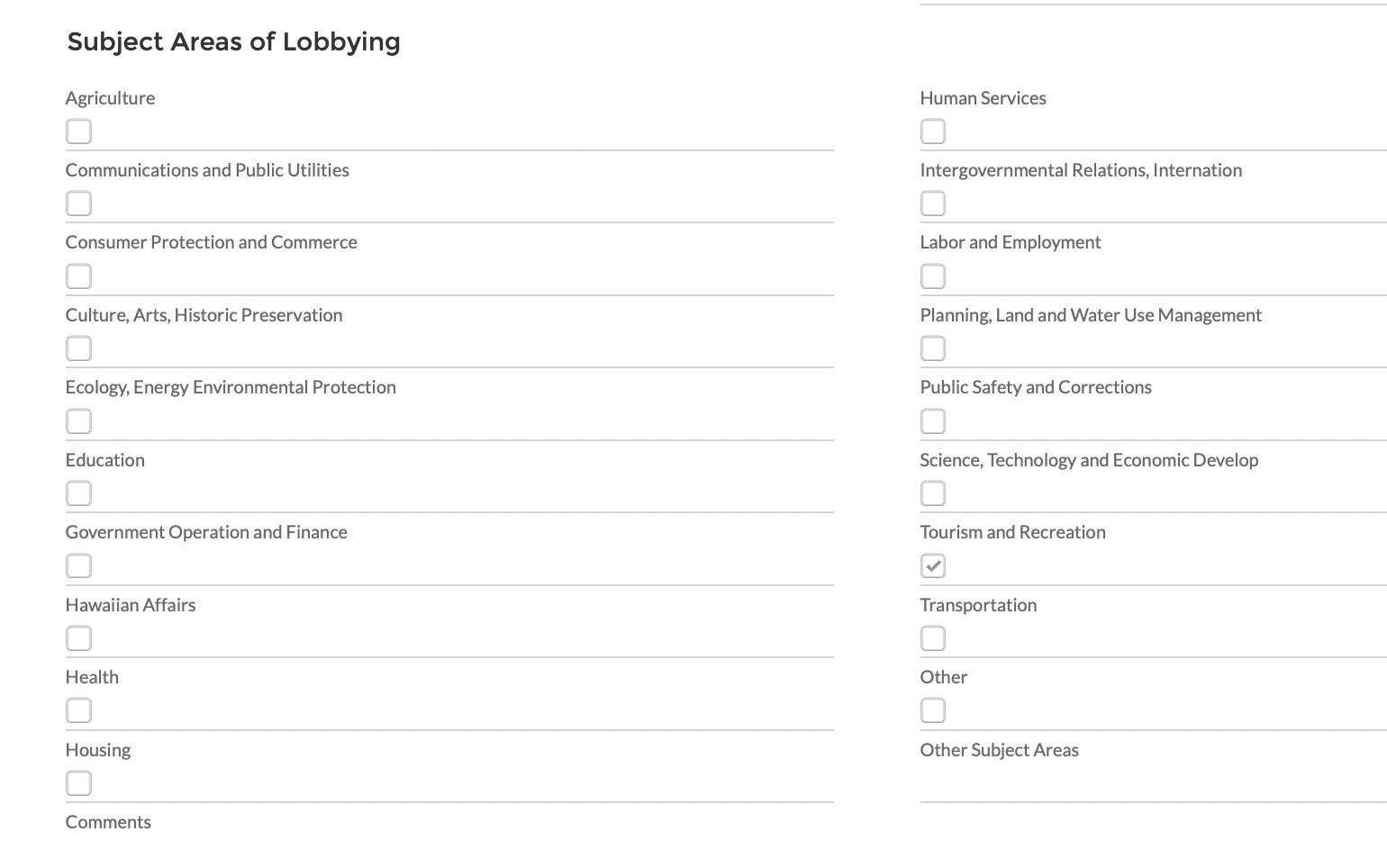
Then they are asked a final piece of information: “(3) The subject areas on which the lobbyist expects to lobby.”

The categories are so general and broad that they are essentially meaningless, and tell little about what the lobbyist is actually interested in. Here are the subjects that currently appear in lobbyist registrations. This happens to be from the registration for the 2019-2020 period filed by Ross Yamasaki, who was employed by Capitol Consultants of Hawaii to lobby on behalf of Airbnb.

This is simply not adequate to inform the public of any lobbyist’s interests.

I would suggest that the lobbyists law be amended to require each lobbyist to disclose as part of their registration the name, bill number, or brief description of any measure they will be lobbying on that hasn’t yet been given a number, along with a checkbox to indicate whether they have submitted a draft bill to any legislator or legislative officer with a request that it be introduced “by request.” And lobbyists should be required to update this information as part of their required periodic disclosures of contributions and expenditures.

In terms of transparency, Hawaii should follow the several states that also require lobbyists to submit a recent passport-type photo as part of their lobbyist registration, which would aid the public in recognizing lobbyists at work in the hallways and offices of the capitol.

These likely aren’t the only tweaks that the lobbyists law needs, but they would address the issue raised by today’s Civil Beat editorial.

Also see:

Monthly public disclosure by lobbyists? Yes, it can be done,” iLind.net, July 23, 2021.

It’s time to shine some light on special interests lobbying the Ige administration during this pandemic,” iLind.net, August 12, 2020.

The Silence from the Fifth Floor: Is This the Transparency We Were Promised? Ililani Media, February 4, 2015

Ian Lind: Lawsuit Exposes Blind Spot in Hawaii Lobbyist Law, Civil Beat, September 9, 2015.

“Regulating executive branch lobbying”, iLind.net, February 25, 2016.

Ian Lind: Lawsuit Exposes Blind Spot in Hawaii Lobbyist Law, Civil Beat, September 9, 2015.

Legislative push-back could follow “gut and replace” ruling

If history is any indication, we should brace ourselves for legislative pushback against the recent Hawaii Supreme Court ruling that found the “gut and replace” maneuver in violation of the state constitution’s mandate that a bill must pass three readings in each house in order to become law.

“Gut and replace” refers to a legislative maneuver in which the entire contents of a bill are removed, and replaced by new content that is unrelated in either subject or substance to the original bill.

This has been a long-standing but controversial practice often used to circumvent legislative deadlines by gutting a bill that had met required deadlines, and was thus still “alive,” with the content of another bill that missed a key deadline, giving it new life. Gut and replace has also been used by powerful committee chairs to muscle force their own preferred bills through conference committees in the waning days of a legislative session.

The bill was challenged by the League of Women Voters of Honolulu and Common Cause in 2019. The two good government groups were represented by attorney R. Brian Black and the Civil Beat Law Center for the Public Interest. Their lawsuit argued that Senate Bill 2858, which was passed during the 2018 legislative session and signed into law failed to comply with the state constitution. The circuit court ruled in favor of the Legislature, “holding that the process for enacting the law complied with the Legislature’s adopted rules of procedure, which do not require the three readings to start again in each legislative chamber after a bill is amended or replaced.”

The plaintiffs appealed the ruling, again arguing the process for adopting the bill violated Section 15 of the Hawaii State Constitution because the House made non-germane amendments in a classic gut and replace move, and the Senate did not hold the required three hearings to consider what was essentially a new bill, except for the assigned bill number and generalized title (“A Bill for an Act relating to Public Safety”).

By a slim 3-2 majority, the Supreme Court ruled in favor of the challengers and concluded a bill must receive three readings after being altered by non-germane amendments, effectively putting an end to gut and replace. Chief Justice Recktenwald, joined by Circuit Judge Kawamura, in place of Pollack, who recused himself, dissented.

The ruling was issued on November 4 while the Legislature was not in session, and there was little comment from legislative leaders.

However, a brief filed on behalf of the Legislature by former Congresswoman and Senate President Colleen Hanabusa made clear the Legislature’s position.

The primary issue presented in this appeal is whether the overruling of the
decision of the circuit court would result with judicial intrusion upon a co-equal branch of government. The Legislature believes this appeal is about the separation of powers.

Hanabusa repeatedly argued the state constitution provides that the Legislature is empowered to determine its own internal rules of procedure, is a branch of government co-equal to the judiciary, and that its enactments “are presumptively constitutional.”

This would not be the first time that Legislators have accused the judiciary and the courts of overstepping their constitutional bounds and intruding on legislative prerogatives, and then retaliated.

One example followed a series of decisions, beginning in 2012, in which the Supreme Court ruled legislators had failed to comply with a 1978 constitutional amendment requiring that the Department of Hawaiian Home Lands be provided sufficient funds for its operations. A 2015 Circuit Court ruling put a number on the constitutional deficiency, saying more than $28 million in additional funding would be necessary to comply with the constitutional requirement.

Legislative leaders reacted by pushing a series of bills during the 2016 session that would have reduced judicial independence and exerted more political control over judicial retention decisions.

At least two bills would have required judges to be elected, while another would take the power to approve judicial reappointments away from the state’s Judicial Selection Commission by requiring Senate consent or approval of judges seeking additional terms.

Here’s an excerpt from what I wrote at that time.

…[T]here will be little for the Senate to review in the case of reappointments except for a judge’s prior rulings. So the process of reappointment could easily become an an occasion for pressuring judges over past legal rulings, with the aim of altering their future rulings.

And by appearing to hold the threat of judicial elections over the judiciary while this case is playing out in court, the Legislature is showing exactly why making the process more political is a bad idea.

Perhaps the worst thing about the situation is that none of the legislative leadership have owned up to their role in pushing these bills. They haven’t defended the bills, or had to answer for bending the process to make a political point or gain an advantage in court.

It feels a lot like the bad old days when back room deals ruled and no explanations were due to the public.

The political retaliation continued the following year.

Legislative leaders called [the DHHL decision] a violation of the separation of powers, an argument which had been raised before the Supreme Court but proved unpersuasive. So in fit of legislative pique, they launched a thinly disguised campaign of intimidation aimed at judges and justices, putting forward bills threatening to require Senate approval for reappointment of any sitting judges, calling for judicial elections rather than merit selection, and in the latest case, singling out judges for a large cut to retirement benefits. All the measures were seen as undermining the independence of the courts.

You could almost hear House and Senate leaders taunting the high court. “If you want your independence, you’d better keep your hands off of ours,” they seemed to be loudly signaling.

Old-timers may recall an earlier example of legislative retaliation that followed in the wake of scandal-fueled reforms in the mid-1980s that toppled a judiciary lobbying effort led by the deputy administrative director of the courts, Tom “Fat Boy” Okuda.

Okuda was popular among the elected officials of both parties who he lobbied on behalf of the judiciary budget. He built strong personal relationships with key legislative leaders, routinely rewarding them with campaign assistance from groups of court employees, sheriff’s badges which could be used to obtain special benefits (including free parking at airports or other state facilities, as well as the “right” to carry firearms), and even administratively “fixing” traffic tickets for politicians or their friends on request.

A blue-ribbon panel appointed by the chief justice confirmed many of the inappropriate and sometimes illegal lobbying activities, and the judiciary instituted internal reforms, shutting down the whole lobbying program. Okuda himself was eventually convicted on 13 misdemeanor counts of ticket fixing, part of some 3,400 tickets administratively dismissed between 1982 and 1986.

But Okuda had friends in the State Capitol.

There was a backlash from legislators loyal to Okuda, who punished the judiciary with results that have lasted for decades, refusing to fund judicial raises and reversing the favor that prior court budgets had enjoyed.

As a result, the 2007 State Commission on Salaries reported that Hawaii judges were the lowest paid in the country, ranking No. 51 among the 50 states and District of Columbia. Worse, even after their recommended salary increases, Hawaii’s judges still remained at the very bottom of the salary heap.

That turns out to have been the lingering legacy of Fat Boy Okuda, who said everything that he did had been for the good of the judiciary.

I would like to think such back-room power plays were no longer part of the legislative repertoire, but I suspect that’s just wishful thinking on my part.

UH budget tripped up by Dela Cruz pork

When final votes were taken, we suddenly realized that there were winners and losers in the budget that was finally passed and sent to Governor Ige for his signature. One of the losers–the University of Hawaii, especially at its flagship Manoa campus, the center of research and graduate graduate programs often cited as being vital to any reimagining of the state’s economy.

Civil Beat’s Blaze Lovell did a good job recapping the impact of the UH budget cuts in a story published on Thursday (“University Of Hawaii Officials Push Back Against Proposed Budget Cuts“).

The budget that cleared the Legislature would axe $47 million in general funds from the UH budget in the fiscal year that begins July 1. It would also cut $42 million in the fiscal year after that.

All told, UH is looking at a total budget reduction of about 10%. However, UH Manoa is bearing the brunt of those cuts.

In fiscal year 2022, the flagship campus will have its budget reduced about 14%, or $35.6 million, compared to its current budget. Meanwhile, UH Hilo’s budget would drop by $2.2 million, and UH West Oahu by $1 million, budget reductions of 5.9% each. The community colleges would lose $4.6 million, or about 3%.

The overall 14% cut to the UH Manoa budget is about twice the hit that other state departments are facing, at something around 7%.

A message sent out by the University of Hawaii Professional Association, the faculty union, on Friday called it “our Senate’s punch to the gut of UH.” According to UHPA, the House version of the budget used “federal relief funds to fill in the budget gaps to ensure the University of Hawai‘i could continue to operate without interruption. The proposed House budget provided the necessary components to ensure stability in our local economy and ensured faculty could continue to deliver key and vital services and functions — exactly what the federal relief funds were intended to do.”

But then the Senate undid the balance that the House had sought.

The Senate decided to throw a wrench into everyone’s plan by suggesting that the University of Hawai‘i make up the budget shortfall by seeking other sources of funding. Our elected senators decided to instead gut and replace as much as they were allowed under federal guidelines. With no regard for transparency and openness, they offered no rhyme or reason for their changes. Their rationale and modus operandi still remains a mystery.[emphasis added]

But then UHPA pointed to another twist in the tale.

It seems the approximately $43 million in cuts the Senate made to the budgets of the different campuses were made at the same time, and in generally the same amount, as a bit of pure political pork slipped into the Senate’s version of the budget.

UHPA points to “$42.5 million dollars for a Resource and Education Center in Wahiawa that was not requested by…the UH Board of Regents or the UH administration.”

Let’s see. So the university’s own planning and budgeted process was ignored in order to shoe horn this hefty bit of pork into the Senate version of the budget.

Hmmmm. And whose district will this unrequested $42.5 million drop into? Well, Wahiawa is smack dab in the center of the 22nd District, represented by none other than Senator Donovan Dela Cruz, who chairs the Senate Ways and Means Committee. Yes, the same committee that controls the Senate’s version of the budget.

If I understand that correctly, it appears that if that this unrequested item was removed, the cuts items cut from the UH budge could have been restored.
Continue reading