Category Archives: John Lind Collection

Documents, photos, and notes in the collection of my dad, John M. Lind, who turned 95 on Dec. 7, 2008.

Site of 1938 surfing contest in Long Beach designated a historic site

I learned this week that the State of California has now officially designated the site of the First National Surfing Championship held in November-December 1938 in Long Beach, California, as an official Point Of Historical Interest

The historical designation was approved by Armando Quintero, director of the California Department of Parks and Recreation, in April 2024.

My dad, then a 23-year old active in the Long Beach Junior Chamber of Commerce, was one of the key organizers of the 1938 event. He learned to surf while a junior lifeguard in Long Beach. At the end of his life, he told me he had never been a good surfer. But he was an excellent and enthusiastic organizer who pulled together the Long Beach Surf Club and then drew the Junior Chamber into sponsoring a forward-looking First National Surfing Championship held in Long Beach in November and December 1938.

Conducted over two days in November and December 1938, the contest was the region’s first surfing and paddleboard competition billed as a national event. The Championships was both a successful visitor attraction for the city and a notable contest for Southern California pre-war surfers and paddleboarders. The event brought 50,000 visitors to Long Beach’s West End shoreline to watch more than 100 competitors.

Check out more of my dad’s photos of the 1938 event.

There were no waves, at least on the first day of the event, but as the caption on one of his photos of the event noted, it was “a good day for paddling,” and they made do with surfboard and paddleboard races and other events. And with major press coverage by the Los Angeles Times and the Long Beach Press Telegram, the event drew crowds!

Congratulations to the sponsors of the historic designation, the San Diego-based nonprofit Sea of Clouds, and the Surfrider Foundation, Long Beach Chapter.

Fifteen Years

Today marks 15 years since my dad died on October 23, 2010.

I was surprised to realize that it has been that long.

Here’s some of what I wrote at the time.

On Friday morning, when my father’s nursing home called and advised that we come as soon as possible, I was at home in Kaaawa without a car. After dressing and walking quickly down to the bus stop on Kamehameha Highway near the post office, I was a minute too late. The 11:01 a.m. bus slid through Kaaawa and headed off towards Kaneohe while I was still a block away. It was a short block, but at that moment it seemed like the longest block in the world.

I was frantic. For nearly two years, we’ve known he could die at any time, but he didn’t. Then, when the day actually arrives, I wasn’t ready, and I wanted to kick myself for being caught unprepared.

Deep breath. A half-hour to go. You just have to wait. Calm down, I said to myself.

So we crossed the street, myself and I, and sat on the seawall behind Swanzy Beach Park to watch the ocean at play. It was quiet, sunny, and clear. There were a few other people in the park, but I was alone with myself and the ocean. I thought about my father’s nearly 97 years, during most of which he swam, surfed, and fished in this same ocean. I let that connection wash over me, and willed it to wash over him as well, wherever he was or would be soon.

The ocean, the healer.

My father died about 12 hours after I finally arrived at his bedside. We were there with him for much of that awful time, but not, I have to say, at the very end.

For the record, my father did not appear in my dreams last night.

Perhaps the ocean did its magic.

I posted a few photos that I thought he would have enjoyed seeing again, and that he wouldn’t mind sharing with others in his memory.

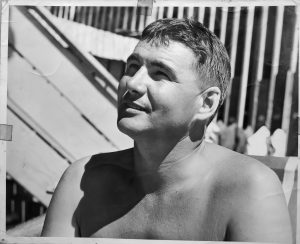
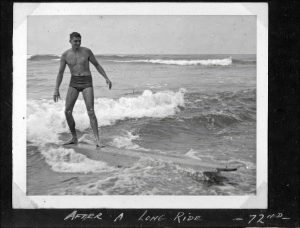
That’s him in the top photo surfing in Long Beach, California, in 1938, where he was one of the key organizers of the First National Surfing Championship at a surf spot later wiped out by construction of the Long Beach breakwater. His board had been built by the father of his close friend, Myron Brejcha, who was a Long Beach city official.

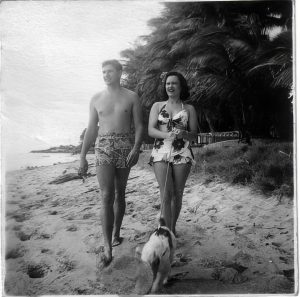
The middle photo was a Christmas card sent out by my parents around 1940. They’re walking on Kahala Beach with my mother’s dog, Kiki, the same beach Meda and I regularly walk today.

The bottom photo was taken on the beach in Waikiki, early 1950s.

Long-gone Honolulu eateries

My dad, John M. Lind, was a restaurant supply salesman who arrived in Honolulu in mid-1939 to work in the local office of San Francisco-based Dohrmann Hotel Supply Company. Within a couple of years, he was promoted to manager, and stayed with Dohrmann until 1959, when he left to start his own small company, Honolulu Restaurant Supply Company.

I found these photos among his many boxes of papers after his death in 2010. They depict several restaurants and bars in or near Waikiki, and date from the late 1930s. They are commercial quality B&W photographs, probably commissioned to show off Dohrmann’s work planning and equipping restaurants and bars.

Kau Kau Korner

Located at 1819 Kalakaua Avenue, it was a landmark from its opening in 1935 to until its final meals in 1960.

The first mention I found in a newspaper search was in the “Help Wanter-Female” section in March 1936: “Attractive haole girl, good salery. Kau Kau Korner, 91252.” The following month, there’s a brief story reporting “an unidentified burglar” had stolen cigarettes and gum from the business.

A year later, the help wanted ad had been rewritten. “Young, attractive haole waitress.”

A brief history can be found here.

Waikiki Drugs

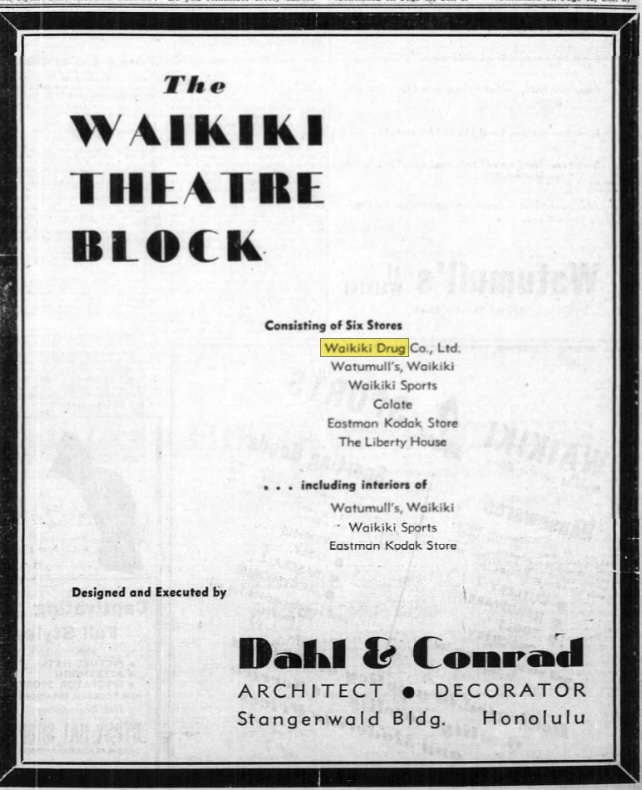
The first mention I was able to find was an announcement in Honolulu Star-Bulletin about the opening of a new shopping area to include the new Waikiki Drug Store. It was one of several stores to open for business around the Waikiki Theater in September 1937.

Click to see a larger version.

Waikiki Drug

Located at 2282 Kalakaua, it was touted at the time as the first drug store in Honolulu to be open 24-hours a day, seven days a week.

Hawaiian Town Cocktail Lounge

1502 Kapiolani Blvd.

Honolulu Star-Bulletin, January 8, 1938:
“HAWAIIAN TOWN OPENS COCKTAIL LOUNGE-Hawaiian Town on Kapiolani Blvd. opened its new cocktail lounge on New Year’s Day. The main room is furnished with chromium upholstered furniture and lauhala mats. Private booths are off the main lounce. In the enciosed area behind the lounge are tables and chairs arranged under gay umbrellas.”

Mother Page’s Waffle Shop

The Waffle Shop opened in 1932 at 2394 Kalakaua Avenue, across from what was then the Moana Hotel. The proprietor, Mildred Page, was trained as a nurse and dietician, and was previously assistant manager of the Niumalu Hotel (located where the Hilton Hawaiian Village now stands), and had worked at several other hotels.

In 1940, the Waffle Shop was purchased by the well-known Honolulu restaurateurs Peaches and Tony Guerrero, and transformed into the renowned “Tropics” restaurant, a popular haunt for locals and tourists alike.

My dad’s first job out of high school

My father graduated from Wilson High School in Long Beach, Califoria. I think he graduated in the class of 1932. The country was still mired in the Great Depression. Work was very hard to find, so he signed up for the crew of the Grace Line freighter, Santa Cecilia, bound from the west coast down through the Panama Canal and then up to New York.

According to an entry in Wikipedia, the ship was built in 1913, the same year my dad was born. It was taken over by the Navy in 1919 and used as a troop transport, making four round trips between New York and Europe during the year. The Santa Cecilia was then returned to commercial service. It was ultimately scrapped in 1935.

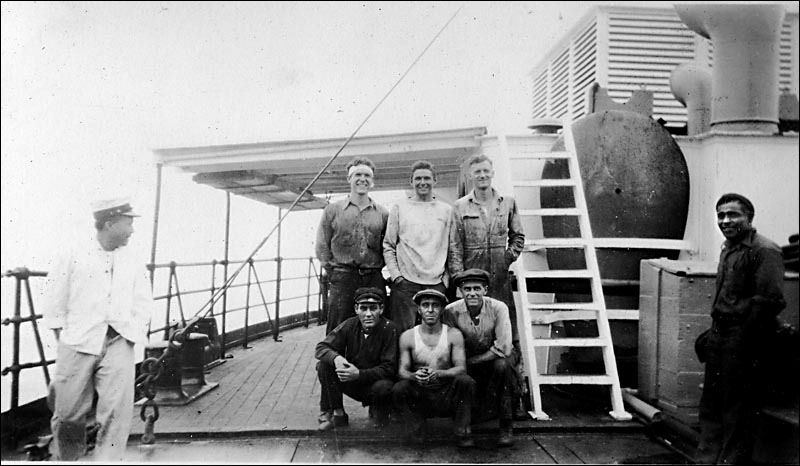
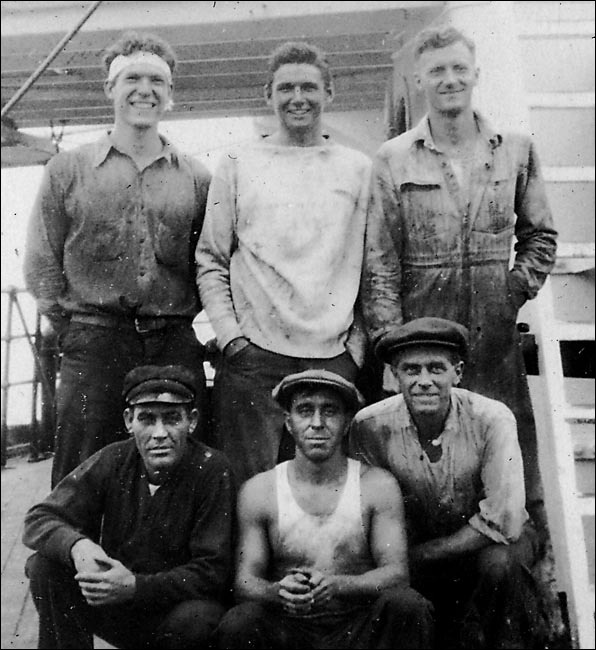
Several of the Black Gang in 1933 (engine room) on board the Grace Line’s Santa Cecilia. John Lind is at the center in the back row.

My dad was assigned in a crew of oilers, whose job it was to oil the engine parts and other machinery below decks. The group apparently referred to themselves as the “Black Gang.”

The ship left a harbor in Southern California, made its way down the Pacific Coast, went through the Panama Canal, and then proceeded up the coast to New York, I believe. My dad didn’t talk about the experience much, and I don’t know whether he stuck around for the return trip or not.

I enlarged a section for a closeup of the Black Gang. My dad appears to have been the kid among more experienced oilers.

But he sure looks happy!

When I get home, I’m going to try to clean and sharpen this image, although I suppose that detracts from its authenticity. Such are the tradeoffs given the availability of the new generation of photo software.

Closeup of the “Black Gang”. John Lind is standing, center, with light colored shirt.