Category Archives: Mike Miske

Did Mike Miske organize a conspiracy to nullify the jury’s forfeiture verdict?

Don’t miss Madeleine Valera’s story in Civil Beat on the latest twist in the saga of Mike Miske (“Mike Miske Killed Himself To Protect $20 Million Estate, Prosecutors Say“).

Valera does a good job of summarizing the government’s allegation that an ongoing investigation of Miske’s deaths found evidence of a successful conspiracy to smuggle fentynal into Honolulu’s Federal Detention Center. Miske then used the drugs first to inject himself for several days in order to appear to be a regular drug user, and then to administer an overdose he hoped would be determined to be accidental.

The allegations were made in a second amended complaint in the civil forfeiture lawsuit seeking to claim Miske’s properties.

If sustained by the evidence, which has been describe only in general terms, the government argues that the transfer of ownership from Miske to his trust was the product of a conspiracy to obstruct the criminal forfeiture proceeding following the jury’s decision that all of the itemized properties were subject to foreclose.

The government alleges that the plot started with extensive revisions Miske made to his revocable living trust in September 2024, which I described in a later Civil Beat story (“Miske’s Trust: A Look At His Moves To Control His Fortune From The Grave“).

According to the amended complaint:

In early 2025, an inmate incarcerated with MISKE at FDC Honolulu was interviewed by federal investigators about the circumstances surrounding
MISKE’s death. In his interview, the inmate identified MISKE’s source of supply for fentanyl while in custody at FDC Honolulu, identified other inmate(s) who obtained drugs from the same source of supply at the same time, and described his conversations with MISKE, who had expressed a belief and desire that his death by suicide would interfere with the federal government’s criminal forfeiture of the Defendant Properties, based on advice MISKE had received from his attorney(s).

Subsequent interviews with others who had been detained at the facility, as well as other unnamed sources (likely correctional officers or others with knowledge of the situation) identified the same person as Miske’s drug source, prosecutors allege.

Valera’s story fills in the details, with comments from the attorney representing the Miske trust in the forfeiture case.

I would expect federal prosecutors will file a criminal case that would disclose evidence gathered to date.

The section regarding the suicide allegations appeared for the first time in the amended lawsuit filed in Honolulu’s Federal District Court this week.
Heavy workload in Hawaii U.S. Attorney’s office blamed for slowing pending cases

Thanks to all of you who read the incredibly flattering profile published yesterday by Civil Beat as part of their “Bright Spots” series, especially those who shared gracious comments!

And to those of you who subscribed to ilind.net as a result of reading the profile, welcome board. I hope you find enough of what you’re looking for to become regulars.

Here’s today’s bit of news.

Today is the deadline for the government to file its answer to Miske co-defendant Norman Akau’s appeal of the 14-year prison sentence handed down by Judge Derrick Watson last March. The sentence included the nearly five years he had already been held in Honolulu’s federal detention center awaiting sentencing.

At the time of his indictment and arrest in mid-2020, Akau was an elected member of the International Alliance of Theatrical Stage Employees (IATSE) local union executive board. He was a founding member of the Nakipi Motorcycle Club in Kaneohe, and was implicated (along with several other Nakipi members) in drug dealing, robberies, and assaults. He pleaded guilty to a single count of racketeering conspiracy and, in exchange, the government dropped other charges against him. He is currently scheduled for release from prison on June 19, 2032.

The Akau’s opening brief was filed in December, with an original January deadline set for the government’s reply.

That deadline was extended for 30-days at the request of the government through a “streamlined” online request, which can only be used once.

But on February 11, Assistant U.S. Attorney Aislinn Affinito filed a motion asking to extend the deadline an additional four months until June 23, 2026.

No action has been taken on the motion, according to a check of the court docket this morning, although the motion says the continued delay is not apposed by the defense. If the motion is not granted, the government’s answer is due by the end of today.

Affinito’s motion in support of her request for a further delay points the finger at internal pressure from a very heavy workload within the office of Hawaii’s U.S. Attorney.

Affinito wrote:

I am requesting an extension of time because I have been unable to turn my attention to this case until now due to my supervisory responsibilities as Chief of
Major Crimes at the Hawaii U.S. Attorney’s Office — overseeing hundreds of cases/investigations, including 7 trials in the next two months — as well as my own individual case load, which includes, among other things, my participation as lead counsel in a complex civil forfeiture matter (D. Haw., 1:25-cv-00028-DKW-KJM) and in multiple, active, complex white collar investigations.

The “complex civil forfeiture matter” she refers to is the government’s civil lawsuit seeking to seize millions of dollars worth of property owned by the late racketeering kingpin, Michael J. Miske, Jr. That case has dragged on for more than a year with little reported progress toward a settlement.

Affinito is also named as the contact for media follow-up in news releases from the U.S. Attorney’s office for more than a year.

Affinito joined the Hawaii U.S. Attorney’s office in December 2022 and was quickly assigned to the legal team in Miske’s criminal trial. She previously spent about eight years in private practice in Washington, D.C.

Akau’s appeal focuses on a claim that the government breached the terms of his plea agreement by including his participation in a murder for hire plot when calculating the appropriate sentence in his case. Akau’s attorney, Arizona-based Ramiro Salazar Flores, argued that Akau first disclosed a murder plot targeting an ILWU union official during his plea negotiations. Miske reportedly identified the official as the person blocking his continued access to union jobs on the docks. Flores argues Akau’s plea agreement barred the government from using that self-disclosure against him. The government said at sentencing that it had relied on “derivative evidence” gathered from other sources, but Flores argues prosecutors failed to disclose the “derivative evidence”, putting Akau at an unfair advantage.

Flores argues that it comes down to a question of due process and fairness.

Did the government violate Mr. Akau’s right to due process and fairness in the plea bargaining process when, prior to the change of plea proceeding, it
assured him the evidence of the murder for hire offense would not be used to calculate his sentencing guidelines while at the same time failing to disclose derivative evidence of the same murder for hire offense it possessed and intended to present.

An update on Miske’s Millions

My latest update on the legal tug of war over the property of the late racketeering kingpin Michael J. Miske, Jr., was published today at Civil Beat (“Mike Miske Case: Investigation Into Crime Syndicate May Not Be Over Yet“).

Although the government filed a civil forfeiture lawsuit more than a year ago claiming the right to seize a list of more than 20 properties, including real estate, vintage cars, and art, along with more than $4 million in cash and checks, there has been little measurable progress reported.

The only information available concerning off-the-record discussions between the feds and the Miske Trust have been in a series of brief status reports and stipulated agreements filed in the case. Although largely repetitive and pro-forma, there are occasionally bits of interesting information to be gleaned from these documents.

And the most recent court filing, an agreement among the parties to seek another 3-month delay in further court proceedings, offered up a surprise.

From today’s story:

A stipulated agreement between the parties in the asset forfeiture lawsuit states that prosecutors intend to use evidence collected in a previously undisclosed criminal investigation to bolster their legal claim to his properties.

Until then, the Miske-related criminal cases appeared to have effectively ended with the 30-year prison sentence doled out to Lance Bermudez in July, the last of about 18 co-defendants and associates of Miske to be sentenced — although three defendants have appeals of their sentences pending at the 9th U.S. Circuit Court of Appeals in San Francisco.

The stipulation, filed in the U.S. District Court in Honolulu on Feb. 5, was signed off on by all current parties to the forfeiture case — the government, the Michael J. Miske Jr. Trust and three lenders holding secured interests in certain of Miske’s properties. In seeking the delay, the parties agreed “these upcoming motions … may affect the status of the civil action and/or discovery.”

It’s the first the public has heard about the existence of a new criminal investigation that has already yielded evidence prosecutors believe will provide further legal support for their attempt to seize the bulk of Miske’s assets.

In any case, check out today’s story in Civil Beat.

Bermudez dumps another attorney

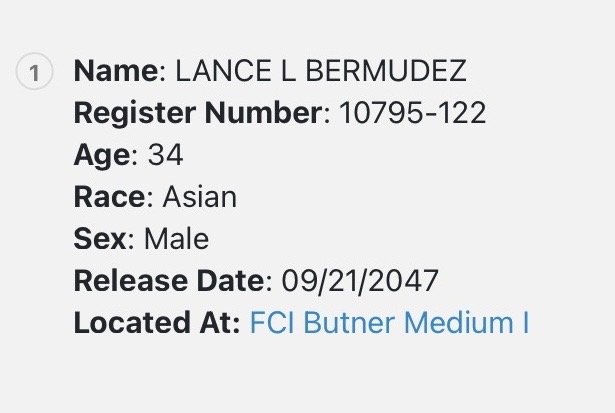
Screenshot

Lance Bermudez was the last of about 18 associates of the late racketeering boss, Michael J. Miske, Jr., to be sentenced. On July 14, Judge Derrick Watson sentenced him to 30 years (360 months) for drug trafficking, with lesser sentences for racketeering and assault to run concurrently to the drug term. It was the longest prison sentence among that 18 or so of Miske’s co-defendants and other associates who pleaded guilty.

He is currently serving his sentence at a federal facility in North Carolina.

Within days of his sentencing, Bermudez filed a notice that he would be appealing to the 9th Circuit Court. At the same time, his attorney, Myles Breiner, filed a motion asking to withdraw from the case. In a declaration filed in court, Breiner said Bermudez wanted a court-appointed attorney to take over. Breiner also said there could be a conflict of interest if Bermudez were to appeal based on a claim of “ineffective counsel.”

A California-based attorney, DeAnna Dotson, was appointed to replace Breiner on August 14.

On the same day, Dotson mailed Bermudez a letter informing him of her appointment to handle his appeal. She also telephoned and was able to speak with him.

In a declaration filed in court this week, Dotson said Bermudez “refused to receive the letter I had mailed to him and it was returned to me unopened marked ‘Inmate refused to Legal Mail.’”

“My client signed a Plea Agreement which waived his right to a direct appeal,” Dotson continued. However, if the government breached that agreement I would be able to file a direct appeal on his behalf. I received his documents and reviewed all of them to see if there was a breach. I could not find any such breach by the government.”

“My client does not want to have any contact with me, either by mail or telephone,” Dotson wrote.

As a result, she has also asked to withdraw from the case. Before withdrawing, however, Dotson reported spending time trying to arrange for Bermudez to be transferred to a prison in Beaumont, Texas, where he wants to be held because he has family in the area.

It is unclear at this point whether another Bermudez will be offered another court-appointed attorney or whether his failure to cooperate will end his appeal.

Meanwhile, appeals filed on behalf of John Stancil and Norman Akau are on hold due to the ongoing government shutdown.

Deadlines for filing opening briefs in their appeals, and other cases being handled by court-appointed attorneys, have been vacated by order of Mary Murguia, chief judge of the 9th Circuit. Those deadlines will not be reset until a funding bill is passed and funds are available to pay the attorneys.

Both men have filed notices of appeal. Stancil’s opening brief was due last week, while Akau’s would have been due next week. Both are now in legal limbo pending the end of the shutdown.

Also see:

The “Hammah” falls, iLind.net, September 8, 2022.

Seven years since the fatal shooting at Ala Moana Center, iLind.net,

What’s Next for “Hammah”? Lance Bermudez, key Miske associate, to be sentenced, iLind.net, October 12, 2025.

The “Hammah” and his attorney get hammered as the Miske Enterprise case winds down, iLind.net, October 16, 2025