I awoke today mourning my failure to protect a little trinket from the past. I don’t really know why it has left me so unhappy. It just feels like I’ve failed, and another fragile link to the past has been broken.
It started last night when we were cleaning up after dinner. Meda flipped on the disposal, but the small racket that followed prompted her to quickly turn it off. After a safe time, I came over and reached down into the disposal. First I found a bent piece of metal that I didn’t recognize. Perhaps the disposal mechanism was breaking apart, I thought. Reaching in again, and my fingers tracing a circle across the blades, I felt something else, a larger piece that didn’t belong there. I had made a chicken soup for dinner, and perhaps a piece of bone had ended up in the disposal. It took me a minute to finally get a grasp on the errant item and pull it out.
And my heart immediately sank as I recognized what it had been.
It was a miniature brass rat that had been part of a small collection of Professor Carey D. Miller, who had come to the University of Hawaii in 1922 armed with a Masters Degree from Columbia University, and a position on the faculty to develop the tiny Home Economics Department on the university’s Manoa campus. She was a nutritionist, and immediately set up a laboratory with eight white rats that might have made the trip from Columbia with her.
She was proud of those rats. When a friend from graduate school passed through Honolulu a few years later on her way to a teaching job in Dunedin on New Zealand’s South Island, Miller sent her off with Romeo and Juliet, a pair of white rats that would start a new laboratory down under.
Miller became my mother’s mentor when she entered the university in the fall of 1931, and the two became close lifelong friends. My mom later served as executor of her estate. While sorting my mother’s belongings after her death at the beginning of 2013, I found a number of items that had belonged to Carey D., as she used to call Miss Miller. Things with sentimental rather than monetary value. Several albums of stamps from around the Pacific and Asia collected in the mid-20th Century. Copies of old research notes that informed some of Miller’s many publications. Descriptions of the diets of Native Hawaiians and newcomers to the islands taken from 19th Century diaries and letters, later interviews with Hawaiiana experts about typical diets, traditional medicines, etc. Several versions of a condensed history of the UH Home Economics Department. A few personal items. A high school graduation photo taken in Boise, Idaho. A lock of carefully saved hair. A few family photos. A painting Miller had purchased directly from the artist a half-century before that evoked memories of Idaho’s mountains.
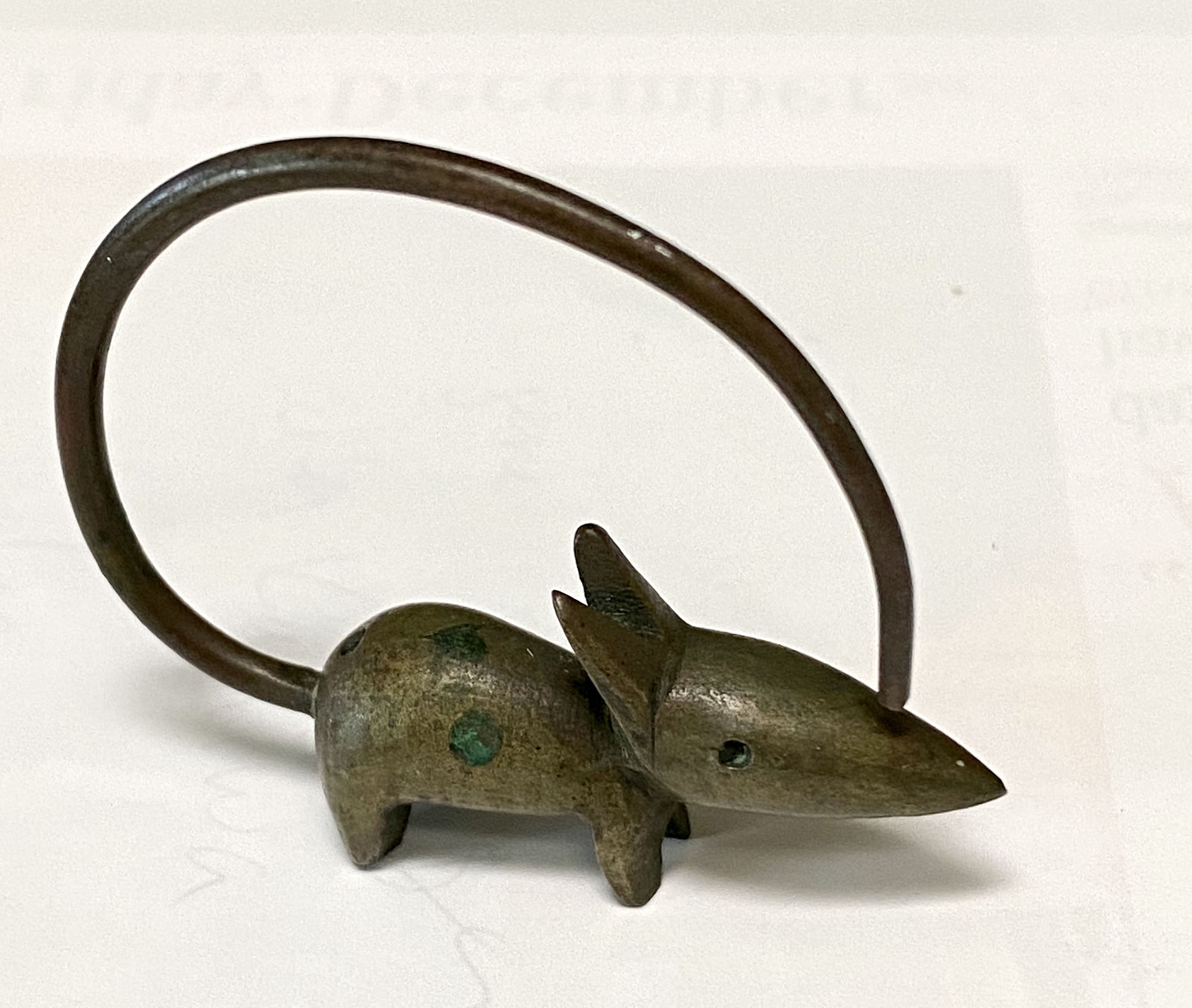
And the small, beautifully done brass rat which showed its age proudly.
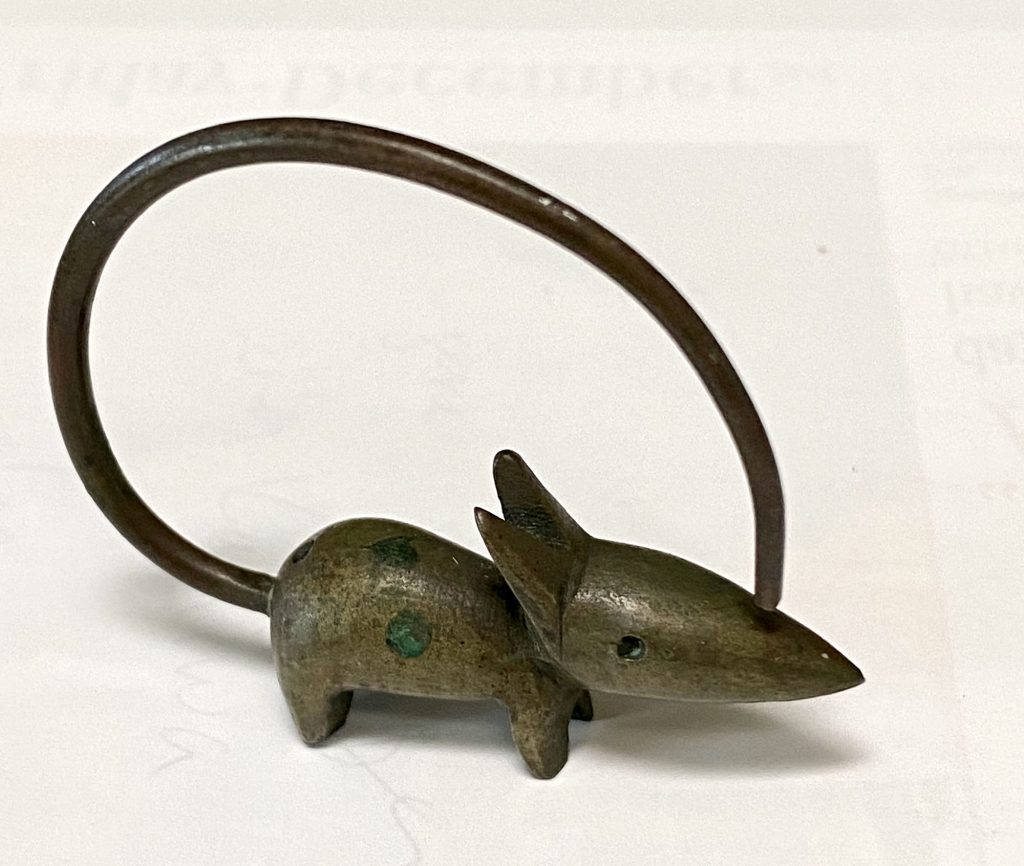
The rat itself was only about an inch long, with a tail that wrapped around and nearly doubled it’s overall size.
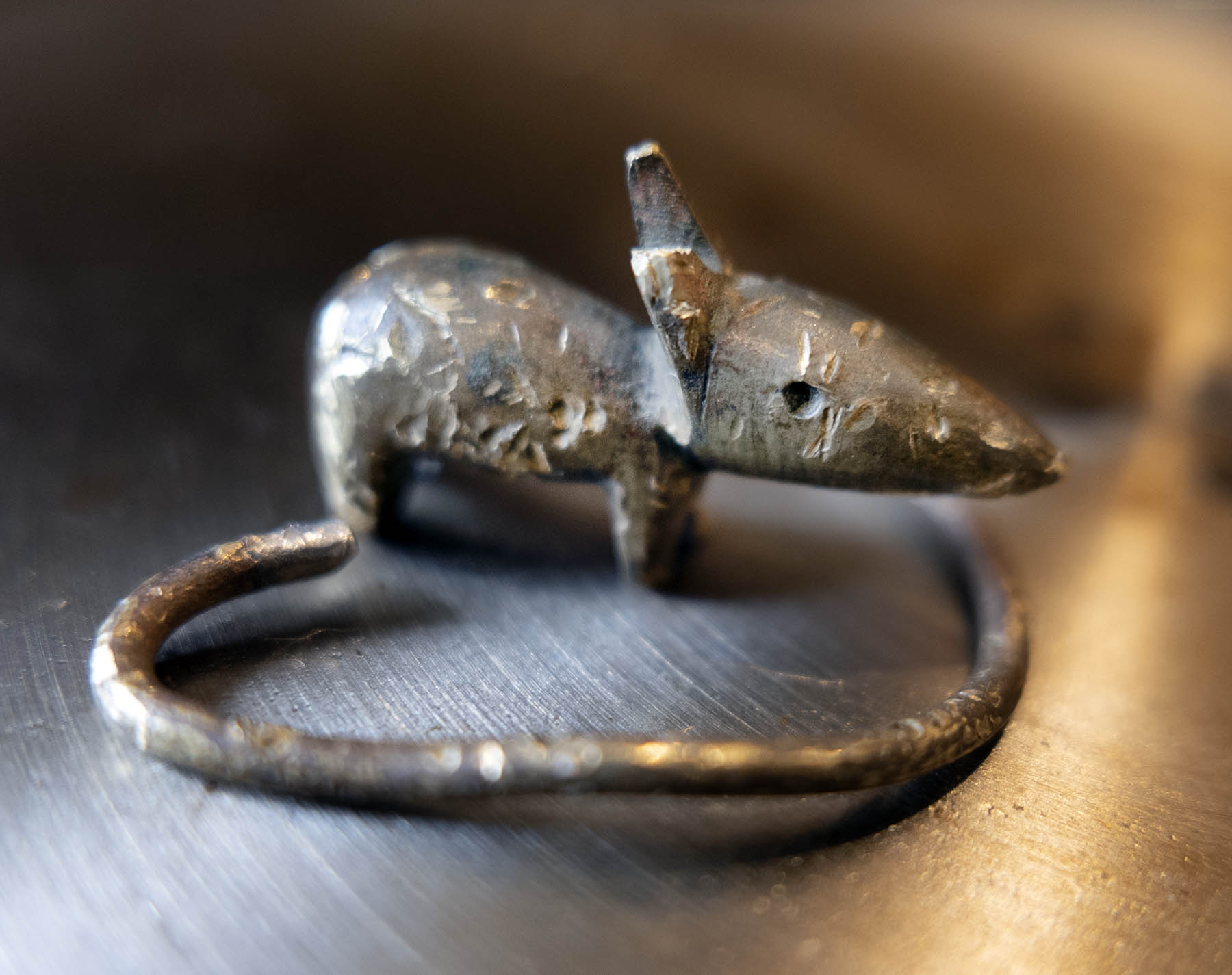
The tail. It only took me a second to recognize the first piece of metal that came out of the disposal was none other than this tail. And the piece I expected to be a chicken bone was the remains of Carey D.’s miniature rat, now badly scarred, with a piece of one ear chewed off by the spinning disposal blades.
It had been in a spot of honor on the window ledge above the sink in our kitchen. The window looks out across the front yard to Kealaolu Avenue, which runs past the house. My mother always found a lot of time to stand there at the sink doing something or other, which I later realized was an excuse to observe this little piece of the world, to keep track of the comings and goings of neighbors, watch the changing seasons, the growth of the shrubs she was forever planting and replanting, keeping mental notes of who was walking past the house and wondering where they were going and why.
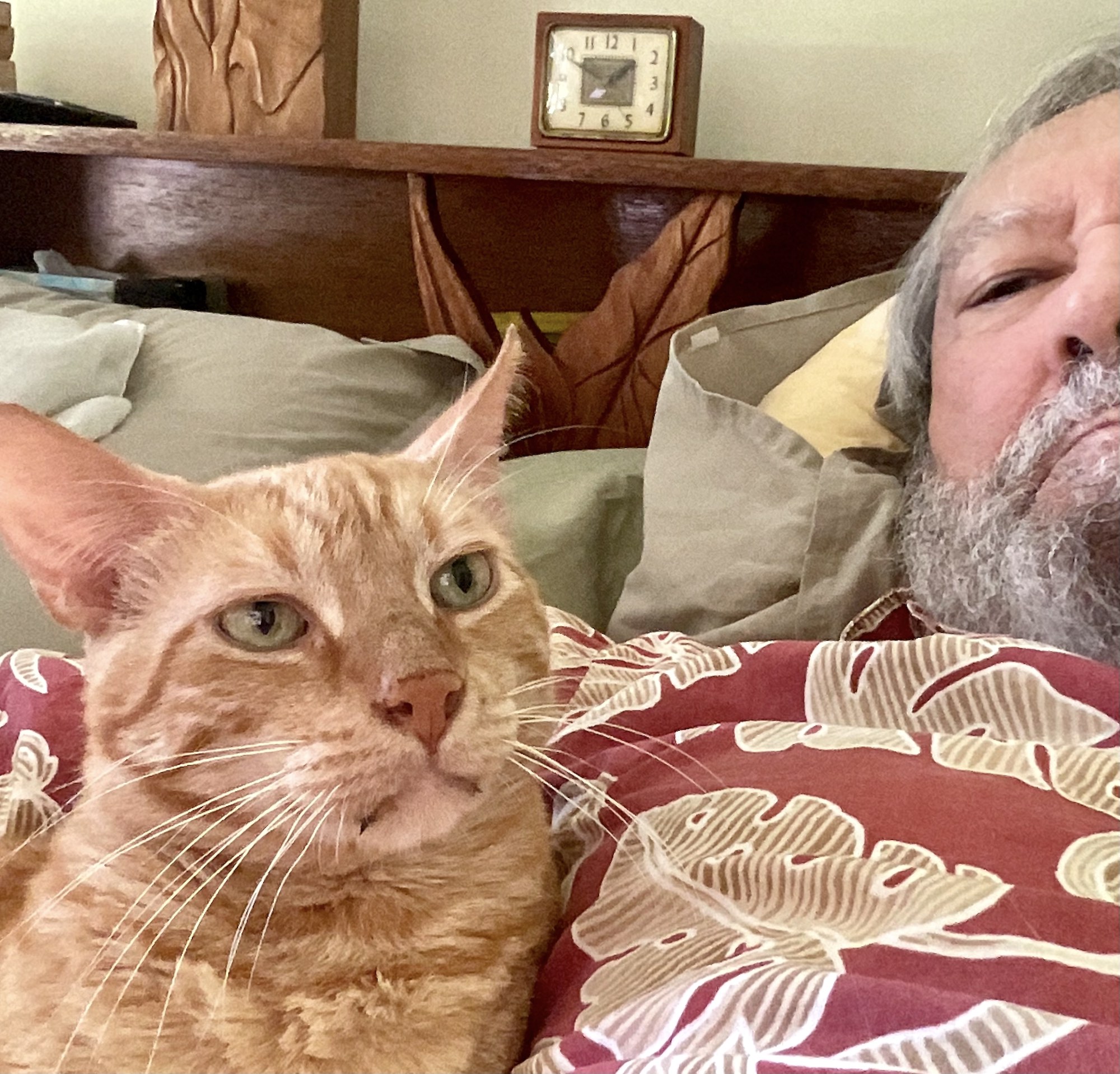
Somehow one of our cats had not only knocked Carey D.’s rat off the ledge, but managed to score a hole in one, right into the disposal. I could easily see how it happened. And I couldn’t blame the cats. It was an accident, just “one of those things.” Life goes on.
So why am I so depressed about it? It had no real value. It was simply among the detritus left behind by two generations of long-lived women, Carey D., who died at age 90, and my mom, Helen Yonge Lind, who passed away a few months before her 99th birthday. It’s not the first, nor the last, of the things with sentimental value that I’ll misplace, break, or otherwise have to part with.
I suppose it was, in my mind at least, a memonic talisman, a small tie to my memories of the past, my personal and family history, Hawaii’s history.
And maybe that’s the source of what I’m feeling. Time passing. Things changing. That little rat is just a small thing, perhaps for me a symbol of a slowly eroding past.
One thing at a time. Lost, stolen, broken, or strayed. Just another one of those things, I suppose.

 In any case, John and his family have been very active and contributed so much to the Hana-Kipahulu community.