Category Archives: Vintage Hawaii

A family link to the Kamehameha Schools annual song contest

The 105th annual Kamehameha song contest was held last night. Hawaii New Now covered the event, and you can find other video if you seach a bit online.

There’s a family connection to the song contest that I didn’t discover until after my mother’s death.

The contests date back to 1921, when the first song competition was held at the School for Boys, followed by the School for Girls, which held its first contest the next year. The girls and boys competed in separate contests until 1952.

My mother, Helen Yonge, graduated fron the Kamehameha School for Girls in the Class of 1931. Her class was the last to graduate from the lower campus, which was located on the makai side of King Street across from what is now Farrington High School. By the following year’s graduation, the girls, along with the School for Boys, had moved to the Kapalama Campus, where they remain today.

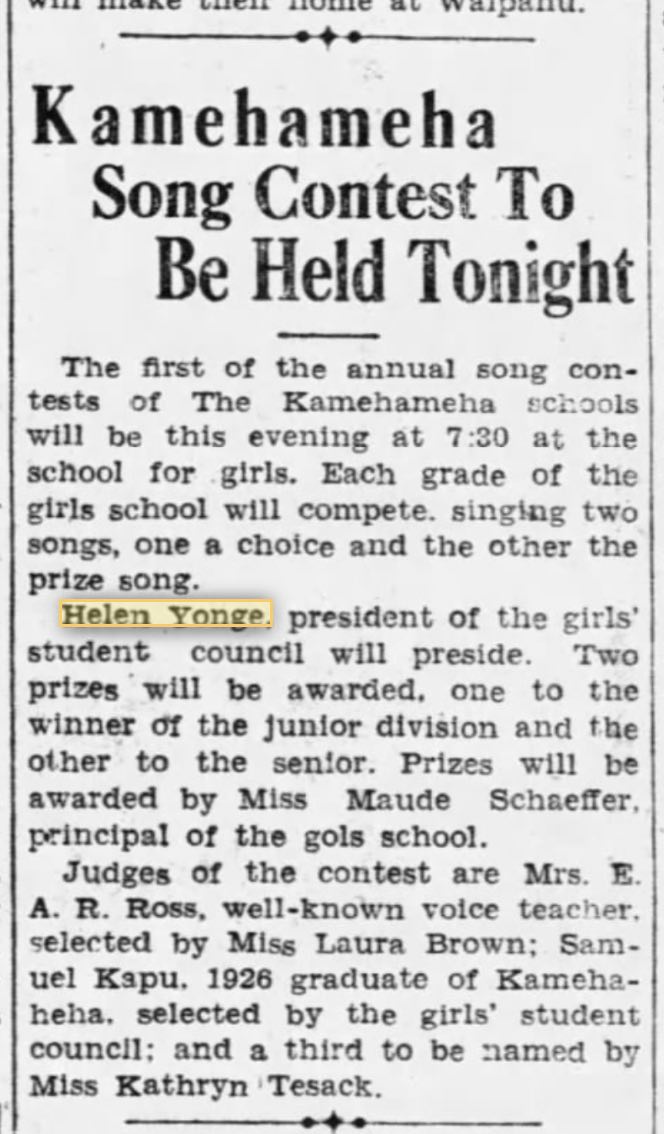
During her senior year, my mother was president of the student council at the Kamehameha School for Girls, and in that capacity presided over the annual song context, held on November 4, 1930. The Honolulu Advertiser ran a news brief about the contest that mentioned her role.
My mother and several of her friends are shown in this photo taken on the School for Girls campus during her senior year (1930-1931). Just click on the photo to see a larger version. This photo was in a small album found among my mother’s papers after her death in 2013.
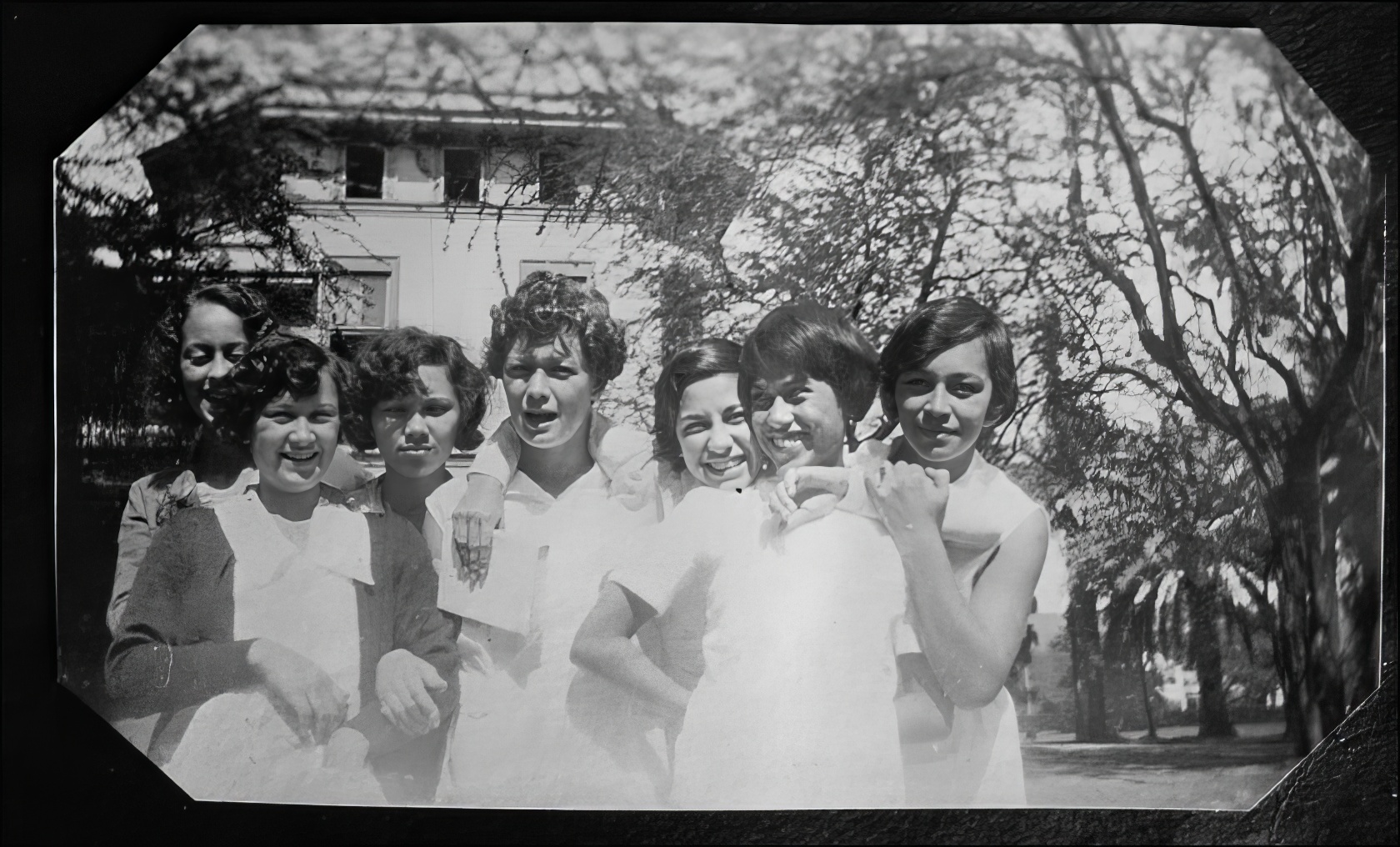
From left: Ellen Wittington, Helen Yonge, May Bradley, Bernice, Victoria Atchley, unknown, Rowena Buchanon. Names are from my mother’s handwritten note.

The funny thing is that I cannot recall my mother ever reminiscing about this part of her years at Kamehameha, and I have to wonder why.
Party on!

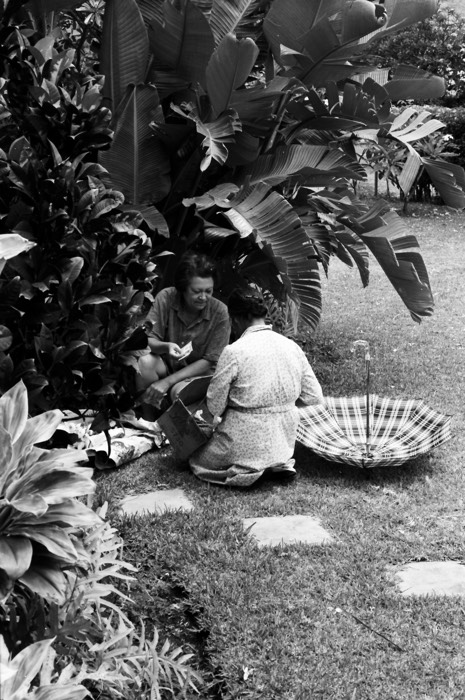
I don’t remember my parents hosting large parties, but apparently they did just that during the first decade of their marriage (they were married in December 1939).

Once they bought their house in 1942, friends gathered in the back yard to cook on the brick BBQ, and play volleyball (or sometimes badminton) using a net that could be easily set up and removed for storage. Permanent footings were buried in the lawn, so they just had to bring the poles out, drop them into the two footings, and string the net between them.

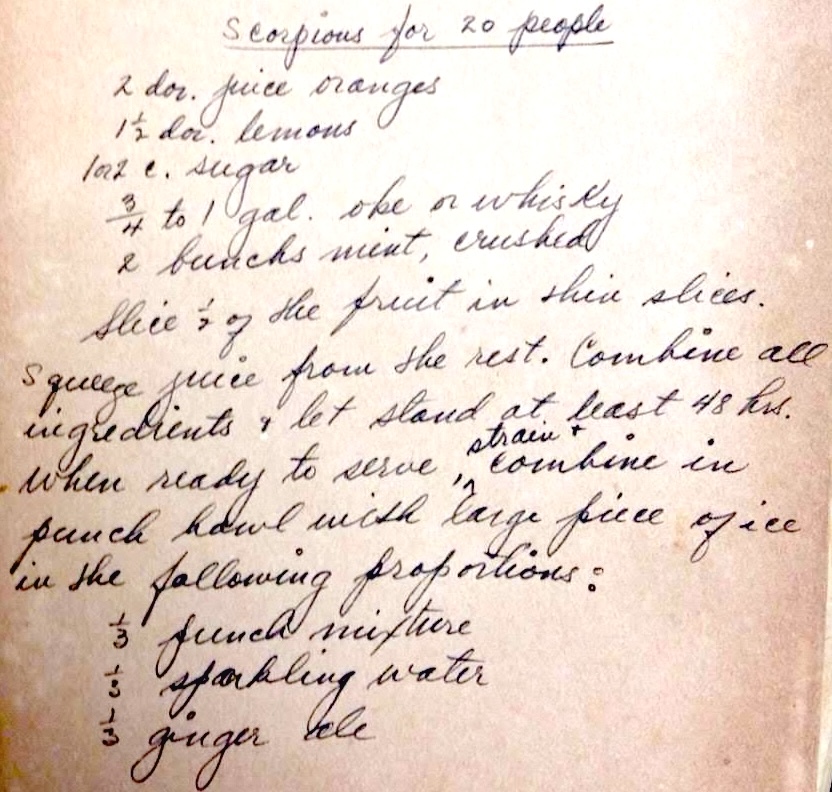
My recollection is that my parents rarely drank alcohol, except when they had guests. And, it seems, more guests meant more aclohol, at least according to this recipe in my mother’s handwriting for a rather potent sounding mix, “Scorpions for 20 people.”

It called for a gallon of oke (referring to Hawaiian okolehao), which might have been more accessible during WWII than commercial whiskey, along with slices of fruit and fruit juice, with the explicit instruction to “let stand for at least 48 hours.”

No, I’ve never tested the recipe.

The flower ladies

For your Hawaii history file. People’s history, not political history.

In October 2003, my mother typed out a page of memories about some of the old-time vendors in Waikiki during the early 1930s. At the time she recorded these brief memories, she was 89.

The typed note began with a description of the “Flower Lady” in the part of Waikiki where my mom and her older sister lived during several years when they were attending the University of Hawaii. I believed they lived down on or near Seaside.

In the 1930’s when my sister and I were apartment dwellers in Waikiki, we listened every Saturday morning for the “Flower Lady”. She was a little Japanese woman who carried a large basket filled with bunches of flowers and walked slowly down the block calling out in a rather melodious voice: “fla-WAH, fLa-WAH”.

Although I have retained a clear mental picture and the sound of her voice, I don’t remember what flowers she sold besides the carnations which were our favorites. We discovered there wasn’t just one “flower lady” in all of Waikiki, there were several, each with her own territory staked out.

To me they all looked alike, all small middle-aged Japanese women with the same call to potential customers in the same tone of voice: “fla-wAH” fla-WAH.

I recently ran into her page of memories while browsing old files, and it triggered a memory of my own.

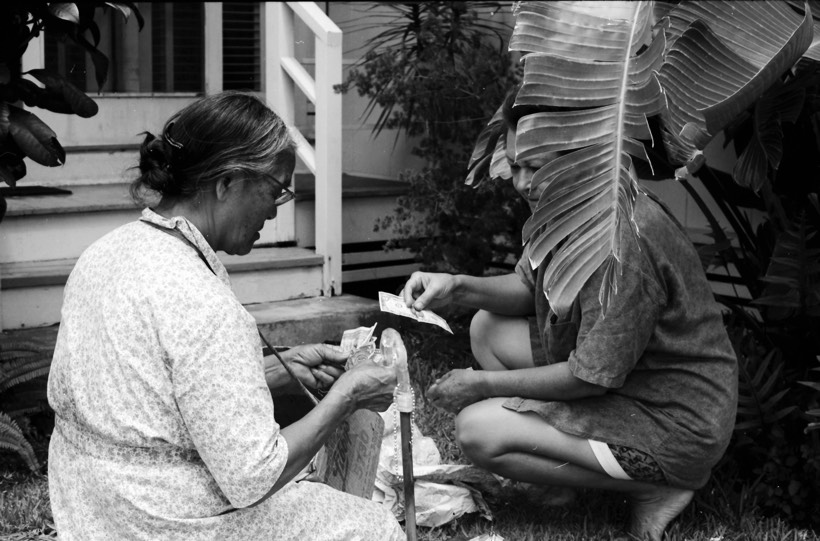
I was visiting my mom sometime in 1970 when a modern version of the flower lady came walking up Kealaolu Avenue past my parents’ home, her melodic “fla-WAH” announcing her presence like a voice from the past. My mom was quickly out the door and asking her into the yard where she could look at and purchase some of the flowers. I happened to have a camera with me, and was able to find a couple of the resulting photos courtesy of Amazon Photos (I searched for “flower lady” and these were among a larger number of photos Amazon identified that included flowers and women).

I don’t know if any flower ladies are still peddling their wares in the same way. It’s been a long time since I heard one of their sing-song voices, and certainly this neighborhood has changed enough that most current residents would no longer recognize what they were hearing, nor would they be likely to buy flowers from a street vendor.

Click on either photo to veiw a larger version. And the link at the top of the post will take you to my mom’s full typed page.

Looking back to 1941

December 7, 1941, was my father’s 28th birthday. My parents would celebrate their second anniversary later in December. I wasn’t born for another six years.

Of course, December 7, 1941, was also the day Japanese warplanes attacked Pearl Harbor and other military sites in Hawaii.

On the afternoon of December 6, my parents attended a Univerity of Hawaii football game at the old Honolulu Stadium in Moiliili.

The game was between the University of Hawaii and Willamette University (Salem, Oregon) in the Shrine Classic, and was apparently a big deal, as the Advertiser reported a crowd of 24,400 packed into the old Honolulu Stadium in Moiliili. UH won 20-6.

That was 9.5% of Oahu’s total population at the time! Compared to the population, that would be like a crowd of 97,593 today.

A lifetime later, I looked up the Honolulu Advertiser’s December 7 edition. It was the morning newspaper, so copies were already on the street when the Japanese attack began around 8 a.m.

After the game, my parents had partied into the evening. They were still in bed early on Sunday morning, December 7, when my grandmother phoned from Waipahu with word of what they first thought were very realistic maneuvers taking place. It didn’t take long, though, to figure out this was the real deal.

Later, my mother started a letter to her sister describing what was happening that morning in Kahala, a neighborhood on the east side of Oahu, quite a ways from Pearl Harbor.

I found the letter among her papers after her death in January 2013.

Handwritten letter about at… by Ian Lind