I didn’t mean to go digging around in family history again on Friday.
 I was actually trying to do a bit of cleaning, and found myself looking in a box out in the garage trying to find stuff that could be thrown away.
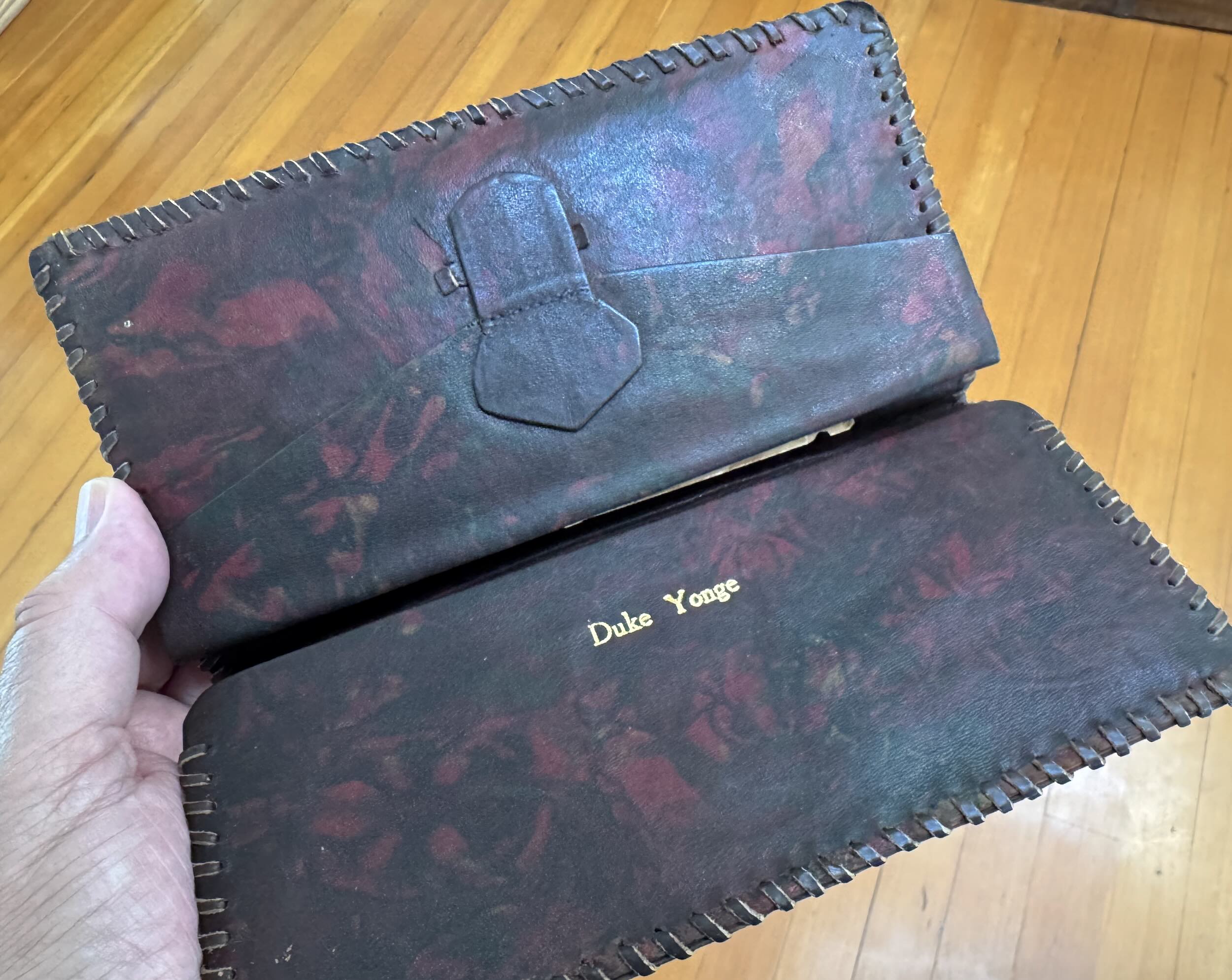
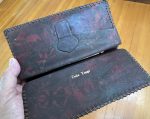
But instead I found an old leather wallet and when I opened it, the name of my grandfather–my mom’s father, Duke Yonge– was embossed on the interior in gold letters.
Just click on the photo to get a closer look.
Inside the wallet was a small stack of well-aged papers, which turned out to include an original Social Security card as well as a 1923 drivers license.
My grandparents lived in Waipahu. He died when I was just three years old, and I never had a chance to know him.
So, of course, I had to drop my plans to throw things out and instead took the wallet and papers back inside in order to look through them.
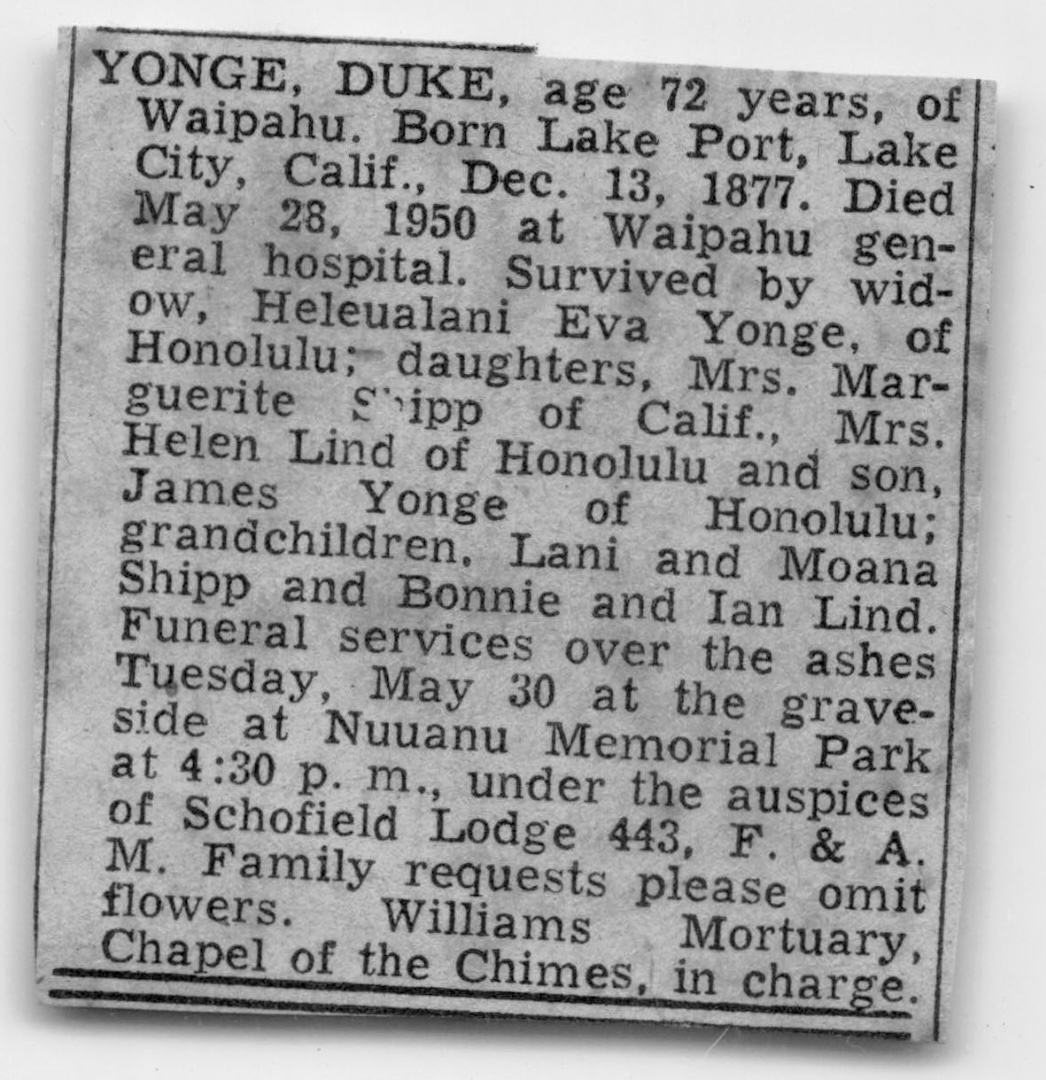
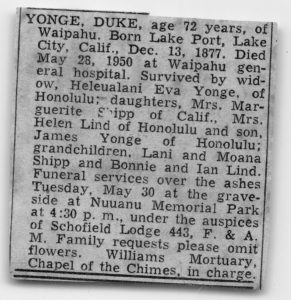
First, I found a copy of his obituary published in one of the Honolulu newspapers.
Obituary
He died in May 1950, and the funeral was held under the auspices of the Masonic Lodge 443 at Schofield.
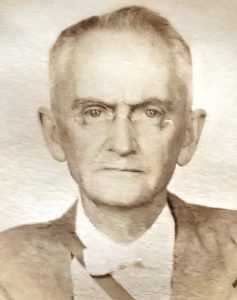
I was able to find a couple of photos of him. One shows my grandparents at a luau in their home in Waipahu in 1946. Another is from an identification card from a period where he worked as collector for Mutual Telephone Company, the predecessor of Hawaiian Tel.
I tried to give them a little digital cleaning, which accounts for a little unnatural sharpness for old photos.
Then I started looking through the scraps of paper, where I learned something that surprised me.
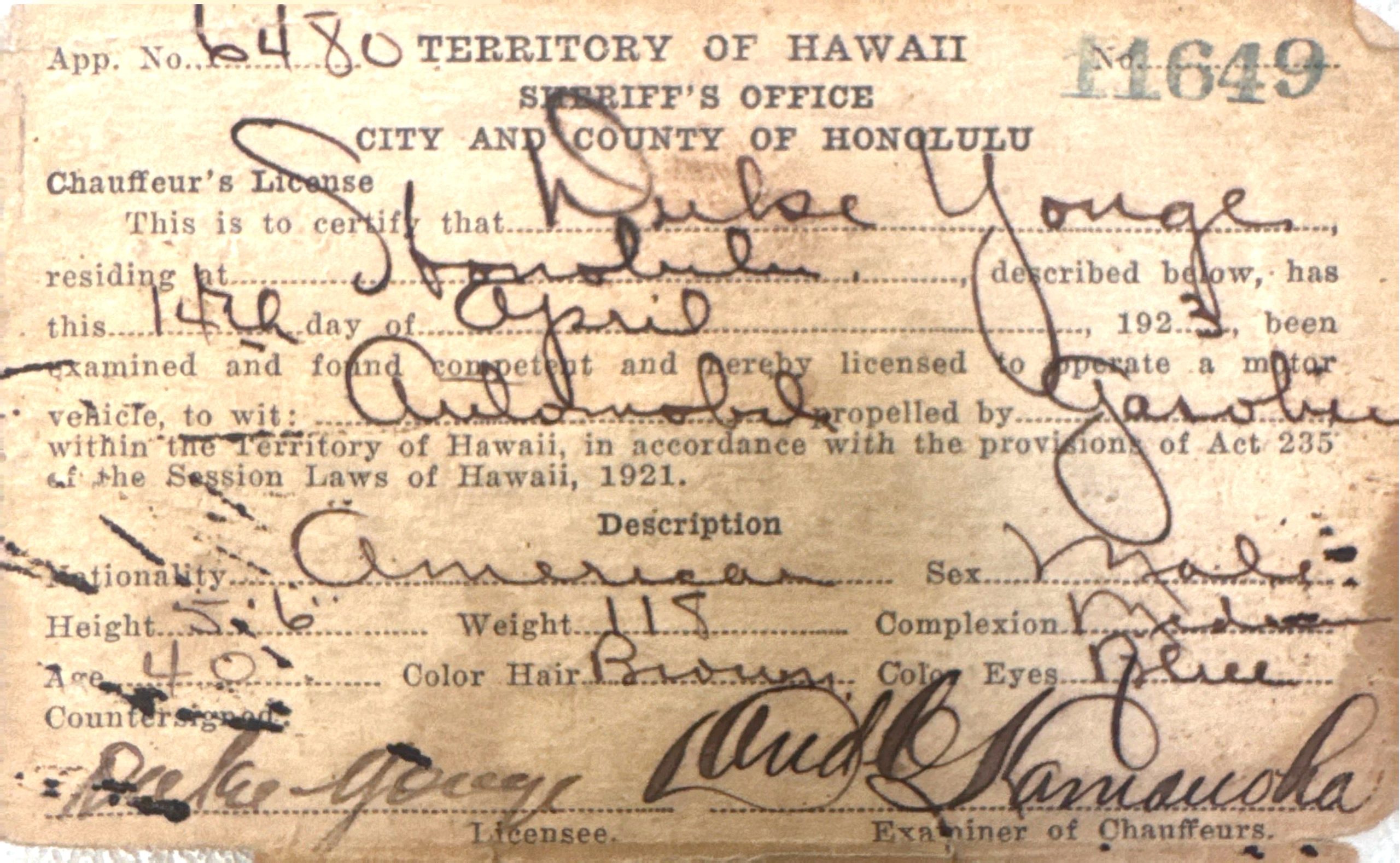
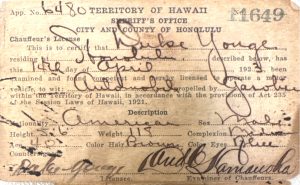
In April 1923, he obtained a “Chauffeur’s License” from the Sheriff’s Office in Honolulu, which stated he had “been examined and found competent and hereby licensed to operate a motor vehicle, to wit, Automobile propelled by Gasoline….” There were blanks on the form where the words “automobile” and “gasoline” were written in by hand.
The license described Duke Yonge as standing just 5 foot 6, and weighing 118 pounds. He was, it seems, a small man. I outweigh him by about 100 pounds!
And he had blue eyes, like Meda! My mother used to joke that the only people with blue eyes out in the country were the bill collectors. I didn’t realize she might have been talking about her father.
Territory of Hawaii IDENTIFICATION CERTIFICATE
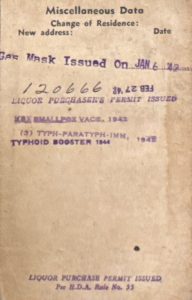
This was issued pursuant to the Hawaii Defense Act, first passed in 1941 and updated after the December 7 attack on Pearl Harbor. Although undated, this ID card appears to have been issued in 1942.
The stamps on his ID card indicate he was issued a gas mask on January 6, 1942, and received a liquor purchaser’s permit on February 27. In addition, he received smallpox and typhoid vaccinations in 1942, and a typhoid booster in 1944.
I got one additional surprise. His ID card indicated he had a “crooked 5th finger on his rt hand.”
This could be a coincidence, but I’ve got some arthritis here and there, including the last joint on the little finger of my right hand which makes it appear, well, crooked. It has developed only late in life. A genetic “gift” from him? Who knows.
And I also noted that the birth date on the ID certificate is 1878, where all the other sources indicate he was actually born in 1877.
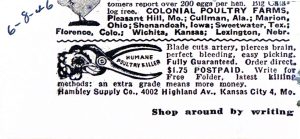
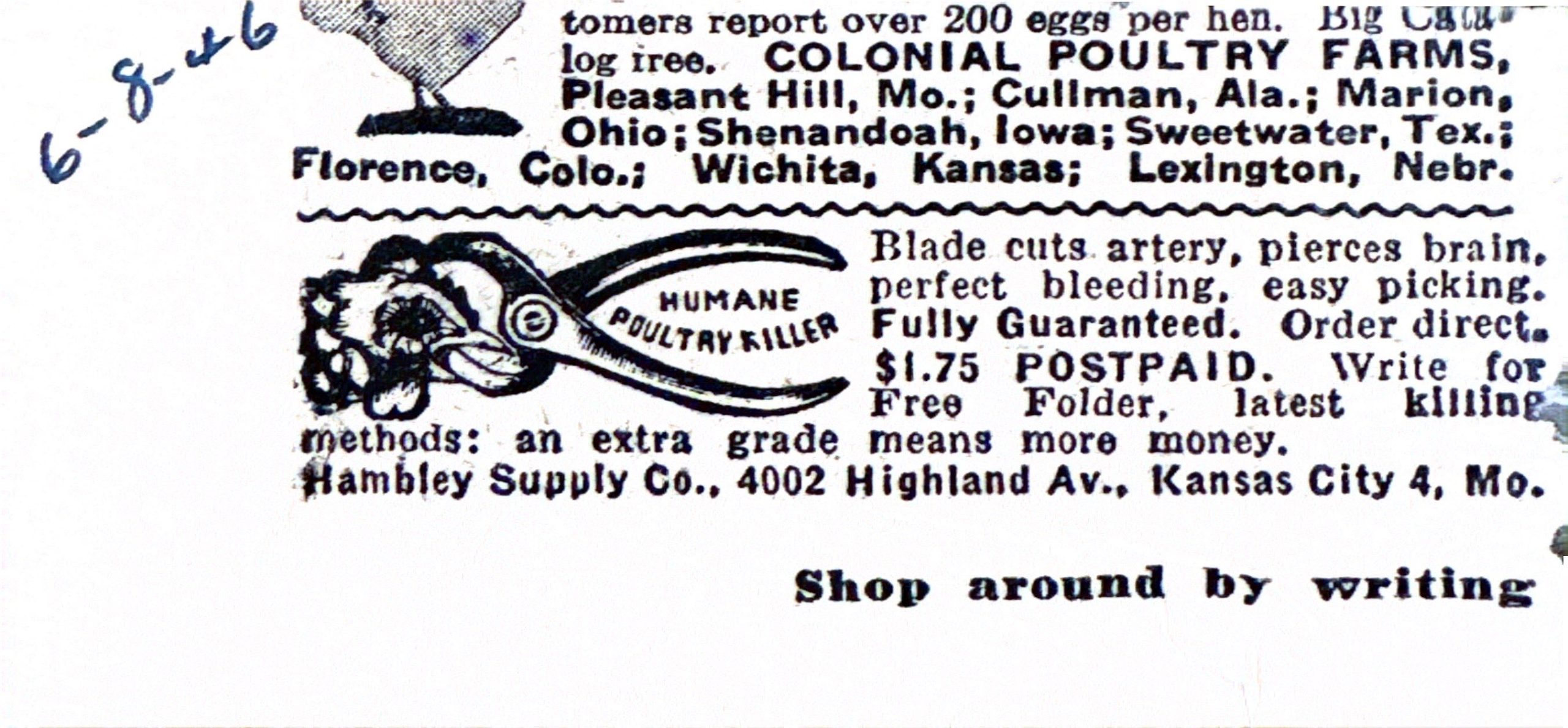
And there’s one additional document of interest, a small advertisement cut from an unknown source. It offers a “humane poultry killer” available for $1.75 from a company in Kansas City, Missouri.
It’s a little gruesome by current standards (“Blade cuts artery, pierces brain, perfect bleeding. easy picking.” And, it adds, “Fully guaranteed.” It also offers a “free folder” containing “latest killing methods.”
But folks in the country grew a lot of their own food, and my grandparents raised both chickens and pigeons, meaning this might have come in handy. My mother recalled enjoying meals of chicken and squab in Waipahu.