Category Archives: Genealogy/family

The Meda List, continued

I thought that my post over the weekend, “The Meda List“, had found the answer to the origin of my wife’s name.

Of course, I gave myself some wiggle room, adding a suggestive sentence at the end of the post:

I haven’t started to claw my way back through the next generation or two of the Morgan and Bishop families, looking for more appearances of the names Almeda or Meda that would further confirm this new origin story.

I was itching to peel back another layer, but instead of starting on the Morgan and Bishop families that had married Menardi men, I decided to take a look at the first Menardi to come to the U.S., Joseph Sebastian Menardi, who sometimes is referred to as Giuseppe Sebastiani Menardi. Late in his life, he married Harriet Granger, who was considerably younger.

And I quickly learned Harriet Granger was the daughter of Roderick Granger Sr. and, are you ready? Almeda Dunlap! Suddenly there was another independent “Meda” to add at the top of the Meda List, challenging my initial answer.

Here’s my problem at this point. There is a lot of potential slippage in this whole story. The genealogical sites use their own search algorithms that don’t always return the same result when the same search terms are used. This makes it harder to replicate findings, or to find bits of information that I recall seeing but didn’t think important enough at the time to include in my notes. Searches in Newspapers.com are subject to similar frustrating peculiarities.

I’m going to have to set this aside for a while until after my upcoming surgery. But I’m sure my curiosity will lure me back to it over the next couple of months.

The Meda List

I’m choosing to stay at arms length from digging into current events and issues that I would normally be eager to investigate. Somewhat fragile health is frustrating, and I’ve decided to reduce the stress and anxiety by just putting these things aside for a while and looking elsewhere for puzzles to challenge my curiosity, chasing questions of less social consequence.

Here’s an example.

Meda, my wife’s name, is unusual, and I have to admit that we have never known much about it’s origin.

Meda was named after her maternal grandmother, Meda Mendardi Renton.

Given Meda Menardi’s Italian heritage, we long held the belief that “Meda” was an Italian name. It sounds Italian, and it’s easy to imagine it rolling off the tongue in an Italian accent.

But as I was fiddling around this week, I asked several AI assistants if “Meda” is an Italian name. There was general agreement it is not considered Italian nor found much in Italy.

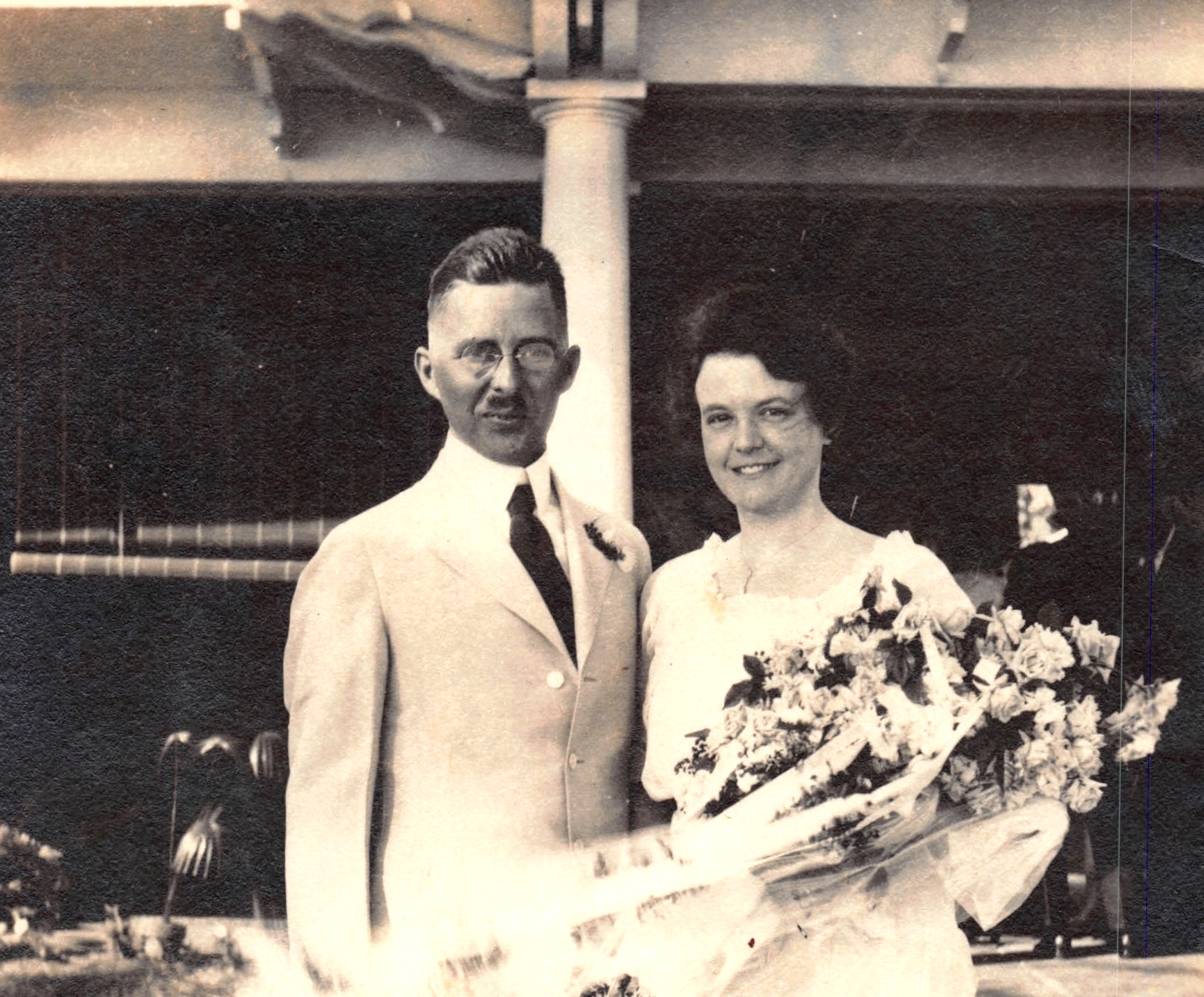
Meda is named after her grandmother, Meda Menardi, shown here with her husband, James Lewis Renton, on their wedding day in Sept. 1921.

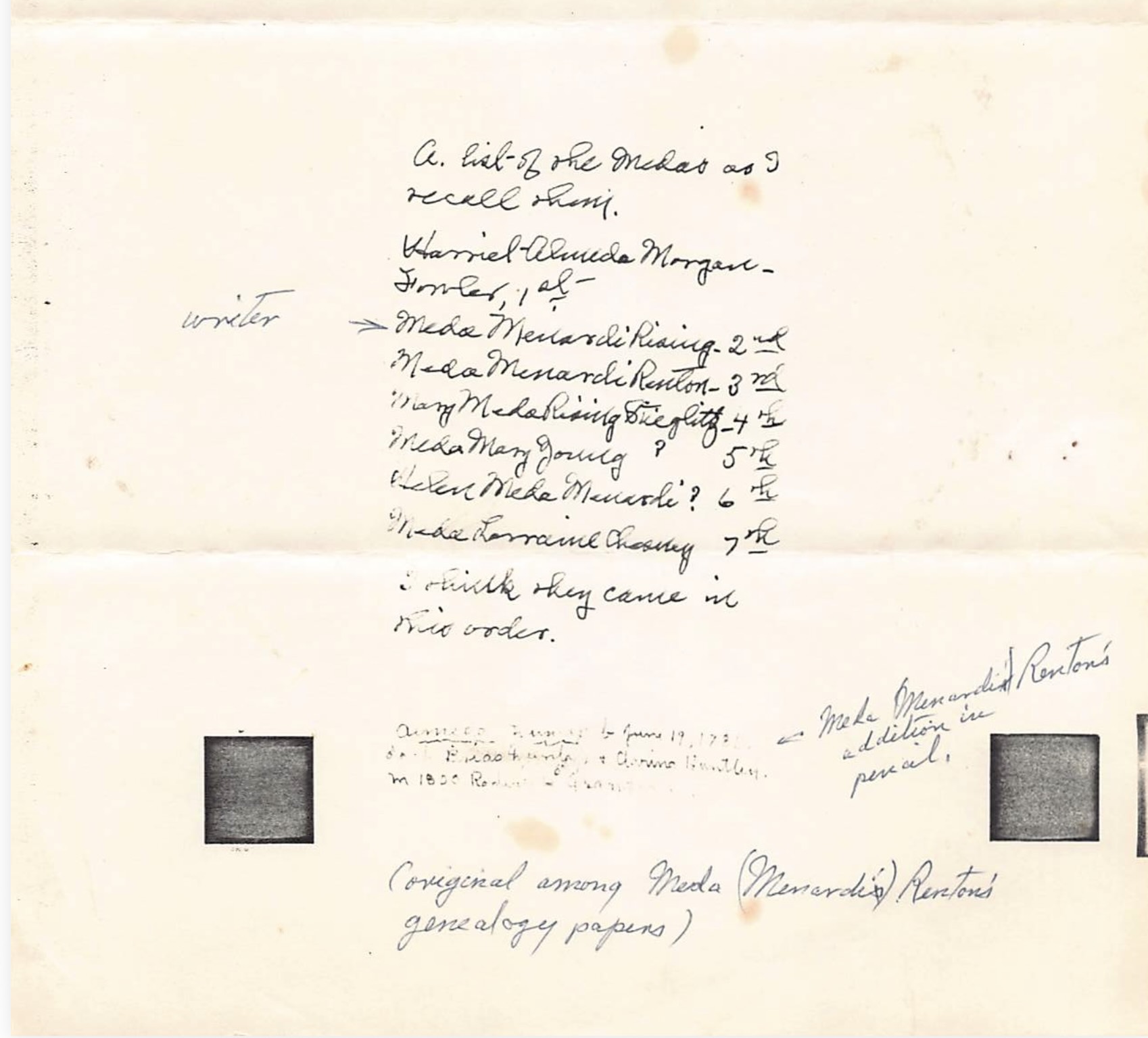
Then I found a list buried in one of my digital archives in which Meda’s grandmother, prior to her death in 1980, wrote out the names every “Meda” in the family that she could remember. She placed herself as #3 in the Meda list, which appears at the bottom of this post.

In the #2 spot was her aunt, her father’s sister, Almeda Menardi (married name Rising). So she was likely named for this aunt, still consistent Meda being a traditional name in her Italian family.

I then tracked back to the first Menardi to come to the United States, Joseph Sebastian Menardi, sometimes identified as Giuseppe Sebastian Menardi. I’ve had trouble dating his entry into the United States, but it appears to have been in the late 1700s or early 1800s. Family lore has it that he was drawn into late 18th century Italian and European revolutionary movements at the time of the French Revolution, and was ultimately forced to flee. Whether that’s true or not is, well, unsettled.

Genealogical records suggest he joined other early pioneer settlers of the towns of Wysox and Towanda, Bradford County, Pennsylvania, located in the Susquehanna River Valley along the New York line, and his descendants intermarried with other pioneer families in that part of Pennsylvania.

But then a noticed a problem with the Mendardi origin story.

Joseph Sebastian Menardi had a son, Andrew Elijah Menardi, born in 1826. Andrew was the grandfather of Meda’s grandmother. Is your brain having trouble with the generations? It took me days to wrap my head around the information without getting hopelessly confused and losing track of generations.

But here’s the thing. The name “Meda” doesn’t appear to have been handed down within the Menardi family, but from the family of Andrew Mendardi’s wife, Mary Lemora Mendardi, born Morgan.

Mary Morgan Menardi had a sister, Harriet Almeda Morgan, born in 1818 to parents Harry Morgan (1790-1872) and Harriet Bishop (1794-1868). And Meda’s grandmother identified this Harriet Almeda Morgan, whose married name was Fowler, as the first Meda.

I haven’t started to claw my way back through the next generation or two of the Morgan and Bishop families, looking for more appearances of the names Almeda or Meda that would further confirm this new origin story.

It was only at this point that I recalled an aside suggested by one of the AI assistants that I had initially discounted because it was inconsistent with the Menardi thesis.

In English-speaking regions—particularly in the 19th and early 20th centuries—Meda became a popular diminutive for Almeda. Parents would often name a child Almeda on official records while using Meda as the “call name” or everyday nickname. This pairing was especially common in American pioneer and rural communities, where Almeda saw its peak popularity.

Screenshot

Repost: My mother’s memories of Haleiwa

In the months following the death of my mother, Helen Yonge Lind, in early 2013, just months before her 99th birthday, I found lots of interesting items in her jumbled collection of papers, including correspondence, typed or handwritten notes, photos, and miscellaneous newspaper clippings.

This is a slightly-edited version of an entry originally posted in November 2013. It describes time she spent living in Haleiwa as a girl.

She moved to Haleiwa with her father in 1922 after he took a job as a collector for Mutual Telephone Company, the predecessor of Hawaiian Telephone. My mother’s version of the story was that she was assigned to do housekeeping for her father.

Her older sister, Marguerite, stayed in Waipahu with their mother and their newborn brother.

They lived in Haleiwa for three years before her father was able to transfer back to a position in Waipahu, according to her notes.

Sometime after her 90th birthday in 2004, my mother sat down and typed out notes of what she recalled of that time.

For three years of my childhood in the 1920s, I lived in Haleiwa in the makai section close to the grand old Haleiwa Hotel and the Anahulu Bridge. Even at the tender age of 10, there was no mystery about the names. I understood perfectly that I lived in Haleiwa in the district of Waialua. The town that bore the name of the district Waialua was several miles distant surrounding the sugar mill and plantation housing. I doubt if that particular area was actually called Waialua before the advent of the plantation. When the plantations of Waialua, Waianae and Ewa were established, each was given the name of its district, not the Hawaiian place-name of the location.

Although located in Haleiwa, the Waialua District Court House and the Waialua Elementary School were so named because they served the entire district. That was the Waialua District court and the Waialua District school. Some of my school friends came every day from the banana farms of Kawaihapai and from Puuiki out beyond the Waialua mill. Next to the school, out on Kaiaka Point, was the Waialua Fresh Air Camp, now a state recreational area.

On the 1841 Wilkes map prepared by the U.S. Exploring expedition of 1838-1841, the various districts of Oahu are shown with Waialua extending across the entire North Shore.

Over the years some names of places have changed or new ones have been adopted. I don’t know when it happened, but Paumalu, the “beach of the sneaky waters,” disappeared and Sunset Beach entered the scene. Other place names well known years ago have been forgotten. Puuiki and Kawaihapi don’t even appear on current road maps.

It was many years ago, but I still recall a few of the names of people I knew in Haleiwa. My best friend and constant companion was Jenny Woodd, who became an entertainer and the grandmother of currently popular singer, Amy Hanaialii Gilliom. Jenny’s brother, Johnny Woodd, was a well known local swimmer in his day. There was John Kukea who chose the career of a fire fighter and a water sports enthusiast. One of his sons is connected with the Kamehameha Schools. Tommy Cleghorn sat behind me in the 5th grade and delighted in poking my back with sharpened pencils. He went on to Punahou and became an anthropologist with the Bishop Museum.

The Mahoe family lived on a rise beyond the Anahulu river. A granddaughter is Marie Adams McDonald, an artist and the author of the beautiful definitive book about the Hawaiian lei. Across the street from us was the Takahashi family. I don’t remember if they had a store, but I believe they were the owners of the community furo which I remember well. On a number of occasions, my sister and I donned our kimono, placed a bar of soap in our little bamboo baskets, grabbed a towel and trekked across the street to bathe and bask in the warm, soothing waters of the furo amongst people of all ages. The Laird family lived on the banks of the Anahulu near the old missionary Emerson house. Years later we met again when one of the daughters and I worked together in the same department at UH.

I wonder if many residents today are aware there was once a thriving glass bottom boat business owned and operated by a man named Jenkins. His boats that took paying customers out into the bay to view reef life were moored next to the bridge on the lowest slope of the hotel grounds. As far as I know, he was not married and left no descendants.

I have two outstanding memories of the area. One was a tidal wave around 1922-25. A couple ran up the street shouting, “the kai, the kai” (the sea, the sea) and people flocked to the beach. We stood on a high area above the sandy beach to watch. I have a mental picture of the water in the bay receding and then suddenly rising into a high wall of water pushing toward the shore. There weren’t any curling waves as portrayed in surfing films. The ocean seemed to just swell up and then move forward. Then someone hustled us inland so I did not see what happened next. Nor do I remember if there was any property damage.

Another vivid memory is one of ethereal beauty, the spectacular and captivating sight of the lotus ponds in full bloom. The scene was so impressive, it has remained with me through all the years.

Helen Y. Lind

Kahala

Seeking Mapala123

This is an example of the kind of small mysteries that continually arise as a result of DNA testing.

I’ve done DNA tests with several companies. My sister first pushed me to take a test with Family Tree DNA, which was for Y-DNA, that is passed down father to son, generation after generation. She was interested in the history of the Lind side of the family, which explained her interest in Y-DNA.

Later, again with her encouragement, I did additional testing of so-called “autosomal” DNA, which is inherited from both parents.

This question comes out of the DNA testing by Ancestry.com, considered the largest company doing consumer DNA tests.

Ancestry produces a list of people who match your DNA, with the amount and nature of the overlap, and the total amount of shared DNA.

Ancestry divides matches into several categories. The first is “Close Family.” There my list includes known relatives, a half-brother and half-sister; a couple of grand nieces; several children of my cousins; and one of my Lind grandmother’s relatives in Scotland. None of these were surprises or mysteries, and all reportedly share at least 5% of my DNA.

The next category is “Extended Family.” Most of those in this category share between 1% and 4% of DNA with me. The top match in this “extended family” category is a woman using the name “Mapala123.” Ancestry reports we are related on my maternal line.

She is followed by a known relative, a daughter of one of my paternal cousins in Long Beach, California, making her a 1st cousin 1x removed.

I share almost the same amount of DNA with each of these top extended family matches.

My relation to my cousin’s daughter is clear. My relation to Mapala123 is unknown, a complete mystery. Ancestry estimates we are 2nd cousins, based on the pattern of DNA overlap. That would mean that our grandparents were siblings. In my book, that’s a pretty close connection and should make it possible to identify Mapala and our family relationship.

That would be meaningful because knowing their identity could, in turn, help identify others who are a little more distant genetically. Each unknown that gets identified potentially leads to more discoveries.

But finding Mapala123 isn’t proving easy.

I’ve reached out through Ancestry’s messaging system, which enables ways to reach those who remain anonymous. No answer, which is not really surprising. Not many people check on their Ancestry messages. I know that I only very occasionally peek to see if I’ve gotten any new messages.

A search of Newspapers.com found the 1931 obituary of a Leonard Mapala published in the Honolulu Advertiser. He was born in Kaupo, Maui, in 1879. This is probably a hint, because the Hawaiian side of my mother’s family came from that area on Maui between Keanae and Kaupo. At the time of his death, he was reported to be a carpenter living in Kaimuki. A second newspaper story said Mapala had been sick and directed not to drink alcoholic beverages, but went on a binge despite the warning and died.

Another clipping shows Mapala was a 39-year old soldier who had been inducted into military service in 1918, according to a clipping in the Pacific Commercial Advertiser, and was reported as a deserter the following year.

My online search also turned up an essay by John Kelly Jr., son of the hawaii artist and a founder of the Save Our Surf organization in the 1960s which is credited with saving numerous surf breaks from destruction.

John and Kate Kelly’s son, John Kelly Jr., grew up as a Hawaiian boy, swimming, surfing, diving, fishing, and learning from the neighboring k?naka maoli, Native Hawaiians. This account was written about the man named Mapala, who, as a kupuna, mentor, and the boy’s adopted grandfather, taught John Jr., who he called Keoni, to fish and relate to the sea with respect and a deep reverence.

Kelly Jr. wrote about Mapala in an essay now available online, and Mapala was captured in some of the senior Kelly’s art:

Screenshot

Mapala taught me all he knew about the sea, the moi, how to spot their fins in the swirling foam waters of Lae o Kupikipikio (Point of Spouting Waters, or Black Point). He showed me how to make heavy aho (cotton) nets with the Hawaiian knot for the rough waters, and light linen nets for ‘ama ‘ama (mullet) for inshore reef waters. He knew the comings and goings of inshore fishes according to moon cycles, tides and spawning seasons. He showed me where to pick opihi and ha’uke’uke (limpets), to catch the darting ‘a’ama (black crab) for uhu (parrotfish) bait.

Black Point, where Kelly’s adventures with Mapala took place, wasn’t far from a a lot near the beach in Kahala where my mother found a cousin who had been raised by his grandfather in or around Hana. Perhaps just a coincidence, I don’t know.

In any case, I’m grasping at straws here.

Any suggestions about how to find Mapala123 would be welcomed.