
A bit of history.
It was Sunday, May 30, 1971. It was the last Memorial Day observed on May 30, which Congress then moved to the final Monday of May.
We were among those taking part in a peaceful demonstration against what was then the continuing war in Vietnam. What was unusual was the location, the War Memorial Cemetery of the Pacific at Punchbowl, where we stood along the entry road as the public arrived for the annual Memorial Day observation.
As I recall, we had gathered first at Church of the Crossroads, where signs were being made and makeup applied, and then drove to Punchbowl, where our group of about 50-60 lined the road into the cemetery.
Here are some photos from my archives (just click on the photo to see the rest).
[Continue reading below]

After getting them ready to share, I went looking for more information about the event.
I thought it might have been sponsored by the Hawaii People’s Coalition for Peace and Justice, which had been formed in March 1971.
In March of 1971 over a score of community, peace, student, military, low-income and other groups and individuals formed the Hawaii People’s Coalition for Peace and Justice–reflecting the joining of concerns for an end to the war, racism, exploitation, repression and poverty, and for a society based on human equality and respect for the earth.
But my first look at the HPCPJ newsletters found lots of other protests and activities being held during the month of May, but the Memorial Day event wasn’t among them.
Then I finally spotted this brief announcement identifying the sponsor as Liberated Barracks, another group that had just been formed to operate a GI coffeehouse, among other activities.
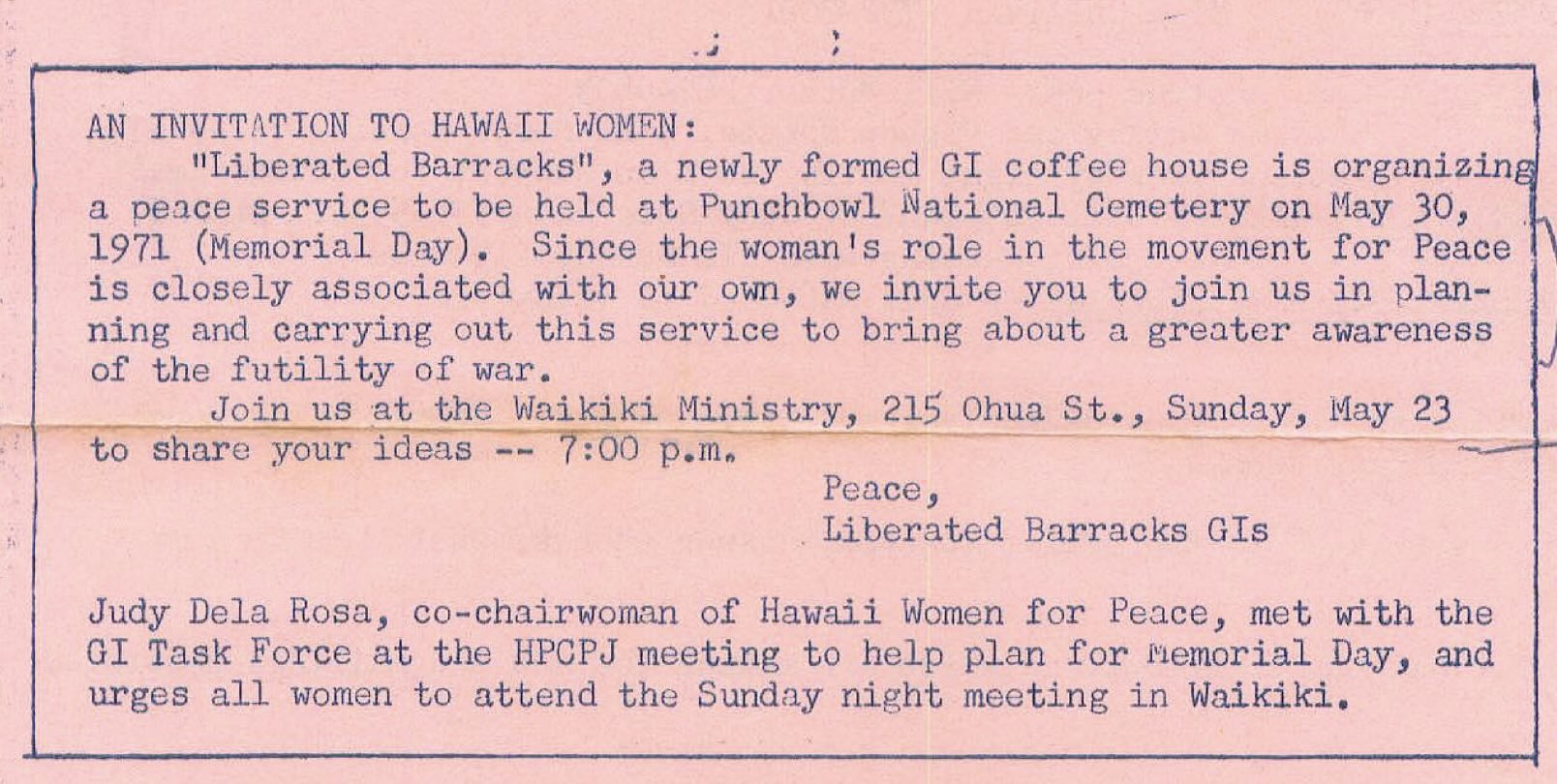
Screenshot
At the time, Honolulu had two competing daily newspapers, and both carried stories reporting on the Memorial Day observance and the protest outside.
The Honolulu Star-Bulletin carried a story on page 2, with a photo of the demonstation, and another of the official action.
The caption noted: “Demonstrators lined the lawn-flanked drive up to the crater, chanting ‘How many more?'”
Lyle Nelson, who reported on military affairs for the Star-Bulletin, led his story by contrasting the message of the Pacific Fleet Commander, who decried “policymaking by protest in the streets,” to that of then-Honolulu Mayor Frank Fasi, a former Marine who served in the Pacific during WWII.
“We would have to be deaf and blind if we failed to recognize that across the nation a new wind is blowing, the Mayor said.
REPRESENTING the new wind at Punchbowl were about two dozen antiwar demonstrators who stood a grim vigil just outside the front gate.
Faces masked by black and white paint, they carried protest signs and chanted, “How many more?”
This kind of questioning of national purpose, domestic priorities and international motives is good, Fasi said.
William Helton, the Honolulu Advertiser’s military reporter, provided additional details.
“[Fasi] was dressed in a black suit, white shirt and a red, white and blue tie. The tie’s windsor knot showed white stars on a blue field,” Helton wrote.
“This is profound questioning in regard to the military establishment and its relationship to our national purpose,” Fasi said. “Thirty years of the draft, 30 years of cold and hot war, 30 years of constant alarms and excursions, 30 years of mounting casualties and cost have taken their toll.”
“Across this land of ours, a new generation is little by little causing us to examine our national purpose, our domestic priorities, and our international motives. And it is good.”
Helton continued:
The Mayor said that young people today are impatient.
If America has been wrong “as they say, then the cost has been ghastly,” he said.
This description of Liberated Barracks appears in the first issue of the group’s small underground newspaper published between 1971 and 1974. Copies can be viewed online in a collection of the Wisconsin Historical Society.
Liberated Barracks grew out of a void in Hawaii. The void-the lack of a place where G.I.’s could get together and collectively work on solutions to problems that are a daily part of military life. It began with a group of concerned G.I.’s and civilians working together within the People’s Coalition for Peace and Justice and has since grown and expanded to the point of having a coffee house open on a daily basis. It offers military counseling and referral services including limited legal assistance (hopefully to be full time in the near future). The coffee house is openevery day with evening programs consisting of educational and entertainment events.
The weekly schedule is: Monday-the newspaper staff meets to work on the Liberated Barracks paper. Everyone is invited to help out, especially with articles that you would like to see printed; Tuesday-free nite; we eventually plan to have classes in the use of the UCMJ for the benefit of the G.l.; Wednesday-Movies on current and past political struggles in the world followed by an informal rap; Thursday-guest speakers and/or informal raps on topics relating to the G.J. struggle; Friday-Fun Nite usually we have movies such as classics like Buster Keaton or Adult cartoons. This is a time reserved for everybody to come together and enjoy themselves; Saturday-live entertainment such as folk singers, small groups, ete. You are weleome to bring in any musical instruments and play; Sunday-during the day the Steering Committee, which consists of the civilian staff and G.I.’a from each base, meets to plan events for each week and generally analyze the operation of the coffeehouse. This is followed by a general meeting of everyone participating in the coffeehouse to make plans for the future, such as fund raising, projects, etc.