
Gift disclosure statements filed with the State Ethics Commission by two key administrators who were part of the review process of the failed Stevie Wonder concert show they took free tickets to athletic events worth thousands of dollars over the past several years.
The practice of letting top administrators accept gifts of event tickets has been a longstanding practice at the University of Hawaii, despite a 1996 opinion by the State Ethics Commission limiting the conditions under which they would be considered appropriate.
Recipients have included administrators, many with no direct roles in or responsibility for athletic activities, as well as some (but not all) members of the Board of Regents.
It isn’t unreasonable to wonder whether acceptance of free season and single-game tickets to UH athletic events from the Athletics Department undermined the independent judgements of administrators when reviewing the proposed fundraising concert. These concerns would be magnified if any administrators received or were promised free tickets to the concert, or used their status as season ticket holders to buy concert tickets during the pre-sale period before tickets were offered to the general public.
Darolyn Lendio, the university’s general counsel and vice president for legal affairs, reported accepting gifts during the past year that included two season tickets in each of five sports, plus a pass for free parking at Aloha Stadium. Lendio valued the gifts from the UH athletics department at $3,500 in the past year alone. Lendio reported receiving a similar packet of tickets during the prior two years as well. She reported the total value of these athletic department perks added up to $7,390 over three years.
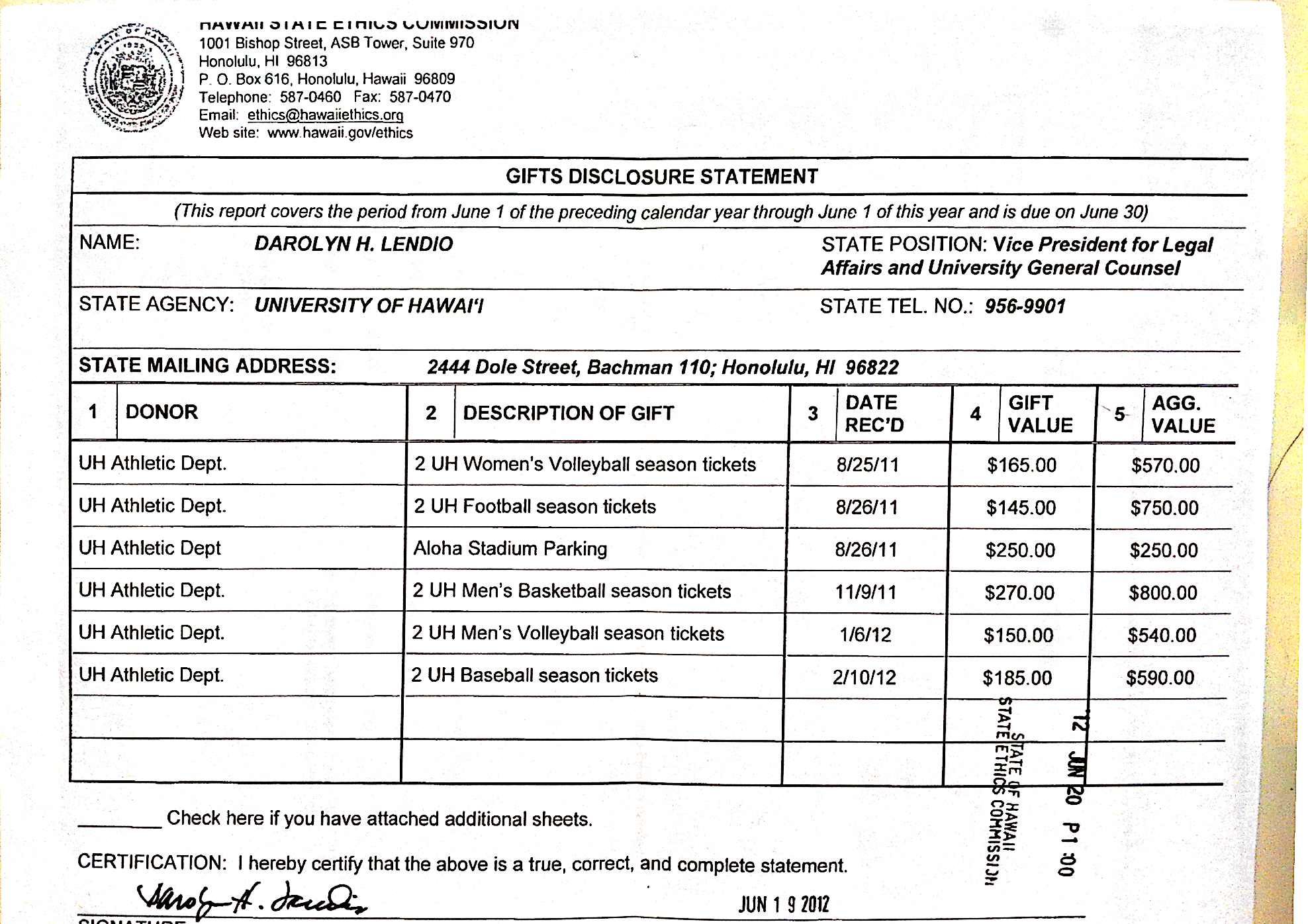
Lendio’s office reportedly reviewed the contract with local promoter Bob Peyton proposed by the athletics department and gave the go-ahead for it to be signed.
Howard Todo, the university’s chief financial officer and vice president for budget and finance, reported receiving two season tickets for both football and women’s volleyball, as well as a free stadium parking pass, over the past year. He valued the package of tickets at $1,570. Todo also accepted free tickets for the same sports in each of the previous two years. The total value of free tickets and free parking given to Todo by the athletics department over the past three years was nearly $5,000.
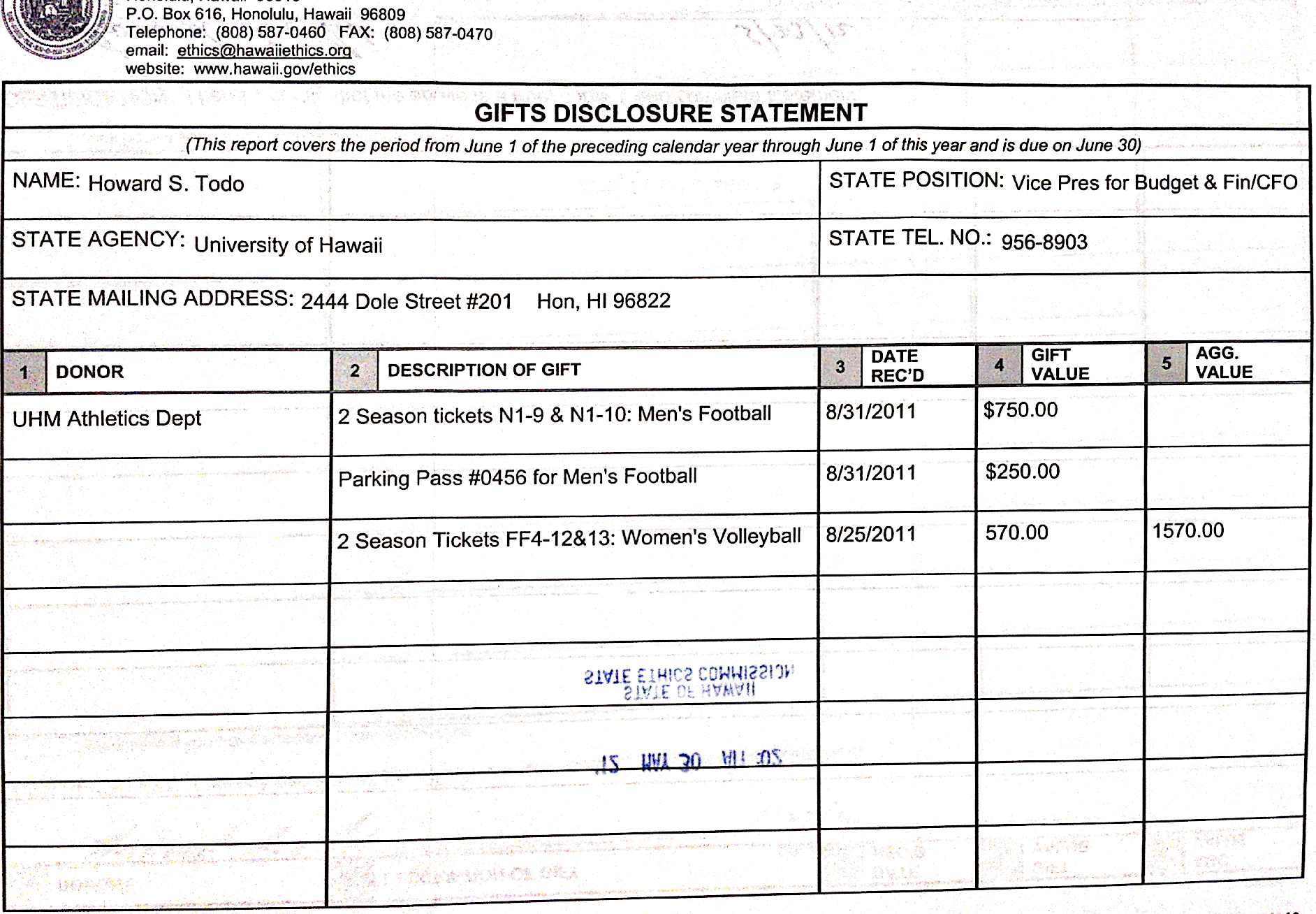
According to published accounts, Todo authorized the transfer of $200,000 to a bank account in Florida which was supposed to seal the concert deal. Instead, the money is missing and the FBI reportedly found no trace of it in the account.
Lendio and Todo are only two of many administrators who have taken advantage of the largess of the athletics department, despite the ethics commission opinion which found such gifts acceptable only under limited conditions.
The opinion presented a set of guidelines for these gifts. Here are the two most basic.
1. Tickets and seating that were controlled by the Agency were state property, and could not be used to grant unwarranted privileges or advantages to Agency officials or others.
2. The distribution of free tickets or passes to any person by the Agency had to serve a valid state purpose.
In addition, the commission said any unused tickets should be returned prior to the event, or as soon as possible afterwards, “to provide accountability for the use of those tickets or passes and to obviate concerns about the possible misuse of tickets or passes.”
I checked with the ethics commission back in 2010, and was told the opinion is still valid and continues to reflect the commission’s view of the issue.
Under the circumstances, the years of free tickets–and the promise of future gifts–creates at least the appearance that administrative independence may have been compromised, and could have contributed to the debacle that the concert has become. It’s a perfect example of the kind of situation our ethics laws are designed to avoid.
The policy of allowing widespread administrative gifts has been allowed to continue for too long. Perhaps this will provide the motive for UH to tackle the issue directly and strictly apply those ethics guidelines going forward.
Discover more from i L i n d
Subscribe to get the latest posts sent to your email.
Couple things here:
1. I believe it’s “DarOlyn.”
2. Would your analysis differ if the tickets had been negotiated as part of the employees’ compensation package? They would no longer be gifts but wouldn’re the underlying conflict be the same? Wouldn’t it always be a conflict to review the actions of the employer who pays the employee’s compensation?
Questionable ethics and marginal competence what a great combination for people who draw salaries higher than the Governor or Chief Justice.
I think the Board of Regents should be an elected post, at least the public can get some accountability from the UH at some point.
solution: New mandatory language for all future enormous UH salary contracts.
“Section 1(a): You break it, you pay for it. You might have to sell one of your cars.”
Looks now as if Apple and Ms Greenie suspended wrong people. Does UH-Manoa now face suits for wrongful actions by the employer?
“Even Napoleon had his Watergate”
Yogi Berra
Keep in mind that we do not know what the lawyers were actually asked to do, and likely never will because that communication should be privileged.
It would not be unusual for a client to reach an agreement in principle with another person/entity, and then hand her lawyer a draft agreement, perpared by busniesspeople, for review/revision/approval. Your account of what reportedly happened here seems in line with this typical structure.
In that case, the lawyer is not typically asked to second guess the deal, deal points, or bona fides of the other party. Rather, the lawyer is asked to make sure the contract properly states the material deal points and complies with the governing law. The lawyer’s role is limited, and would not include opining on whether the deal is a good one for the client, or whether the other side has authority to enter the deal, is trustworthy, etc.
When is an escrow account not an escrow account and who should have checked? That strikes me as the central question here.
An escrow account is set up to hold money until the conditions of the agreement that sets it up is met. One would assume that the lawyers of the UH would have been required to review the escrow agreement, especially since it was not with a known escrow company and was out of state.
At a minimum, a sharp attorney would have required a Hawaii escrow company to assure that there was some sembalance of control over the funds. That is called due diligence.
Obvious follow up question: Was there a determination that a valid state purpose is served by distribution of tickets to the two individuals and who made that determination (or should have made that determination)?
I’m not adverse to UH employees getting free game and parking tickets so long as they are reported on ethics filings.
We need to make a distinction between certain courtesies and niceties fully disclosed and those not disclosed or obviously improper such as they same given to lawmakers with a vote over UH funding.
I find the cases presented here to be stretching the goodie two shoes goal to the breaking point.
On this point, I respectfully disagree.
“Certain courtesies and niceties”?
UH has experienced a huge growth in administrative costs. Even mid-level administrators now make more than most full professors. The folks we’re talking about make as much as several professors.
Why do they qualify for free season tickets? What job responsibilities make attendance, with a friend, a state interest?
Sometimes, sure. The president and chancellor should make their appearances. Perhaps some administrators should take in an occasional game so that they have a sense of the scene.
Those “courtesies,” as the ethics commission opinion recognized, are limited to a few positions.
The rest are certainly paid well enough to buy their own tickets, should they desire to support the teams.
It’s hard to discern any possible state interest in the tickets going to a wide range of administrators.
-Ian
The problem is that it is not “UH Employees” getting the free game and parking tickets. They are not going to custodians, grounds keepers or administrative assistants. It is the HIGHLY paid well connected administrators who are using their positions to extract perks to which they are not entitled. This goes back to the question which was asked a couple of weeks ago, “Is Hawaii politics corrupt?” The answer is a resounding YES! This is a prime example of why. People in influential positions get the freebies while everyone else has to pay full freight.
Check with the NCAA as to how other Division 1-A schools treat their high-ranking administrators when it comes to free tickets to intercollegiate sports.
I have a close relative who sits on the Board of Regents of a PAC-12 school. He gets free tickets as do all the other Regents, but he also is a major donor to the school’s foundation. However, the donation and the tickets are not connected in any way except to the school.
I have no objections whatsoever to high-ranking administrators receiving tickets. They’re working hard – especially the unpaid Board of Regents members.
FYI – SigOth and I have season tickets in all six ticketed sports and are also major supporters of Wahine softball and soccer. I’d guess we probably spend about $3500 a year in tickets, parking & refreshments.
In addition to enjoying the games/matches, we also like value the intercollegiate sports bring to UH.
My view of the university: Mr. Donovan aka Mr. Slush fund, free meals, golf tournaments, doing wink ,wink business made no friends with the students when he stuck us with an annual $100 fee. Wanna bet that price will go up and never get lowered. We pay a lot in fees, Campus Center fees (run by the Gestapo), (please investigate how much CC administrators make for the amount of work they do. And letting the students volunteer or get paid minimum wage and let the students do all the heavy lifting). Add up more lab fee$ the school newpaper; KTUH etc., it is getting ridiculous. When doing business if I contract an attorney to review and to dot the ‘eyes’ and cross the ‘tees’ and something goes awry, guess what I would fire that attorney. And regarding “free” tickets for administrators, hey they are making 6 figures ,”they can afford to buy their own’ , so quit acting like “pigs at the trough.” Which is insulting to the pigs. You already have an ethics ruling. Follow it, or is the place run by crooks? Oh they may circumvent by having freebies written into their contracts, that would reveal their sense of entitlement. obey the spirit of the law. They aren’t going to the games like they are working. If it walks like a duck, quacks like a duck and you call it a chicken, guess what it is still a duck. Their compensation is already pate~ fat with Hawaii’s generous ‘high 3’ rule. If they feel they aren’t compensated enough let them work in the private sector and see their real value.
So why does UH have a banana republic/ ghetto feel to it. All we need is a Penn State scandal (closer than you may think)and we can call ourselves State Pen. “we are State Pen.” Mahalo. P.S.- Is the university buying silence from the fourth wall by hiring media reps, friends,pals of VP Waters, how did she ever become a VP? Ah, she’s married to a state senator. Something stinks. Auwe. Aloha.
[Comment has been edited.]
As poorly as some UH teams have performed in the past couple of years, I would hardly consider these tickets gifts. More like punishment?
Today’s Star Advertiser reports that the UH system president Marcy Greenwood is negotiating with Mountain West over reducing conference costs for UH.
“Thompson said the subject is “part of the conversation” with UH President M.R.C. Greenwood, who is chairwoman of the MWC’s revenue subcommittee.”
Two problems here. First, NCAA rules say the university with the football team manages it, not a third party, in this case a system president. Second, if Greenwood is head of the MWC revenue committee, isn’t there the teeniest conflict of interest, if she is trying to reduce MWC revenue on behalf of UH?
Question: so assume there is a violation of the ethics laws. Now what? Do they go to jail? Who initiates the action?
I remember your article on the “powerful state senator” who was never fined for sequential filing of false financial disclosures. So do “powerful university officials” escape the ethics law as well?
What next, Ethics Commission?