|
|
Recent photos: Vieques (Puerto Rico) 1978 • Malaekahana 1959 •
Historic Kualoa sugar mill • Kaaawa in November •
March 3, 2007 - Saturday [ permalink ]
I haven't heard details of the Star-Bulletin's major design makeover, due to make its appearance next week, but I'm looking forward to what their design wizards have come up with.
It's Saturday morning and, after reading a Maui News story about the county council and the so called "Sunshine Law" (thanks to Doug & Poinography.com for the link), I'm about ready to seriously propose that the law needs to be repealed and replaced with something sane. Somewhere along the way of adopting the long series of tinkering amendments to the sunshine law over the past 30 years, we've lost sight of the original intention--to end secret decision making and move as much of the political process as possible into the public arena--and now face a bizarre twist in which "sunshine" is being asserted as a reason for excluding members of the council from participating in public business during public meetings. Instead of fostering openness, the sunshine law is being used as a hammer to restrict public discussion. It is almost too strange for words.
According to the story, the Office of Information Practices has informally opined that council committee meetings must be closed to council members who are not named members of the particular standing committee.
I'm having a hard time fathoming the logic behind this one. The council is organized with a number of five-member committees. The sunshine law applies to these standing committees which are required to hold public meetings, which by law "shall be open to the public and all persons shall be permitted to attend any meeting...."
Read that one again: "...shall be open to the public and all persons shall be permitted to attend any meeting...."
I can't find anything in the general open meeting requirement that would limit a council member' s right to sit in on another committee, especially in light of the overall presumption that council interactions should take place in public meetings.
Remember that overall original intent, written in to the law in a declaration of policy and intent, which reads in part: "Therefore, the legislature declares that it is the policy of this State that the formation and conduct of public policy - the discussions, deliberations, decisions, and action of governmental agencies - shall be conducted as openly as possible."
How in the world does an extra council member's participation in a public meeting contravene that intent?
In my own experience, council members are rarely eager to create more work for themselves by attending meetings of standing committees they have not been named to. On the other hand, it is common for members to sit in on a meeting of another committee considering a matter than impacts their own district or has unusual public interest. Those additional members don't have votes on the committee but have traditionally been accomodated as a courtesy, if nothing else. Their participation is not hidden and these interactions occur in a properly posted public meeting, which is the whole goal of the sunshine law, so that's why it is difficult to fathom why this practice is being frowned on by OIP.
What sense does it make to somehow interpret the sunshine law to allow anyone else in the world to attend and take part in a public meeting while turning away an elected member of the council in the name of some strange sense of openness? That logic is beyond me.
Poinography.com, in yesterday's entry, also noted my Friday ramblings on the Ko Olina tax credit and commented on a statement that the general fund would retain the $75 million if the budgeted tax credits were not used.
Does that sentence mean that for every year the tax credit was available the Lege had to assume during budget calculations that some or all of the credit would be taken and, thus, had to reduce spending by a similar amount?
That's precisely what a budget is all about. Take available revenues and plan on how to expend or save them. If you plan on reducing revenues by $75 million via a multi-year tax credit, then you have that much less to expend on other things. And if you reduce tax revenues by $75 million via a big tax credit without budgeting accordingly, you end up with a big budget shortfall.
In any case, I agree with Doug that responding to each other is the blogger's "easy way out". It is, after all, Saturday.
March 2, 2007 - Friday [ permalink ]
The House and Senate money committees (Finance and Ways & Means) have been going at a mad pace to meet today's decking deadline. All bills that are going to survive have to be "decked" today for consideration on third reading next week. An alert reader caught this on the bottom of a House Finance Committee meeting notice yesterday: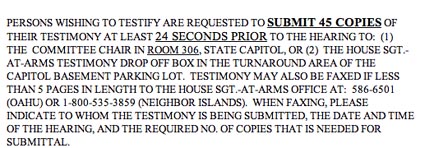
Turning that last minute testimony around in 24-seconds must have been quite a trick!
Doug White, who writes the always interesting Poinography.com, was sailing yesterday so I'll take the opportunity to take issue with one of his entries this week. On Tuesday, he commented on a Star-Bulletin story concerning bills to repeal or retarget the $75 million in tax credits that had been set aside several years ago for the aquarium at Ko Olina.
Doug takes lawmakers to task for talkng about "imaginary money" and being confused when they talk about this tax credit "as if it were an appropriations bill".
Actually, this is a common approach used to prepare a "tax expenditure budget", and has been used to understand and highlight uses of tax funds that otherwise aren't seen by the public because they are doled out as invisible credits rather than appearing in the budget as line items of spending. Federal law, for example, requires preparation of a tax expenditure budget, a listing of those tax expenditures--credits and exemptions--in the annual federal budget.
In the past, businesses or special interests would be given huge tax breaks while other community needs would be met through direct appropriations. But when things got tough financially, the cuts would be made in appropriations and all those tax breaks--in essence, giveaways of what would otherwise have been taxes collected and available for public use--went unseen and unexamined. So speaking of tax credits as expenditures serves a significant public purpose by giving a more complete picture of where money is going.
Then Doug goes on:
“The money” is not the State’s to spend, and until Ko Olina (or another taxpayer) builds the facility there is no $75 million!
Not so, Doug. Using the Ko Olina credit as an example, it's correct to say that the Ko Olina tax credits wouldn't have been taken, or expended, until constructon of the aquarium had been underway. But don't confuse the credit with the taxes it offsets. The taxes would have been due and paid (or payable) and those tax dollars part of the general fund and available for other uses as long as the aquarium wasn't built and the tax credits weren't claimed. Without the facility, there would have been $75 million more sitting in the general fund. Nothing imaginary there, at least not any more imaginary than the estimates of future economic activity by the Council on Revenues, which are the basis of the state budet.
For this Feline Friday, I wanted to share an email that came in this week from another fan of Toby:
I'm particularly interested in Mr. Toby. I got a cat, who by all accounts could have been Mr. Toby's "grandfather", some 17 years ago. His name was JoJo and he died last May. He was the "light of my life" besides my kids and husband and like all pets, I miss him terribly, but he was special.
I wanted to know if you have seen another cat who looks like Mr. Toby? I keep hunting here, in New Hampshire, on all the websites of the animal shelters hoping to find a cat who has similar attributes and haven't even come close.
Click here to read the full message, which includes a wonderful description of JoJo, the Toby look alike.
March 1, 2007 - Thursday [ permalink ]
If you managed to get your hands on a Honolulu Weekly yesterday, you would have seen my piece on the retirement of embattled elections chief Dwayne Yoshina. Although he had asked to be reappointed, it seems he now faced bipartisan opposition from the Election Commission's Republican as well as Democratic members. This time Yoshina got the message and withdrew his reappointment request and instead took out retirement papers. Unfortunatly, this week's item has not made it into the Weekly's online edition.
That's part of the story, and the dailies caught up with stories today. Richard Borreca does an excellent job in today's Star-Bulletin in explaining Yoshina's departure. But the situation also highlights splits in the Democratic Party. Oahu Democrats' central committee, led by former state representative Annelle Amaral, met last week and voted to support Yoshina, citing his experience. But they failed in an effort to bring state Democrats together to openly discuss a party position and strategy for filling the chief election officer position. Indications are that a deal has already been struck among a small group of party leaders on both sides of the political aisle.
The election commission meets this morning in what should be a very interesting session.
Trying to pursue a story like this with a weekly deadline is a bit tricky because you're trying to dig out information without calling enough attention to the story to tip off reporters who could get to print earlier. It's not so bad on a enterprise story that's not likely to be on anyone's radar, but the agenda for this meeting was published a week ago and there's been a lot of prior interest in Yoshina's situation. I was lucky that the story didn't break more generally until after my version appeared. And, to be honest, I was betting that the legislature would be keeping the daily political reporters too busy to get to other stories like this one.
West Hawaii Today sent out an email offering an introductory one month trail to their new e-edition at a cost of $10.50. That's $10.50 per month. That sounds like a pretty steep price for the electronically delivered paper.

Pacific Business News offers its e-edition as a free add-on for print subscribers. And there are a lot of folks in Kona with their private jets, but not enough to sustain this rather expensive route to the local paper. I wonder how much response the paper is going to get to this offer?
Don't miss Doug Carlson's lively recounting of the panel put on this week by the Honolulu Community Media Council on the media and emergency reponse. Carlson was on the panel, along with representatives of the office formerly known as Oahu Civil Defense, and media reps from the Advertiser, Clear Channel, and public radio. He's already drawn a reaction from State Civil Defense, which apparently chose not to take part in the Media Council's panel.
February 28, 2007 - Wednesday [ permalink ]
Did you hear the loud whistling sound yesterday? I wonder if that was the steam going out of the market for Honolulu's spate of new high priced condominiums in the wake of the crash of stock markets in China, Japan, and the U.S. and increasing tolk of recession that must have left potential buyers clinging more tightly to their wallets. It must also be raising red flags in the Finance and Ways & Means committees down at the Capitol that are now wrestling with portions of the state budget.
My friend Chuck Smith's blog has been devoting a lot of space to technical analysis of the stock markets with predications of a "correction" in the overheated averages, and now he gets to have some of that "told you so" attitude. He's also gathered some charts and graphs worth looking at.
This morning he writes: "I wonder how many pundits in the financial press issued a warning as pointed as I did Monday any time in the past 2 weeks. I think the answer is near-zero."
Neither Honolulu daily appears to devote any space today to financial and political fallout for Hawaii of the worst stock market drop since the Sept. 11 attacks.
I've got a bit of real news in today's issue of Honolulu Weekly. It's hard to beat the dailies in a weekly publication, and I've been holding my breath for several days to see if anyone else would beat me to the story, but it didn't happen. I'm not going to say more until the issue is on the streets today, but it's possible it will appear in the Weekly's online edition later in the day.
A piece of rebar was dropped last week from The Pinnacle, a high rise building under construction at the corner of Bishop Street and Beretania. It fell through the back window of a car on the street below, injuring the two women Of course, I can't find any of the stories about the incident in a rushed search this morning.
But KHON's report several days later cited safety defects on the job apparently identified by a carpenter's union representative. The story wasn't explicit about this, but the implication was that it is a non-union job where corners are being cut. That sounds like something worth a bit more follow-up, although I guess that's unlikely.
Applications are being accepted to fill vacancies on the State Ethics Comission, according to a note on the Judiciary web site and an advertisement published by the commission. Applications can be found here.
February 27, 2007 - Tuesday [ permalink ]
I had to stop and take a deep breath after finishing today's Honolulu Advertiser editorial, "Check politics at door in today's transit vote".
I don't necessarily disagree with its conclusion that the best transit route would connect with the airport but along the way the editorial makes some basic errors.
Consider this one:
Councilmembers since have heard from many constituents angry about that decision. These are voters who want leaders to ratchet down the political rhetoric and show evidence that they've been talking with each other over the intervening week.
Again, I might agree, although I'm not sure just how the Advertiser knows (a) that councilmembers are getting lots of angry feedback from residents, (b) that those calls and messages are coming from constituents, and (c) just what those constituents really want.
But, in any case, wouldn't talks between members of the council that would be evidenced by a different vote than last week violate the sunshine law? If the Advertiser wants to see "evidence that they've been talking with each other", it perhaps needs to reconsider its stance on those changes to the sunshine law council members have been pushing for that would allow private chats outside of public meetings.
Okay, setting that aside, the editorial casually refers to the airport route as the "alignment that intuitively seems most practical". I don't know, a lot of folks would say the most intuitive route would run through the most heavily populated neighborhoods in order to pick up the maximum number of riders, and I don't know if the airport route does that.
After all, here's what Advertiser public affairs editor Jerry Burris wrote this past Sunday:
The logic of the airport route was that it would serve local residents who work at or near the airport and would provide a convenient transportation system for arriving and departing airline passengers.
But who, precisely, would those passengers be?
Not tourists for the most part, since the planned transit system doesn't go into Waikiki and may never do so. Not most local residents, unless they happen to live close to the line and are not burdened with excessive luggage. It's a good bet that even if a transit line runs past the airport (and it may still do so in phase II, III or IV), most local folks will continue to drive to the airport or get dropped off right at the check-in facility.
So perhaps the airport isn't so intuitive after all.
But the underlying premise that politics has no place here is what really gets to me. The editorial concludes:
Whatever the decision, it must be based on real-life, not political, considerations. Which plan would serve O'ahu best, and will enable the city to move forward promptly?
Get real. There is no clean, objective, "which plan would serve Oahu best" approach here. There are competing interests which would be differenentially impacted by the choices made. For each alignment, there will be winners and losers, or, to be fairer, those who benefit more or less, whether those interests are geographic communities, industry groups, or partisan alignments. Getting to a decision despite the inevitable competition of interests is the very guts of politics.
And isn't it interesting that it's always the other guys who are "political" (read "bad") while "our" viewpoint is just "intuitive"?
Really, though, this is all about politics, and these are the situations that make the political process most interesting. In my view, dissing politics and the political process, as the Advertiser does this morning, directly contradicts the newspaper's desire to see more people participate in the public processes that are part of, yes, the political system.
| After that heated start to the day, here's a bit of the calming influence of food. We got home about 7 p.m. last night and almost floundered in our conceptual search for a meal plan. Then I popped a small package of skinless (but not boneless) chicken thighs out of the freezer, popped them into a pan with some garlic and white wine, and added a large chopped sweet red pepper in the last few minutes of cooking, while bringing a cup of water to boil to prepare a bit of couscous. |
|
Meanwhile, Meda was putting together another vegetable plate featuring salad leftover from the night before, along with carrots, tomatoes, and olives.
A light sprinkle of Costco's Romano cheese after serving and it was a fine experience.
February 26, 2007 - Monday [ permalink ]
| When the sun came up on Friday morning, it revealed the little nest with now broken eggs in the spot where a reddish brown hen had been sitting for the past couple of weeks. At least it seems that long. Hen and about six chicks hadn't gone far, but later wandered off, and we've only spotted them once in the past few days. |
|
A reader responded to yesterday's entry about a Star-Bulletin business story on construction litigation:
Couldn't agree with you more. In business journalism, there is a not-too-fine-line between reporting and boosterism. This Star-Bulletin article is clearly one-sided boosterism for the construction industry. The cause is basic laziness. It's very easy to call companies and quote them to give their spin. It's another thing entirely to do some legwork and explore the real world. You don't need to be an investigative reporter to read through lawsuits or talk to a variety of different sources. It's not that hard to get the bigger picture of a story.
I missed the news earlier this month about a letter from Guild members at Gannett's Rochester Democrat and Chronicle raising ethical questions about the blurring lines between editorial, news, and advertising. The letter drew a response from the publisher saying, of course, that all is well.
A press release from Standard Parking, a publicly traded company, announces two new contracts with the City & County of Honolulu, and for what sounds like Restaurant Row.
San Francisco Chronicle staffers have been making their recommendations for Hawai travel, in addition to inviting suggestions from readers.
A class action lawsuit against an insurance company over terms of its equity index annuities sold to Hawaii residents is reported today by InvestmentNews.com. The class is estimated to include 600 to 700 Hawaii residents 65 years or older. The case was filed by the law firm of Bickerton Lee Dang & Sullivan, and the story is accompanied by a smiling photo of attorney Jim Bickerton.
| This is a photo of an African wild cat which a friend sent over the weekend. Apparently these are the immediate ancestors of our domestic cats. A friend of ours is studying cats and now looking at differences in posture between the african cat and our more familiar cats. I'll be digging through photos for examples. |
|
February 25, 2007 - Sunday [ permalink ]
Okay, guys. Get ready for this one. These scientists at Iowa State U now say there's evidence that women developed the first weapons and were the first to use them. That certainly disrupts our familiar ways of thinking and talking. Hey, are you woman enough to carry a weapon?
This morning's Star-Bulletin features a business story by Kristen Consillio about liability issues in the construction industry. Here's the nut graph:
The threat of class-action lawsuits, which has become prevalent in the building industry, is driving up the cost of homes in Hawaii as local firms increasingly are restricted by their insurers from doing residential projects or are forced to substantially raise the price on a high-risk residential job.
The story is startling one-sided, featuring endless quotes from contractors and engineers about the evils of lawsuits, but not a single example--which aren't hard to find--of the egregious construction defects that spawn those lawsuits. If such lawsuits are as numerous as the article implies, it shouldn't have been hard to cite some examples. And when you're the one facing a serious construction defect caused by shoddy workmanship, failed materials, or other errors that can't be resolved and with high repair costs ahead you have to sue everyone involved because the architect blames the contractor who blames a sub who blames the architect who now blames a supplier of materials who blames...And so it goes.
Without any attempt to examine whether the underlying issue of construction defects, the story falls flat, or worse.
Larry Geller chimed in yesterday on the future of newspapers:
Won't newspapers succeed if they are good entertainment? I can see combining the business section and sports if the reason people are subscribing or buying papers is changing.
It seems that on the slide are: investigative reporting, in- depth coverage of almost everything except occasionally (and how long will that last?), economic reporting that relates to real people's lives, substantive but uncomfortable local issues (e.g., in Hawaii, sovereignty), critical analysis of any kind, classifieds, stories of social significance or of interest to a particular demographic only, minority issues.
On the ascent: entertainment (including cool business topics), product "news", infomercials, celebrity spots, juicy local personal items, shopping articles, food/restaurant/superchef promos (all entertaining, of course), and scandals, including juicy political gotchas. Violence may be covered more, it's increasingly popular even now. Catchy crime stories. All entertaining.
And from Kauai Sen. Gary Hooser:
I broke my own record and today posted two blog entries.
#1) A most interesting and inspiring day (on Environmental Council Superferry opinion)
#2) Death of a Piñata (on the death of my solar hot water Bill)
I acknowledge in advance my postings may be a bit too long...but I am working at being more concise and doing my best to post a minimum of once per week. Would love to get up to a daily routine but my schedule as it is now...just will not allow it.
Then I received this message from Chad in Honolulu which just made my day:
Just wanted to let you know how much seeing some of your pictures has meant to me- I was born and raised in Kaimuki (1966), and seeing these captures of my childhood is just blowing me away! My friend and I both lived on 8th avenue, and are pretty passionate about our love of our childhood... We often spend time reminiscing about places that we knew about that are long gone now, and so much of these places have been turning up on your wonderful site.
My friend is actually the one who discovered your site...He e-mailed me, telling me there was a site where a photographer had uploaded pictures of Kaimuki Theater! (our beloved Kaimuki Theater!) I went on your site, and was amazed by how much of our childhood had been captured by your lens! We both attended Aliiolani Elementary, and I was quite pleased that I could see it in your "View from Jade Building" series...not to mention the captures of Kahala Mall in your "Stag Night" coverage...those pics just took me back- every shot I looked at, I was telling myself "Whoa! I remember when Kahala Mall looked like that!"
I attended the Summer Fun program at Kaimuki Park in the 70's, and I spent a lot of time playing on those Wood blocks and playing board games in front of the old office. Since both the Wood block structure AND the old office building are gone (actually, maybe the building itself has only been re-made), It had turned into a vague memory for me. When we take our child to play on the *NEW* jungle gym fixed at Kaimuki Park nowadays, I find myself trying to describe the old building and Wood Blocks to them, becoming a bore with my ambling nostalgia. Imagine my surprise when I logged onto your site and found you had uploaded pictures of Kaimuki Park, and THERE IT WAS- THE OLD OFFICE AND WOOD BLOCKS!...I was floored. The pics are exactly like my memories,and the shots taken of the kids on sitting on the blocks were in pretty much the same places I would sit! WOW!
Thank you, Chad!
| These food photos have gotten great reviews from female readers, so here's another one from last night. This was not for company, just the two of us. I went for a dry pork curry with near-caramelized onions, raisins and banana, with various bits on the side, along with a tray of fresh carrots and olives. Served on a bed of rice.White wine. Ummmmmm. |
|
February 24, 2007 - Saturday [ permalink ]
The Akron Beacon Journal Newspaper, purchased last year by Star-Bulletin owner David Black, has announced that it will drop its daily stock listings and its separate business section on weekdays in favor of a combined sports-business section with slimmed down stock highlights.
A column by Chris Roush from Talking Biz News, a web site produced at the University of North Carolina, predicted that this will become and industry trend and commented: "What it translates to is a loss of prestige for business coverage in the newsroom, and in journalism overall."
Roush went on:
Let me ask all business editors where this is being considered to go to their editors and ask them this question: What is more important to people, knowing information about their jobs and the economy, or knowing whether their favorite sports team won last night? (And I went to the UNC-NC State game last night.) At some point, newspapers will have to decide whether they want to improve society or not.
An article in Slate by Jack Shafer explores the world of newspaper profits, consolidation, and future opportunities based on investments in newsrooms, which seems to endorse David Black's approach in taking over the Star-Bulletin. This one is must reading.
The Seattle Times today seems quite familiar, with stories about politicians discussing a plan for pedestrian safety, a debate over highway construction vs. a tunnel, and news about a new round of charges against Lt. Ehren Watada.
And my friend Mark took another swing at Honolulu's highways v. transit issue:
Many think they should be privatized, to help fix the problems you mentioned, such as excessive cost and mortal danger. Others think that at least their financing should be linked to direct user fees, not broader gasoline or other taxes that affect people who don't use the highways. And road pricing according to demand, of course (a higher fee at rush hour), would help regulate trafffic flow.
There also is the issue of eminent domain, a massive subsidy to road builders (and a massive injustice to people whose land and homes are sezied), and without which we undoubtedly would not have our sprawling roads and highway system. If governments or private road builders had to pay for the full cost of the land they needed, perhaps we would already be flying around in anti-magnetic carts or teleporting with abandon by now, as the cheaper alternative.
So please, forget the train idea. It's probably a done deal, but there are better ways to solve the problem — and they'll still be needed even after the train is built, because it's not going to be the solution!
Personally, I don't view rail as "The" solution. I do accept the idea, though, as part of the overall transportation system.
Another friend added these reactions:
I had the exact same thought in reading the story yesterday-the absence of any mention of the Ethics Commission. And, I thought there was a huge disconnect between Charles Djou's comment about noy taking yaxpayer money for trips and the point of the story--accepting travel expenses from potentiial City vendors. Maybe the City should be paying for the travel if it "redounds to the benefit" of the City.
And with respect to your condo, the resturauntuer's statement about drugdealers, hookers and criminals reminded me of Cher's "Gypsies, Tramps and Thieves" Maybe you can make it your official theme song.
And so it goes on this Saturday morning.
 
|
![[Valid RSS]](../../images_2005/rss2_button.gif "Validate my RSS feed")
Lighten up with Ian's favorite comedies
|