
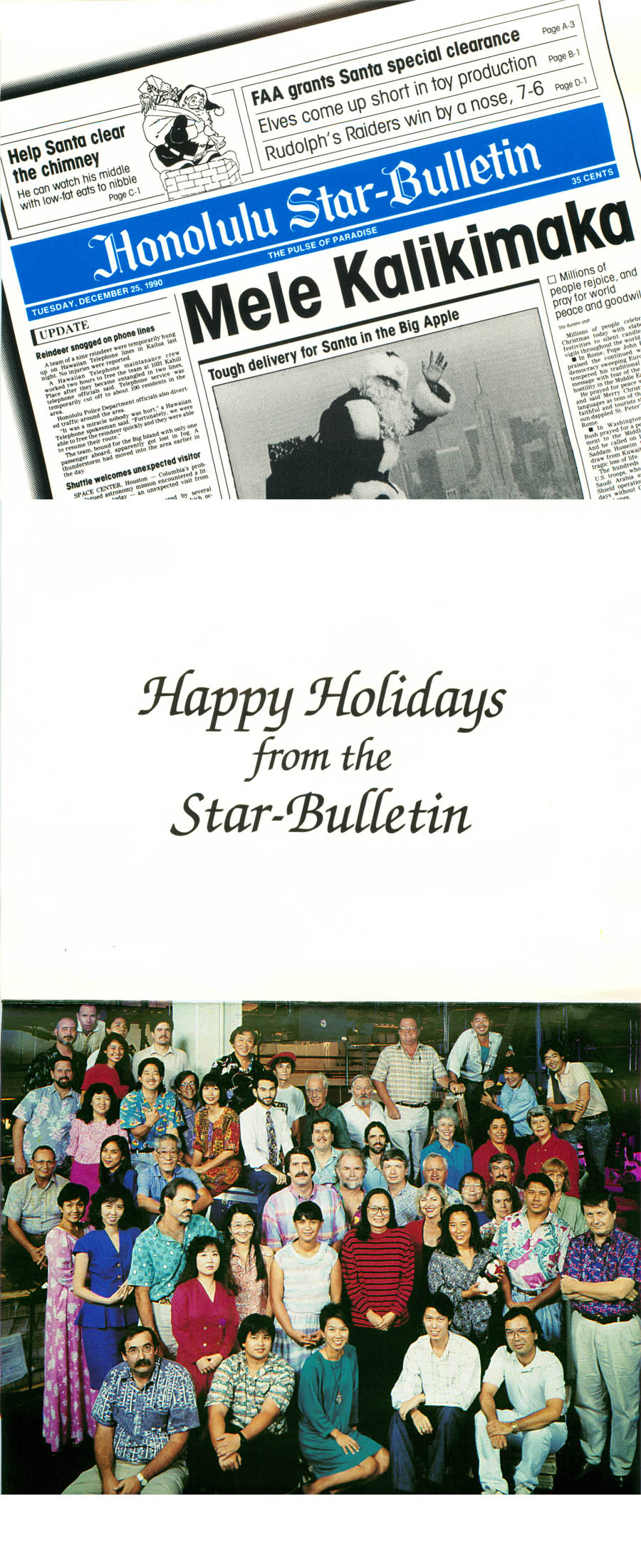
This is one for you media buffs…the Honolulu Star-Bulletin’s 1990 Christmas card, complete with a staff photo.
And how young they were!
Just click on the card to see a larger version.
Discover more from i L i n d
Subscribe to get the latest posts sent to your email.
Is that Jim Donnelly in the back? I don’t see Burl Burlingame in the photo nor you. The photo has clarity, which is surprising since it is not digital.
You should post this on Facebook at full size so we can “Tag” the people!
I believe it’s Dave Donnelly.
L-R (Row 1) Moi, Rick Daysog, Becky Ashizawa, Benjamin Seto, David Oshiro (Row 2) Nadine Kam, Marilyn Ige, Crystal Kua, Arlene Lum, Linda Hosek, Moon-Yun Choi, Susan Manuel, Pat Omandam, John Simonds (Row 3) Catherine Kekoa Enomoto, Lucy Young-Oda, Greg Ambrose, Dick Hartnett, Tim Ryan, John Flanagan, Harold Morse, Mary Adamski, Richard Borreca, Jackie Aweau (Row 4) Carl Zimmerman, Ruby Mata-Viti, Oscar Kuwahara, Steve Petranik, Mark Coleman, Helen Altonn, Trinidad Peltier, Lois Taylor (Row 5) Jim Sylvester, Betty Shimabukuro, Nora Keller, Btyant Fukutomi, Kevin Hand, Tessie Resurrection, Mike Rovner, Phil Mayer, Dave Donnelly (Top row) Burl Burlingame, Jerry Tune, Patrick Chu, Steve Waite, Terry Luke, Hildegaard Verploegen, Russ Lynch, Craig Kojima, Ken Ige, Dean Sensui
Loved those people, that newsroom and my hair.
I didn’t recognize some (not counting those who left before I arrived), so thanks, Dave, for filling in the blanks.
Rovner’s apparently auditioning to be the cover model for a romance novel, as the handsome but coal-hearted villain. “Hello, there, my pet. Let me whisk you away, seduce you, then steal your inheritance.”
Those were the days … um, I guess….
I once went to the state library downtown. Afterward, walking back to Ala Moana Center, I was passing the Honolulu Advertiser building when suddenly I really, really had to go to the bathroom. I walked into the building and the secretary there greeted me with a very warm and musical “Hellooooo!!!” I told her my problem, and she took my book bag and told me to go down the hall to the bathroom. But first I would have to pass through a metal detector. Wow. I walked through the detector to the bathroom, and everyone I encountered had a big smile for me and a “Hello!” I was great. But it was also disconcerting. In a sense, the metal detector for me was the elephant in the building, telling all who pass through it that this embodiment of distrustfulness is the future of journalism. The people there did not seem to get the wake-up call.
So when one sees a photo like this, it’s sad, like seeing a high school photo of German, British or French kids just before World War One. They don’t seem to see what is on the horizon. I think that this sort of fatal optimism is compounded in Hawaii’s journalistic circles by things like the benign tropical climate, the geographic insularity, the socialable and topical nature of journalism, “Hawaii’s small town cultural style” (as you put it) and an educational system that is so broken that it’s graduates don’t realize just how bad it is.
This is what I was thinking when I saw today’s entry on openness in Hawaii’s government. That would be the concern of a journalist naturally. However, why would that be on the mind of some ordinary citizen in this society? It should be a concern for everyone, but it’s the last thing on people’s minds out here. In fact, I am not sure that the average journalist out here really worries about openness in government the way they would in other societies.
The name of the game in a small town in the middle of nowhere would be to get a job with as big an organization as possible in order to gain a certain measure of security. But if that no longer seems to hold true, if the largest corporations no longer offered any security, even for their highest officers, the population of a small town would either panic or enter denial in the face of this weird new reality. So there might be a push for big projects as a new source of security. The kind of prudence and caution that people would show in their own lives in a very limited economy would not extend to their expectations of government, which they would see as an indestructible source of new jobs. The reality that municipal and state governments can go bankrupt and their emergency services terminated (police, fire) would be inconceivable. This is a new reality that the US has faced for several years. But perhaps it just takes a little longer for that new reality to sink in out here in modern Polynesia. It will take a couple more years for people to realize that unrealistic big projects will only make the society less secure.
But I don’t think that Dan Inouye knows that, which is odd, because he physically and spatially lives in the heart of Mount Doom. But mentally and temporally, he lives in 1957.
Here’s an article on how a major county in the US has gone into bankruptcy.
http://www.nytimes.com/2012/02/19/business/jefferson-county-ala-falls-off-the-bankruptcy-cliff.html
By the way, I wrote “But I don’t think that Dan Inouye knows that, which is odd, because he physically and spatially lives in the heart of Mount Doom.”
By that I meant to say that Inouye lived in the focal point of power in the world, yet he seems unfamiliar with the basic realities of county and state governance. He seems to be really out of it.
I always felt that the most dangerous man in Hawaii was Dave Donelley. Yup, Dave Donnelley. In fact, at one time I made a brief character study of the man (or at least looked at articles about him on the Internet). Genial and smart, he was too happy and sociable for the good of Hawaii. His column typically read like “So we started out the evening with drinks at Duke’s, where we bumped into Fred and Wilma. Then the five of us moseyed on over to the Ilikai for dinner (without reservations), where we pumped into Fred and Wilma’s old neighbors from Kailua, Barney and Betty Rubble. Then we went to a night club…” etc., etc. …. That’s not a column about island life, that’s tourism. He was a permanent tourist. His outlook might have been a product of the long boom years when All Was Good. In contrast, Lee Cataluna lives in California off and on, but she really nails local life, the good and the bad. Donnelley seemed to live in a bubble, and that kind of attitude of complacency does have an effect.
Speaking of the good old bad old days, there has been quite a bit of commentary on this blog about how Abercrombie has replaced key members of his team with some of the old guard. I don’t have such a problem with many of the old guard when they consist of George Ariyoshi or Dan Inouye or Ben Cayetano. I don’t necessarily agree with them, and I don’t even know of anyone who really approves of them at this point. They are dinosaurs. But they had (and have) talent and a certain measure of honor. In contrast, here is a description of Abercrombie’s new Chief of Staff:
This in a way reminds me of the photographic feature in the Star Advertiser, the Pulse. It is basically a gallery of mediocre photographs of young, relatively uneducated people wearing expensive clothing and drinking Absolut vodka. In the past, reading about a night on the town would be a relatively elitist affair, with Dave Donnelley articulately recounting his mild indulgences in food, wine and conversation among middle-aged white people who had good jobs and who spend their free time watching PBS. Yes, that was complacent, and dangerously so. But now it’s so much worse. It’s no wonder Lee Cataluna moved to California.
How do developments in the news industry reflect both easily anticipated trends and unexpected events? How is this reflected in Hawaii? These are questions for Ian Lind and his peers, but I’ll take an amateur’s stab at it.
The World Wide Web was launched in 1995, around 17 years ago. A reasonably bright child could foretell at the time what this would mean for journalism: massive consolidation. Does the AP or Reuters or the NYTimes really need a journalist in Seattle when they can just get their info from the Seattle Post-Intelligencer? (Or even just glean information from other news sources?) In fact, does the Seattle PI have a future? The PI became an online only news source in 2009.
http://en.wikipedia.org/wiki/Seattle_Post-Intelligencer
Something like that has happened in Hawaii, only it was the smaller newspaper that bought out the larger one. That is a very odd turn of events, and it might illustrate both the power and desperation of a Canadian news cartel to salvage its past investment, as well as the prescience of the larger newspaper’s owner (the writing was on the wall). This anomaly does not contradict the trend toward consolidation, however. In fact, it could be that the exception in Hawaii proves the rule elsewhere: That consolidation will be even worse in the future than it has been so far. All regional newspapers, and perhaps even elite newspapers might become online-only publications, and sooner rather than later. A lot of people says this already, but this might happen really soon.
Another trend is advertising forums, like the local Penny Saver. It was always pretty obvious that something like eBay would come along and gut that. But now, unexpectedly, there is craigslist, which is a non-profit international sales forum. That’s the anomaly that reveals how inexpensive it is to put that sort of thing online.
But the double anomaly is that one of the founders of eBay lives in Hawaii and created a non-profit online public affairs newspaper run on a shoestring (as a tax write-off?). The triple anomaly is that the best educated and most vocal members of the public now seem to avoid the printed news daily because it is supposedly really awful, and they read Civil Beat.
What does this triple anomaly mean for the future of journalism if it is the exception that proves the rule? Something like CB could be the face of future journalism — but not in it’s non-profit status. Rather, it’s the demographics of CB that might reflect the future. Journalism will be something reporters will do after college in their 20s and 30s before they move on to public relations — kind of like a low-paying internship for public relations jobs. In fact, in the future some reporters might not get paid at all, and will have the status of unpaid interns, a problem of sorts at the Huffington Post. (And in the more-distant future, reporters might have to actually pay to publish, which is what is happening with internships, where now increasingly it is interns who pay to work, so that only rich kids can be interns.) Of course, if this is true, this means that reporters will have to play nice with members of the status quo because the reporters will later be applying for jobs with this elite.
Makes one yearn for the good old bad old days, doesn’t it?
http://www.youtube.com/watch?v=__1EtK0d8rg