
I’ve been frustrating by reporting on the recent riot in the Maui Community Correctional Center. Virtually all the descriptions of the incident and its causes have come from the Department of Public Safety, either through statements by administrators or their public affairs staff. This limited sourcing leaves the public without a full picture of what led to what Public Safety officials refer to as a “disturbance” and what inmates call a “riot.”
Melissa Tanji, staff writer for the Maui News, is my favorite reporter this week. She was the first to report on how two inmates experienced the situation and their views of the causes. She was able to write her piece based on reports from two inmates and family members of others. She deserves credit for leading the way on this.
Her story (“Inmate: Broken phones a starter for ‘riot’ at jail/Smoke-filled modules, locked cells, flames to the ceiling at MCCC“) appeared in the Maui News on Tuesday.
A discussion between staff and inmates at Maui Community Correctional Center over broken phones in the module, combined with “unstable, inhumane conditions and unconstitutional living conditions,” spurred what two inmates described as a “riot” last week at the Wailuku jail.
The inmates and other inmates’ family and friends said those caught up in the incident encompassing two modules that held pretrial detainees feared for their lives. They were trapped in smoke-filled modules with the cell doors locked.
They also say that inmates have been put back into the damaged Module B, in which most toilets are broken and there is no water to wash their hands.
I know from experience just how important it is to hear from the inmates in these situations.
Back in December 1981, Meda and I were both teaching classes for Honolulu Community College at the Oahu Community Correctional Center when a shakedown closed the facility to the public for several days. The administration gave a rosy view of the operation, carried out by police, prison guards from OCCC and the Halawa high security prison, and national guard troops, and saying everything went smoothly, some weapons and drugs were found, and rumored future disturbances interrupted.
But we began hearing a different story from families who were hearing from their incarcerated family members. We heard stories of some inmates being beaten by guards brought in from Halawa, and other sorts of abuses. Within days, we were able to compile a list of inmates who were thought to have been injured, and shared that with officials, up to the governor. The department continued their denials.
Here’s a news story in the wake of the shakedown. Click on the article to see a larger version.
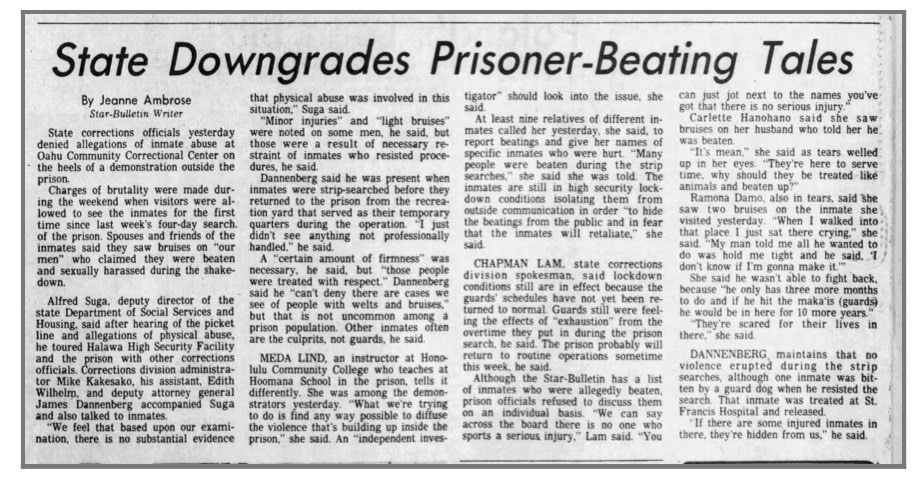
But an investigation by the Office of the Ombudsman confirmed many of the details drawn from inmates’ stories, and was followed by a major special investigation conducted by the Senate Judiciary Committee, then headed by Big Island Senator Dante Carpenter. The investigation again found support for allegations that several key officials were present during the shakedown and apparently condoned the beating of some inmates. Interestingly, I understand that most of the record compiled during that Senate investigation and its lengthy hearings remains secret and has never been publicly disclosed.
In any case, there’s one clear lesson. When administrators of a total institution like a prison paint a rosy picture and deny any serious problems, it’s time to look for additional sources.
Discover more from i L i n d
Subscribe to get the latest posts sent to your email.