
Today marks the 52nd anniversary of the 1968 call-up to active duty of about 4,600 members of the Hawaii Army Reserve and Hawaii Army National Guard, who were assigned to the newly formed 29th Infantry Brigade
On May 13, 1968, the men reported to Fort DeRussy in Waikiki for transport to Schofield Barracks to begin their 19-mohths of active duty service. A group of several dozen peace activists gathered along Kalia Road in Waikiki as a convoy carrying guardsman approached the Army induction center at DeRussy. Then about 20 activists stepped off the sidewalk and sat down in the street, blocking traffic.
Police armed with tear gas stood by while other officers dragged protesters out of the street.
The activation of the Hawaii guard took place as the U.S. war in Vietnam was escalating, and during rising international tensions months after North Korea attacked and seized an American intelligence ship, the U.S.S. Pueblo, and its crew off the North Korean coast.
Several days later, ten people were later arrested and charged with loitering. They were: Jim Douglass, assistant professor of religion at the, along with Dot Buck, Steve Carter, Wayne Hayashi, Pat Higa, Stan Masui, Barry Nakamura, Nick Reidy, Bill Smith, and John Witeck.
All were found guilty in a July 1968 trial in Honolulu District Court. Douglass was sentenced to 15 days in Halawa Jail, while the other nine were fined $25 each. However, two men–Hayashi and Reidy–chose jail rather than pay the fine. Each served five days.
Douglass and Hayashi both denied loitering aimlessly or without purpose.
Hayashi told the judge:
In committing civil disobedience, which is part of my commitment to peace, I am quite willing to accept the consequences for my act of love in direct, non-violent action.
Douglass also made a statement.
We were resisting–resisting the slavery and murder of the draft, resisting the war whose inhumanity increases daily, and resisting the fear of young men who question the war but feel compelled to kill in obedience to a national system and a local community which support no alternative.
There was widespread opposition to the activation of the Hawaii guard and reserves.
U.S. Senator Hiram Fong publicly called the call-up unfair to Hawaii.
“Fong noted that on a percentage basis Hawaii should have had to contribute 89 men in the callup, but instead Hawaii is contributing more tha 17 per cent of the total reserve callup,” Associated Press reported.
And the army reported in late 1968 that 1,500 of the 4,600 members of the 29th Brigade had signed a petition seeking to have the unit deactivated.
At least two of those behind the petition later rose to prominence. Henry Peters, then a 27-year old from Waianae serving as a cook in the 29th Brigade, said he was one of 11 men who organized and circulated the petition. Peters later was elected to the state legislature, where he served as Speaker of the House from 1981-1986.
Another who worked on the petition was the late attorney David Schutter, who later earned a reputation (and a small fortune) as a high-powered lawyer with a successful law firm and several other businesses, as well as a multi-million dollar home in Kahala.
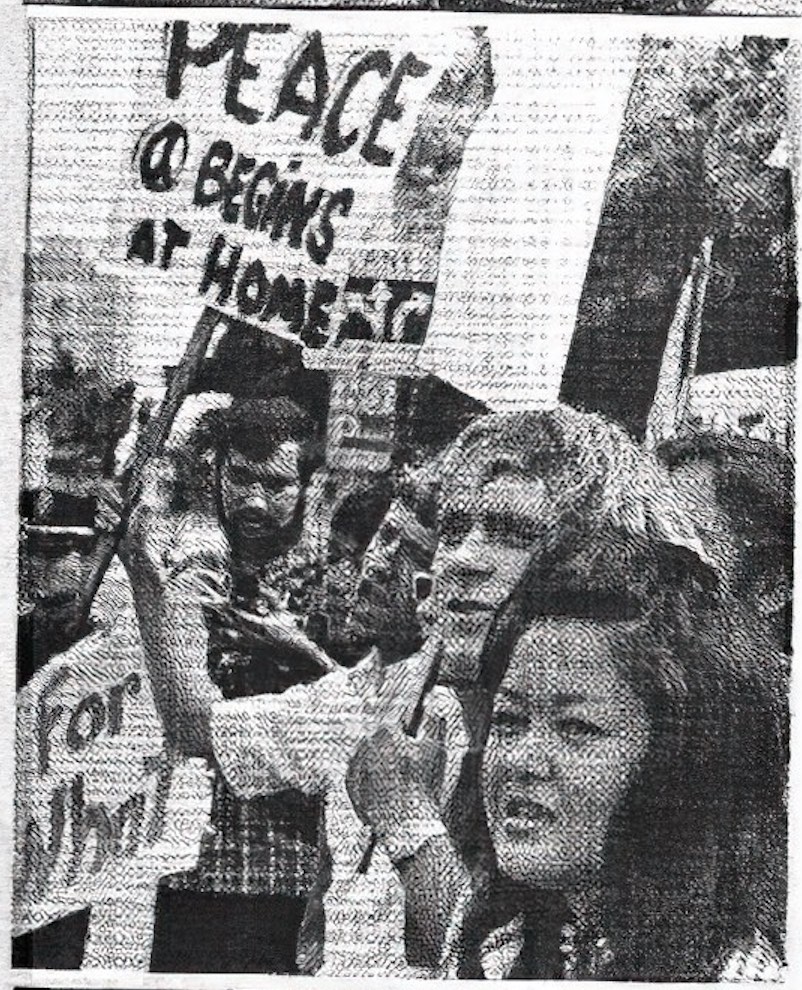 A local “underground” publication, The Roach, reported the sit-in and included several photographs. I appear in one of the photos (I’m the guy with the beard looking down at my camera–click to see a larger version).

I’ve gathered several of my photos from that long ago day in May. Just click below to view them.

Discover more from i L i n d
Subscribe to get the latest posts sent to your email.
Great photos of many old friends Ian. Mahalo for sharing.
Jim
I was attending UH at the time after spending a year in Vietnam. What ever happened to Wayne Hayashi? I heard him speak at a rally at Andrew’s.
I remember that day quite well. I went to work for David Schutter in the early 1970s and stayed for 10 years. His friendship with Henry Peters was more of a curse than a blessing I am afraid. For all of his success and fortune he made during his life time- the Kahala mansion, the Rolls Royce- and he was faster on his feet in a court room than anyone I have ever seen with a photographic memory-he sadly died penniless and his 2 sons from his last marriage went to prison for a series of armed robberies and drug deals in Aspen Colorado. Henry Peters was removed as a corrupt trustee from Bishop Estate in one of the largest political scandals in State History. What profit a man……
I was there that day too.
Thanks, Ian. Was great to be reminded of that. I shared it with Stan Masui and Jim Douglass as well….and will do so with Ko Hayashi as well. Aloha, John