
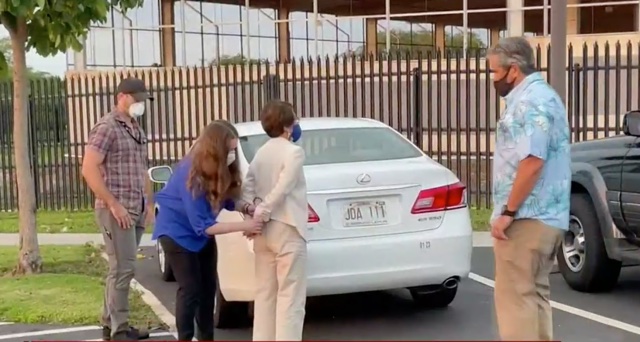
 The image broadcast by Hawaii News Now last night is stunning, showing attorney and former Honolulu Corporation Counsel Donna Leong, at one time the city’s top lawyer, being handcuffed while standing behind her white Lexus.
But the indictment naming Leong, former Honolulu managing director Roy Amemiya, and former Police Commission chairman, which had remained under seal for nearly a month since it was handed down by a federal grand jury on December 16, is a letdown for anyone hoping it might signal the culmination of the years-long federal investigation of local corruption and would finally pierce the veil of secrecy that hides the behind-the-scenes shenanigans within the upper reaches of city and state politics.
This indictment hits central but peripheral players in the political game, it seems to me, on charges akin to taking down the famous mobster, Al Capone, on tax evasion charges.
The government says the three were involved in secretly negotiating and, more importantly, concealing the souce of funding for a $250,000 severance payout to then Chief of Police Louis Kealoha, apparently as an inducement for the chief to “voluntarily” retire at a time when he was already known to be under federal investigation.
According to the indictment, the law requires City Council approval for an expense of this amount, and the government says Leong, Amemiya, and Sword all took part in concealing the payment from the council by twisting arms as well as manipulating internal procedures to initially take the money out of HPD’s budget, over the department’s objections, and then replenish the budget by instructing HPD to request additional funds from an account dedicated to filling vacant positions.
In the normal course of affairs, this might have simply been an instance of insider political hardball. But under the microscope of ongoing federal scrutiny, it checks off all the boxes to be considered an illegal theft of public funds. Potentially a criminal offense, and a felony at that, punishable by up to five years in federal custody.
In the indictment’s recitation of “overt acts” taken in furtherance of the conspiracy, it appears Leong and Sword did the heavy lifting, negotiating the deal with Kealoha’s attorney and then spending months pressing HPD to go along with their narrative regarding the source of funds, even after Kealoha had been paid and the check cleared. Amemiya, even in the government’s telling, enters the tale months later when he was sent to pressure HPD’s representative to avoid mentioning the Kealoha payment when appearing before the council to request additional funds to cover the budget shortfall.
The charge against all three is conspiracy in violation of 18 USC § 371.
If two or more persons conspire either to commit any offense against the United States, or to defraud the United States, or any agency thereof in any manner or for any purpose, and one or more of such persons do any act to effect the object of the conspiracy, each shall be fined under this title or imprisoned not more than five years, or both.
The government alleges the offense that the three conspired commit, bypassing the legally required City Council review of the Kealoha payout and threatening or cajoling others to go along with their scheme, was a violation of 18 USC § 666(a)(1)(A).
(a) Whoever, if the circumstance described in subsection (b) of this section exists—
(1) being an agent of an organization, or of a State, local, or Indian tribal government, or any agency thereof—
(A) embezzles, steals, obtains by fraud, or otherwise without authority knowingly converts to the use of any person other than the rightful owner or intentionally misapplies, property that—
(i) is valued at $5,000 or more, and
(ii) is owned by, or is under the care, custody, or control of such organization, government, or agency;
…shall be fined under this title, imprisoned not more than 10 years, or both.
(b) The circumstance referred to in subsection (a) of this section is that the organization, government, or agency receives, in any one year period, benefits in excess of $10,000 under a Federal program involving a grant, contract, subsidy, loan, guarantee, insurance, or other form of Federal assistance.
(c) This section does not apply to bona fide salary, wages, fees, or other compensation paid, or expenses paid or reimbursed, in the usual course of business.
The government further alleges that their agreed upon plan to bypass City Council review “by materially false and fraudulent pretenses, representations, promises, and omissions of material facts,” resulted in a payment to Kealoha that was routed by the city and its bank was in violation of 18 USC § 1343, a provision relating to wire fraud.
Whoever, having devised or intending to devise any scheme or artifice to defraud, or for obtaining money or property by means of false or fraudulent pretenses, representations, or promises, transmits or causes to be transmitted by means of wire, radio, or television communication in interstate or foreign commerce, any writings, signs, signals, pictures, or sounds for the purpose of executing such scheme or artifice, shall be fined under this title or imprisoned not more than 20 years, or both. If the violation occurs in relation to, or involving any benefit authorized, transported, transmitted, transferred, disbursed, or paid in connection with, a presidentially declared major disaster or emergency (as those terms are defined in section 102 of the Robert T. Stafford Disaster Relief and Emergency Assistance Act (42 U.S.C. 5122)), or affects a financial institution, such person shall be fined not more than $1,000,000 or imprisoned not more than 30 years, or both.
Although the conspiracy charge makes reference to the other two statutes, each of which have far harsher maximum sentences, none of the defendants is directly charged with those offenses.
Understanding how that works, or what it might signal, is something for others to interpret.
And here’s the key unanswered question at this point. If the payment to Kealoha would have been legal had it been reviewed and approved by the City Council, why did these three representatives of the Caldwell administration work so hard to avoid letting the matter be taken before the council?
Sword’s attorney, Bill McCorriston, told Hawaii News Now “said the former police commission chair was simply following the legal advice from Leong’s office and the recommendations of the administration.”
Indictment: USA v. Donna Yu… by Ian Lind
Discover more from i L i n d
Subscribe to get the latest posts sent to your email.
Drain the swamp!
https://www.pritchettcartoons.com/city-swamp.htm
Perfect!
At the time, we were screaming at the television, saying ” If you give them $250,000 and expect it to be paid back if indicted, judging by their lavish habits, they will have spent it all by then” CRAZY Now we know a bit more of why. My question now is, Why did they do something so illegal? What did Kealoha have on them that they had to take the risk? Or was it just brazen criminality?
Total, unchecked hubris. Never liked Sword ever since the breaking of the entire Kealoha drama. Good guy or not, he just came across as SLIMY. I was proven correct.
Waiting for all trails leading to Caldwell to be exposed and him being knocked off his high horse (and gubernatorial run, hopefully).
Does this mean Calvin Say’s “show up only” so-called job on his council staff for Amemiya (in order to collect full retirement bennies on taxpayers’ dime) will be null and void soon?
Sword looks even MORE guilty through all this because of former police commissioner Sheehan’s “NO” vote on the Kealoha bailout and her rationale behind it.
Leong just an unscrupulous operator. No integrity or an ounce of ethics.
The “nine bananas” on the city council? More like nine clowns, but whatever.
I seriously doubt that any of these characters come to the Federal Court with “clean hands”.
The journalism on this matter has been horrendous and does not serve the public interest. It’s one thing to report the details of government actions and dutifully seek out comments and reactions on both sides. It’s quite another to illuminate the real implications of the documents and events, the background and the possible benefits or motives involved. Issues that demand clarity in this case are: Why would the public figures commit the alleged crimes, what did the individuals possibly have to benefit in terms of financial gain and/or political advantage, and to what extent are elected officials responsible. I know most of your readers are probably relatively well informed on the Kealoha case, for example, but there is no excuse for the mainstream news outlets to totally skirt over the essential details, background and implications of nearly every story they post on this and other local political and criminal matters. We shouldn’t have to wade through opinion columns, letters to the editor, unreliable social media and the legalese of official documents to figure out what’s really going on in this community.
“. . . why did these three representatives of the Caldwell administration work so hard to avoid letting the matter be taken before the council?”
My guess is someone thought the council wouldn’t approve the payment. At the time, there was quite a lot of friction between the council and the administration.
Maybe but what would be so bad about that. Anyone who complained to the mayor that Kealoha was still on unpaid (or even paid) leave, he could simply blame council. He had a chance to put Ernie Martin into a no win decision and instead committed a felony to make the widely unpopular decision. I think Louis had something on Caldwell all along, it would explain why the mayor was silent when the mailbox story first broke.
Personally I opposed the payout, and I think council disapproval would have been the right thing for them to do, even with the risk of a lawsuit (and I remember well the lawsuits the Kealohas brought on the Honolulu Ethics Commission and Chuck Totto personally). Remember, however, that Ernie Martin was not chair in Jan. 2017. Ron Menor was slated to take that position when a resolution calling for a change in council officers was introduced the beginning of Dec. 2016.
As for Caldwell, it’s all speculation at this point. I think it’s also worth noting that the mayor had (and still has) no direct say over the police chief.
I know what you mean. It looks like these guys were deeply involved but weren’t running the show. They served the public interest in getting Louis Kealoha to retire. The expenditure of $250,000 may have been worth it. But who, if anyone, directed them to avoid the City Council at all costs, even if they had to break the law to do so? And why?
Of course under our legal system the accused must be considered innocent until proven guilty. How much more so their unindicted and unmentioned co-conspirator(s)! Whom I wouldn’t, however, go so far as to vote for in the meantime.
And the answer may be as simple as what suggested.
… as what Natalie suggested.
Where’s the beef (Keith Kaneshiro)?
What seems simple, like Capone Tax Evasion, is much more ominous when looking at the big picture.
Are these three odd yuppie’s willing to face prison to maintain old loyalties to Mayor Kirk or RAT UP? This case is a simple easy conviction, 101# for Dummies.
Once, one puzzle piece fits, it ensnares the entire, City Hall Scheme…Humpty Dumpty, RAIL, Mufi AND ALL.
Is it just me or is something missing here? Shall we say, in the form of someone ultimately responsible for policy and management decisions by the City and County of Honolulu elected by the people? Was there a Mayor then? Gosh who was it? You know, the elected official the people depend on and vote into office who is supposed to oversee policy decisions and have a sign on the desk that says, “The buck stops here.” Are they all going to fold up, make deals and fall on their swords for Mr. C? Will he offer to testify for all of them? Our former mayor doesn’t seem to believe in the same management style. Will it be the same philosophy when everyone elects him governor?
The purpose is to get one or more to rat out Caldwell.
See today’s newspaper asking Caldwell to respond to the indictments. Instead of saying something himself, da Mayor lets his attorney Lex Smith respond for him. “Ms. Leong, Mr. Sword and Mr. Amemiya have significant experience in public service and the private sector. The city hired them based on that experience.”
That sure sounds likes Caldwell reciting the old Mission Impossible TV signature line,
“As always, should you or any of your IM Force be caught or killed, the Secretary will disavow any knowledge of your actions.”
So true! Thanks for the laugh and reminder of a good old show.
It should be noted that Leong is also accused of lying to federal agents about the alleged conspiracy. If true, that’s pretty shocking and further demonstrates the extent to which the machinations were deliberately hidden.
Why go that route? It’s obvious that there was great concern the City Council would not approve the expenditure. That’s clear as day.
The more important question is why the payout was considered necessary at all, let alone such a priority that people went to such links to orchestrate it.
And the elephant in the room is named Kirk. Either he had no idea that all this was happening, which is simply implausible but if true demonstrates that he’s even more of a sock puppet that so many already assume, or far more likely he had full knowledge of and perhaps even directed these events. Hard to say which is worse.
If any of these three is in a position to implicate the former mayor, it seems they have refused to do so. That can always change now that stuff’s getting real. And maybe that’s the larger goal here: to fry a bigger fish, perhaps for something we don’t yet know about. But that’s just speculation.
At any rate, that loud POOF you heard yesterday was Kirk’s chance of ever being elected governor evaporating with a quickness. Even if these three are somehow completely exonerated long before the election, he was already damaged goods for so many other reasons and these indictments were the political coup de grace. There can be no reanimation. Whether that’s fair or not is beside the point.
It’s interesting to note that some participants in the alleged conversations and machinations were NOT indicted, especially the former Budget and Fiscal Services director who is repeatedly mentioned in the indictment. It certainly seems that some folks were much more forthcoming with the feds than others.
And it’s quite admirable that the former HPD acting chief refused to go along with any of this, even after allegedly being warned that he was burning his bridges. It takes guts to stand up to an abuse of power and threats of repercussions.
Here’s something else to consider: Would the city’s former prosecutor ever have taken action in this case? And will he be the next one indicted? There’s plenty of writing on THAT wall.
Someday the mailbox will turn up and be one hell of a conversation piece.
The mailbox did turn up. See: https://www.pritchettcartoons.com/kealoha-mailbox.htm
@Shakedown: Nice summation. I agree, if Krook had small to no chance against Green before all this, his goose is definitely cooked now. I hope he fries (if he’s guilty of anything, that is).