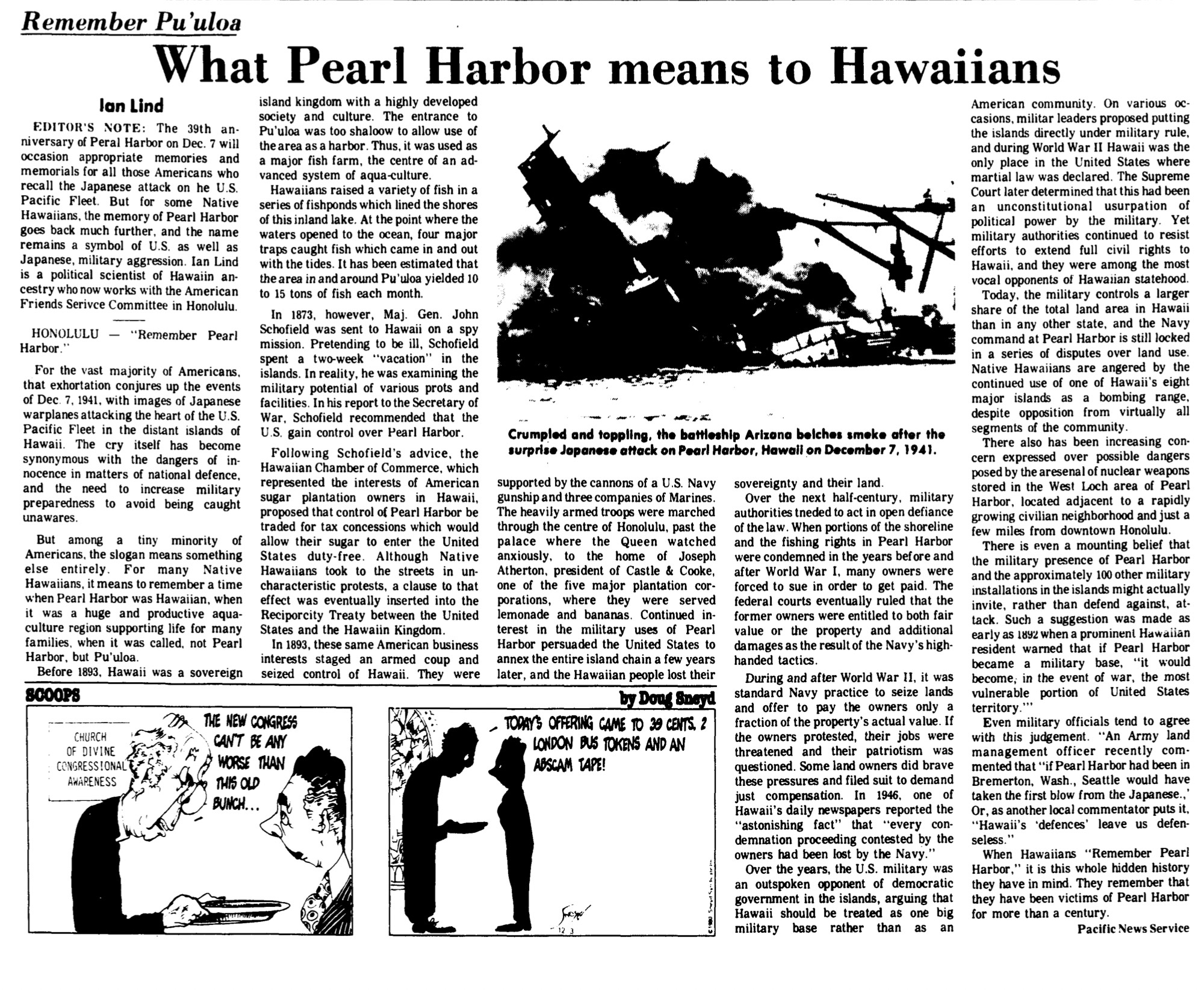
Back before I became a reporter, I wrote a few columns for Pacific News Service.
And this past weekend, I found this one published in December 1980 when, if I recall correctly, I was in one of my periods “between paying jobs.”
I’ll let the piece speak for itself, rather than trying to reinterpret through a 21st century gaze.
If writing this today, I would likely try to be more nuanced in my summary of Hawaii’s history. And such rewrite would obviously benefit from our new knowledge of the Navy’s administrative and political failures leading to the leaking fuel tanks under Red Hill that now threaten a large part of Oahu’s water supply, and a new public appreciation of the threats posed by some routine Department of Defense activities.
In any case, read on. Just click on the article to read a larger version.
Discover more from i L i n d
Subscribe to get the latest posts sent to your email.
Thanks Ian. Would like to use the aquaculture side of the story for my monthly column SPLASH in Hawaii Fishing News. Enjoy the investigation of the syndicate in Hawaii.
US Gov lies, cheats, coerces and finally just takes what it wants from native peoples and even non native citizens (through “eminent domain”).
US Gov pushes the oft repeated, hollow worded fairy tale of “Rule of Law” because it benefits the moneyed, lawyered up class with the guns (aka Police) and packed courts backing and enforcing what they want.
US Gov sells the myth of being a “democratic” system where every vote counts and everyone has a voice and then uses such broken down, archaic methods like an “electoral college”, gerrymandering and senators with equal power to disrupt despite being from states with comparatively minuscule populations, thereby denying the voices of millions.
“United State of America….making sure the dwindling WASP population holds onto all levers of power over the majority since 1776”
this should run every year! so many still do not know the history. mahalo, ian.
Truly a jewel! Native Hawaiians have a right to be angry.
Good article! Timely when it was written as is now. Thanks for reminding us and sharing it (I saved it if you don’t mind). A copy should be sent to each member of the House and Senate.
It’s an interesting read and makes some great points but I really cringe every time I see someone assert that “Hawaiians feel” or “ Hawaiians believe,” as if there were a monolithic and homogeneous entity that the person making the assertion can speak for, especially since most “Hawaiians” are actually one-half or less Hawaiian and there’s considerable disagreement over if and where any line should be drawn.
One size does not fit all, and that goes for any ethnicity or background despite humanity’s penchant for grouping, labeling, and ascribing presumptions.
What’s wrong with saying “many people of Hawaiian ancestry say they believe” whatever is being asserted? That’s usually the case, and in many instances it would also be accurate to add “and many other people from Hawaii.”
These days, oversimplified assertions are frequently made regarding Mauna Kea and other subjects. Are Hawaiians who don’t agree with some popular assertion suddenly not Hawaiian or not worthy of having a view? I doubt that’s ever the intent, but would it be accurate to similarly say, for example, “Black/White/Brown people believe x, y, or z” as if there were presumed uniformity of belief? In 2022?
Just something to think about.
I wholly agree.
Great recollection, Ian. And a decade after your piece on Pearl Harbor, Pat Tummins at Environment Hawai`i reported (among much else) that the National Campaign Against Toxic Hazards said that, thanks to the US Navy, “the Pearl City Peninsula was one of the most hazardous areas in the country. . .sufficiently dangerous to be placed on the Superfund list” with an EPA ranking that bore comparison with Love Canal in Niagara Falls, “one of the most infamous toxic waste sites in the country.” So much for those pristine Hawaiian fishponds and “advanced system of aquaculture” a century earlier.
““the Pearl City Peninsula was one of the most hazardous areas in the country”
And now site of many housing units affected by the fuel intrusion into the water system.