
Interesting to note that Kalani English and Ty Cullen are not charged with bribery, a state offense found at Section 710-1040 Hawaii Revised Statutes. Bribery is a Class B felony punishable by a maximum of 10 years in state prison.
PART IV. BRIBERY
§710-1040 Bribery. (1) A person commits the offense of bribery if:
(a) The person confers, or offers or agrees to confer, directly or indirectly, any pecuniary benefit upon a public servant with the intent to influence the public servant’s vote, opinion, judgment, exercise of discretion, or other action in the public servant’s official capacity; or
(b) While a public servant, the person solicits, accepts, or agrees to accept, directly or indirectly, any pecuniary benefit with the intent that the person’s vote, opinion, judgment, exercise of discretion, or other action as a public servant will thereby be influenced.
(2) It is a defense to a prosecution under subsection (1) that the accused conferred or agreed to confer the pecuniary benefit as a result of extortion or coercion.
(3) For purposes of this section, “public servant” includes in addition to persons who occupy the position of public servant as defined in section [710-1000], persons who have been elected, appointed, or designated to become a public servant although not yet occupying that position.
(4) Bribery is a class B felony. A person convicted of violating this section, notwithstanding any law to the contrary, shall not be eligible for a deferred acceptance of guilty plea or nolo contendere plea under chapter 853. [L 1972, c 9, pt of §1; gen ch 1993; am L 2006, c 230, §47]
But English and Cullen are instead charged with “Honest Services Wire Fraud,” a federal crime, with stiffer penalties.
What is “Honest Services Wire Fraud”?
This is an excerpt from a 2010 article in the Florida Bar Journal:
Honest services fraud, a form of federal mail and wire fraud, is the crime of defrauding citizens of the “intangible right of honest services.” Over the past four decades, the federal government has used the honest services theory of mail and wire fraud to successfully prosecute state and local public officials for a broad range of improper conduct, the most controversial of which is failure to disclose conflicts of interest.
This article provides a general overview of honest services fraud in the public sector. Despite the variety of conduct this theory encompasses, the common premise of public sector honest services cases is that the “the public is not getting what it deserves: honest, faithful, disinterested service from a public official.” Although many of these cases involve high-ranking government officials, public sector honest services charges have been brought against all types and levels of governmental and quasi-governmental personnel.
This is from the criminal information spelling out the charge against English. Cullen’s charge is similar, but taking place over the time period 2014-2021.
Honest Services Wire Fraud (18 U.S.C. $$ 1343 and1346)
45. Beginning on a date unknown, but at least by January, 2015, and continuing to in or about January 2021, within the District of Hawaii, JAMIE KALANI ENGLISH, the defendant, did knowingly devise and intend to devise a scheme and artifice to defraud the citizens of the State of Hawaii of their right to
ENGLISH’s honest and faithful services as an elected legislator and Senate Majority Leader of the Hawaii State Senate, through bribery and concealment of material information.
In explaining the charge, prosecutors in both cases citing the Hawaii State Constitution to establish that public officials in Hawaii have an obligation to carry out their duties faithfully and honestly, and that the public rightfully expects them to display the highest standards of ethical conduct. Accepting envelopes of cash from an interested person to affect legislation would, on its face, conflict with these public responsibilities.
What will a jury have to find in order to convict these two former legislators?
Here are the model jury instructions used in the 9th circuit:
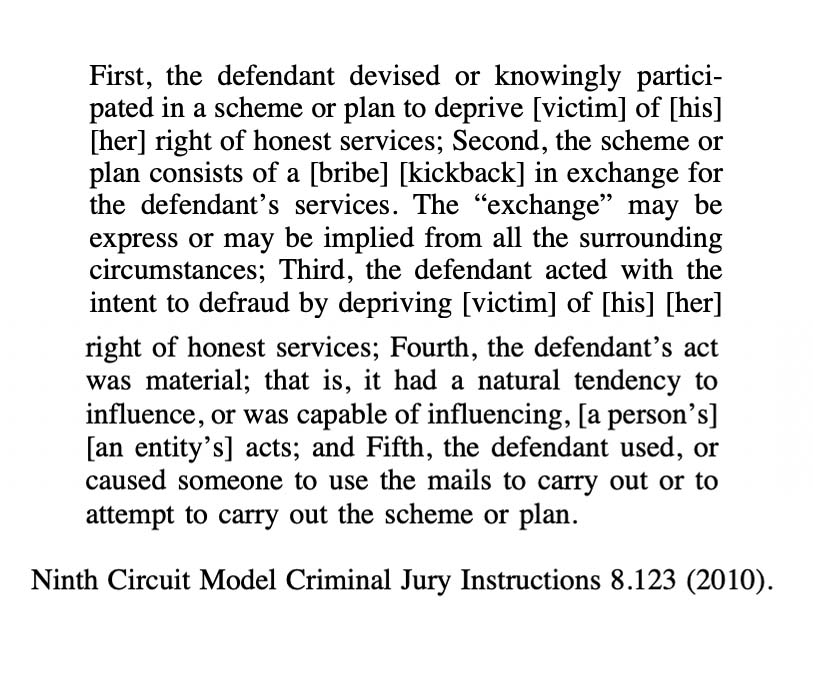
The victims in this case, according to the charges, are the citizens of the State of Hawaii who were deprived of these legislators’ honest services.
It would appear, again based on the allegations described in the charges, that prosecutors will have testimony by Milton Choy (Person A in the charges), as well as surveilance recordings of at least certain of the meetings where payoffs occurred, along with the failure to report these gifts on required gift disclosures, showing that the payments were being hidden with the intent to deceive the public and the State Ethics Commission.
And the maximum penalty if convicted in federal court of “honest services wire fraud” is 20 years, along with a fine of up to $250,000 and three years supervised release following completion of the prison sentence.
How do you spell, “T-O-A-S-T”?
Discover more from i L i n d
Subscribe to get the latest posts sent to your email.
T-O-A-S-T indeed!
Mahalo nui Ian –
Thank god it was classified as a Federal crime instead of a State one!! Al Capone style!! I guess there is a reason the FBI invested in such a nice new building in Kapolei….and I think its paid for itself already…at least intangibly so far in giving some hope to the people of Hawaii that someone is watching out for them …other than the historically braddah braddah stuff that’s been going on.
…..and isn’t the State free to charge all concerned with Bribery (under Section 710-1040, HRS) for the same behavior?
The State, attempted to convict Mayor Kenoi. failed miserable! It ended up looking more like a political vendetta!
Now, if English and Cullen make allegations against Governor Ige, then expect a rapidly filed State case.
Ian, thanks for making this clear. Seems to me that there is probably a lot more of this going on. Talk about the citizens being deprived of honest services, what about the rail!
Looks like our state will have to start from scratch to establish honest leadership! Maybe it’s not the homeless that need a clean sweep!
Apparently, the homeless are the least of our problems these days.
Fire everyone in that building from the top down. Have them reapply for their jobs.
T-O-A-S-T, sounds so good to eat after being on a Carbo restrictions. Prefer it smothered in butter with Bacon! Yum, yum.
Term Limits with a severe prohibition on lobbying for ten years after leaving office; also the Leg should leave Les Kondo alone- he’s probably one of the few honest public servants in that quagmire.
Totally agree. Let’s add campaign finance reform, i.e. public funding only. Maybe require every candidate in upcoming races takes a vow to support exclusively public financing of their campaign, eliminating PAC money, party money, & special interest money. A candidate becomes eligible to run after securing so many signatures & accepts public funding only. Any candidate refusing is ineligible to run.
Pie-in-the-sky, but a cause worth promoting.
Sylvia Luke was reported by KHON as the lawmaker receiving the most contributions from Milton Choy at $19,100 and is now giving away the money. According to Sylvia Luke, “We learned through the media and through the complaint what some of his priorities were and were very surprised,that it was cesspool legislation and another legislation.”
Sylvia was one of the co-sponsors of that Bill along with Ty Cullen! What is she trying to hide?
Signing on to become a co-sponsor of a bill does not mean that you are “in” on anything or that she has anything to hide. Based on my past experience from working at the capitol, staffers bring bills in bulk around and legislators have to read and decided to sign on in minutes to a bill. I would not leap to any presumptions about she or others that simply signed onto a bill.
HNN had a good story describing how English voted on a watered-down version of a bill that was passed last year and could allow him to keep his state pension even if convicted of a felony.
https://www.hawaiinewsnow.com/2022/02/14/embattled-sen-english-could-keep-pension-benefit-despite-new-public-corruption-law/
The original House version of the bill could have taken a convicted public employee’s entire pension. The bill was introduced about a week after English allegedly accepted his final bribe and was pulled over by the FBI in January of 2021.
The bill crossed over from the House to the Senate around three months later. The Senate quickly amended the bill so a convicted public employee could lose only half their pension.
But it appears that the change wouldn’t affect English either way, since the measure does not apply to felonies committed prior to the bill’s effective date of July 1, 2021. The House version had also originally specified that same date, so it’s hard to impute undue Senate meddling there.
But it sure would be interesting to know what kind of private conversations may have taken place among lawmakers about all this, and whether English — who held the powerful position of Senate Majority Leader — was an active discussion participant during the time in which he knew he was facing felony prosecution. And what about Cullen?
Does anybody now feel bamboozled?
Always!
Whenever I get sick and tired of corruption among so-called public servants, I take a drive to the Federal Detention Center and admire the view. Finally, a smile spreads across my face.