

Legislators have been invited to attend a legislative “Meet & Greet Reception” this evening sponsored by the Chamber of Commerce Hawaii. It is pitched to legislators as “an opportunity to meet with Hawaii’s business leaders.” The event is scheduled for Cafe Julia in downtown Honolulu starting with a cocktail reception at 5 pm.

Legislators are asked to register online for a $25 Legislator ticket “in order to be in compliance with the Ethics Committee….”
There’s nothing untoward or inappropriate about such meetings, but there is a question: Does this constitute lobbying? And do the costs to put on such an event have to be reported as lobbying expenditures in lobbyist disclosure reports required to be filed by the Chamber with the State Ethics Commission?
This appears to a regular Chamber event. In 2020, for example, it was held on January 16. I did a quick look at the lobbying expenditure report filed by the Chamber covering the January-February 2020. There do not appear to be any expenditures related to the event reported by the chamber, although the organization reported paying lobbyists $8,000 during the two-month period.
The state’s lobbyist law (Chapter 97 HRS) defines lobbying.
“Lobbying” means communicating directly or through an agent, or soliciting others to communicate, with any official in the legislative or executive branch, for the purpose of attempting to influence legislative or administrative action or a ballot issue. “Lobbying” shall not include the preparation and submission of a grant application pursuant to chapter 42F by a representative of a nonprofit organization.
The State Ethics Commission has previously advised that lobbying isn’t limited to occasions where specific legislation is discussed, but also includes more generalized “goodwill lobbying.”
The commission’s understanding was spelled out in a December 6, 2007 memo by then-Executive Director Dan Mollway.
When trade associations and others meet with lobbyists for the purpose of “getting to know” legislators or to develop rapport, this is considered “goodwill lobbying,” and would constitute lobbying under HRS section 97-1, since there is communication for the purpose of lobbying. The fact that specific legislative measures are not discussed does not mean that the meetings are not considered lobbying. If the purpose of the meeting is to develop a relationship with legislators, getting to know legislators, or establishing rapport with legislators, and the trade association, etc., will be lobbying, then such meetings with legislators constitute lobbying in accordance with chapter 97 and must be reported on the appropriate expenditures report for the appropriate lobbying reporting period.
In February 2015, Mollway’s successor as executive director, Les Kondo, presented the commission with a proposal to reconsider this guidance regarding goodwill lobbying, indicating that he believed prior opinions on this issue would be difficult to defend in the face of a legal challenge.
However, minutes of the February 18, 2015 commission meeting show the majority of the commission disagreed with Kondo’s assessment and felt the regulation of goodwill lobbying was correct and necessary.
Chair Broglio said that the Commission should not reinterpret the statute that was the basis for the Commission’s 2007 memorandum and that he felt the reporting of goodwill lobbying expenditures lends itself to more openness in government. Chair Broglio also said that there are ongoing matters, such as the marriage equality issue, where individuals meet with legislators when there are no bills before the legislature at that time, but may have pending legislation in the future.
Vice Chair O’Neal said that it seemed to be the Commission’s consensus that goodwill lobbying was lobbying. Vice Chair O’Neal said that the lobbyists are building relationships for the purpose of influencing future matters before the legislature.
Kondo ended the discussion by indicating staff would not move forward with the reassessment “unless the Commission requested staff to do so.”
The issue of goodwill lobbying does not appear to have been brought up for further discussion since that time, and the lobbyist law has not had any relevant amendments, so it would appear that the 2007 advice, holding that the costs of goodwill lobbying are reportable as lobbying expenditures, remains valid.
Here’s one assessment of the issue by State and Federal Communications, Inc:
Goodwill lobbying is covered in many jurisdictions. The following 19 states may require lobbyist registration for goodwill activities: Alaska, Connecticut, Florida, Georgia, Hawaii, Idaho, Illinois, Indiana, Kansas, Maryland, Minnesota, Missouri, New York, North Carolina, Oregon, Pennsylvania, Tennessee, Texas, and Vermont. Some jurisdictions have specifically addressed goodwill lobbying. Connecticut covers “door opening,” including such things as telephone calls that you make to set up informational meetings with officials. The Maryland State Ethics Commission has indicated generating goodwill or engaging in educational discussions with officials or employees is considered lobbying.
Some states are explicit in covering goodwill lobbying in their statutes.
Oregon, for example, defines lobbying:
““Lobbying” means influencing, or attempting to influence, legislative action through oral or written communication with legislative officials, solicitation of executive officials or other persons to influence or attempt to influence legislative action or attempting to obtain the goodwill of legislative officials.
Oregon law then defines “goodwill”:
“Goodwill” means kindness, friendliness, benevolence or generosity by a person or entity directed toward a legislative official that could cause the legislative official to have a favorable impression of or thankfulness to the person or entity.
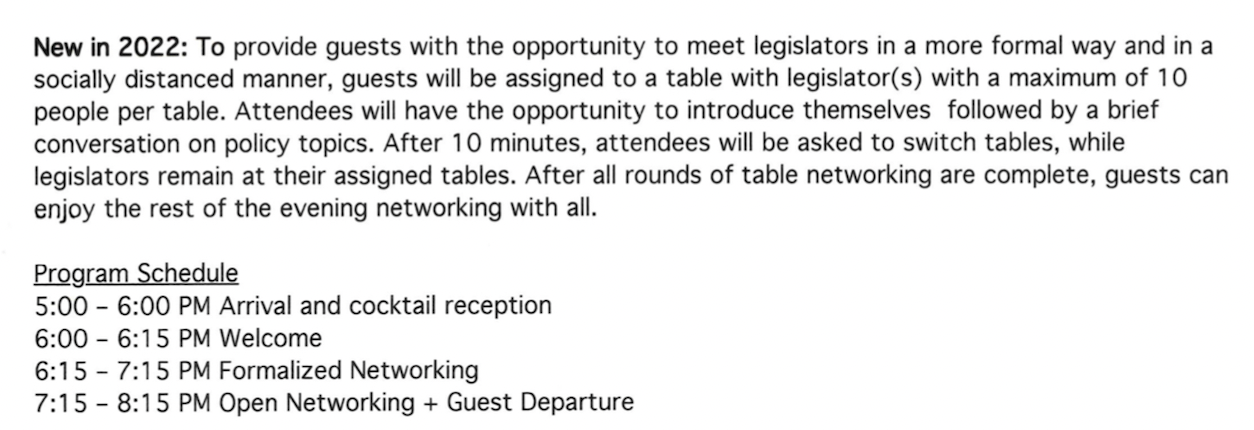
Oh, in case you’re wondering, tonight’s “meet & greet” reception includes “complimentary beverages provided by Koloa Rum, a delicious appetizer menu including Bruschetta, Crispy Pork Belly Bao Buns, Lobster Bisque Grilled Cheese Sliders, Mini Crab Cakes and Grilled Vegetables, and the opportunity to network with like-minded professionals to strengthen the voice of business,” according to an event description on the Chamber of Commerce website. It also includes at least an hour for “open networking” with the legislators present.
Discover more from i L i n d
Subscribe to get the latest posts sent to your email.
It’s lobbying, plain and simple. People don’t go to these events because they find politicians fascinating or incredibly interesting individuals. Any business organization such as a chamber of commerce is a de facto lobbying arm of its paying members.
Oregon’s definitions of lobbying and goodwill are succinct and spot on, cutting through the crap.
hey, that’s kalani english in the photo!
Yes, it is, along with others! Apparently a photo from a prior year’s event.

I bet the attendance went down for this evening….and this is worthy of some news coverage and interviews.
The value of the drinks and dinner is far more than $25. “Just to keep it legal” what a joke!
Give me a break, for first class “Lobster Bisque” and Rum! Even fast food, drive they runs $20. per meal. Specialty drinks alone, with an open bar and huge legislature’s drinking habits.
Seems inappropriate to me. I hope my legislators aren’t attending.
I have another related question. Considering that the head of the chamber is running for office, does this bump up against any campaign spending laws? I have thought the same thing when I see Chamber ads on TV. On the flip side it’s definitely her job, but it seems like a bit of a conflict if she’s pushing the chamber to buy more ads that feature her?