
Another co-defendant charged alongside former Honolulu business owner Michael John Miske, Jr. in a sprawling racketeering case is asking a federal judge to reconsider his continued confinement until trial.
Attorney William L. Shipley Jr. filed a motion this week calling for the release of his client, Jarrin Kalani Young, “on the basis that continuing to detain him pending trial is a violation of his right to due process under the Fifth Amendment to the Constitution.”
Young, 28, was arrested on July 15, 2020, the same day a sweep by federal agents nabbed Miske and most of the ten original co-defendants. According to the motion, Young had been in custody at Honolulu’s Federal Detention Center for 24 months and 26 days as of August 10, 2022, the date the motion was filed.
Three other Miske co-defendants have previously been released on bond pending trial, and three others who have pleaded guilty have been released on bond pending sentencing.
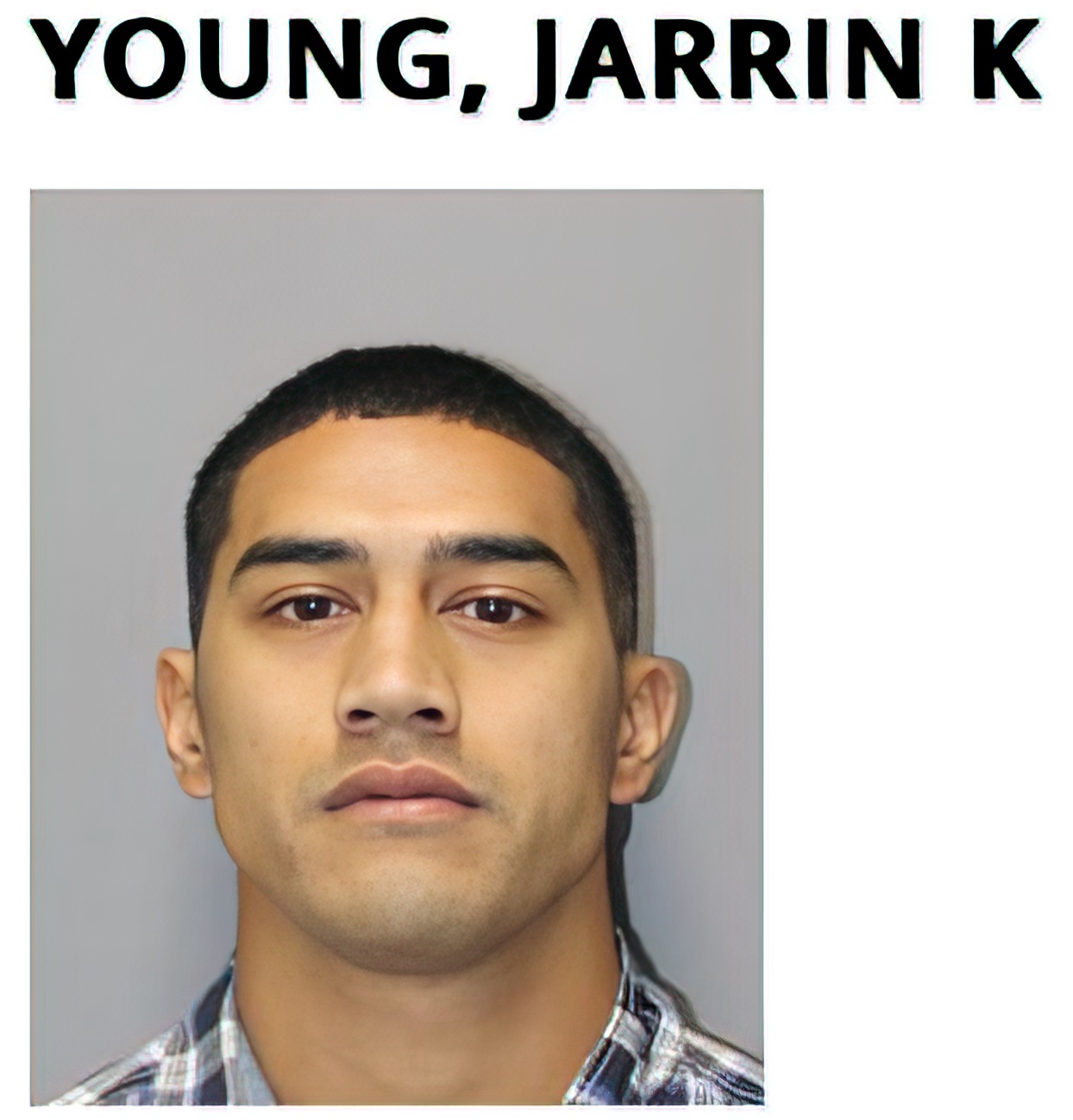 Young is charged in three of the 22 counts of a second superseding indictment in the Miske case, which was handed down by a federal grand jury last summer. He faces charges of being a participant in a racketeering conspiracy allegedly controlled and directed by Miske, of conspiring with Miske and others to distribute drugs, including methamphetamine, cocaine, marijuana, and oxycodone, and with using a firearm in the course of a drug trafficking crime.
At least two of those who have already pleaded guilty to being part of Miske’s racketeering conspiracy have named Young as part of what prosecutors refer to as the Miske Enterprise.
Jacob “Jake” Smith, who pleaded guilty in November 2020 to participating in Miske’s racketeering conspiracy and to drug trafficking, stated in his written plea agreement that Young went with him and another person to rob another drug dealer. They took a pound of methamphetamine from the dealer’s home in the spring of 2016.
Smith described another incident in which he and Young, along with another person, discussed robbing a rapper who was performing in Honolulu in May 2018. According to Smith’s plea agreement, the intended victim “was known to adorn himself in expensive jewelry, including a gold chain and medallion purportedly worth several hundred thousand dollars.” Although Smith, Young, and others “discussed obtaining vehicles and about the timing of the robbery,” they ultimately called off the planned robbery.
Federal wiretap interceptions on several phones in 2018 identified Young as among those who distributed meth along with Hunter Wilson and Timothy Taboada, allegedly under the protection of the Miske Enterprise. Both Wilson and Taboada have previously pleaded guilty and agreed to cooperate with prosecutors.
Elsewhere, prosecutors allege: “Other Title III interceptions of Young and Enterprise members also in 2018 revealed extensive drug distribution activities including Young receiving pound and ounce quantities of methamphetamine, all of which were intended for further distribution.”
One of Mike Miske’s lead attorneys, Lynn Panagakos, disclosed in a court filing that an unidentified defendant told prosecutors that a another person who witnessed the 2016 murder of Jonathan Fraser had named Jarrin Young and Jake Smith as having taken part in Fraser’s kidnapping and murder. The murder allegedly took place at a home in Kalihi. However, this allegation is not included in the recitation of crimes in Smith’s plea agreement, and has not been publicly mentioned by prosecutors. The indictment alleges Miske directed and funded Fraser’s murder as part of a murder-for-hire conspiracy.
Young was ordered to be detained until trial following a hearing on July 24, 2020. Federal law provides a “rebuttable presumption” that continued detention is necessary to protect a person or the community if the defendant has been charged with a crime of violence, an offense with a maximum sentence of life in prison, an offense for which the maximum prison term is ten years or more under the Controlled Substances Act, and any felony if the person has been convicted of two or more violent or drug related crimes at the state or federal level.
All of those boxes could apparently have been checked in Young’s case.
Another factor the court is directed to consider in a detention hearing is “whether, at the time of the current offense or arrest, the person was on probation, on parole, or on other release pending trial, sentencing, appeal, or completion of sentence for an offense under Federal, State, or local law.”
Court records, as well as the summary criminal history available from the Hawaii Criminal Justice Data Center show that from June 2018 through his arrest in July 2020, a period during which prosecutors allege Young was a participant in the Miske racketeering conspiracy, he was also on probation after pleading guilty in state court three counts of 1st degree terroristic threatening and 2nd degree robbery.
According to the government’s 2020 motion to detain Young until trial:
The defendant bears the burden of producing evidence to rebut that presumption. Even if the defendant satisfies that burden of production, the presumption does not vanish; instead, it “remains in the case as an evidentiary finding militating against release, to be weighed along with other evidence relevant to factors….
Factors that can be used to overcome the rebuttable presumption of detention include “the person’s character, physical and mental condition,family ties, employment, financial resources, length of residence in the community, community ties, past conduct, history relating to drug or alcohol abuse, criminal history, and record concerning appearance at court proceedings.”
Shipley, who took over as Young’s court appointed defense attorney just two months ago, does not present any of this type of evidence in his motion asking the court to reconsider the earlier decision requiring continued detention.
Instead, he cites a 2021 9th Circuit Court of Appeals opinion as support for the notion that the lengthy time between Young’s arrest and the end of a potential trial, which isn’t even scheduled to begin until April 2023, could raise constitutional concerns. However, while expressing concern about long pretrial detention, the court in that case upheld the defendant’s continued detention, so how it would be applied to Young’s case isn’t clear.
In addition. Shipley faults prosecutors for failing to provide any specific evidence that Young would pose a danger to the community or be a flight risk.
However, a Justice Department website cites cases providing that the judge in a detention hearing may rely on a proffer by prosecutors of what evidence would show, without having to produce the evidence itself.
The rationale for permitting detention hearings to proceed by way of proffer is that such hearings are “neither a discovery device for the defense nor a trial on the merits.” Smith, 79 F.3d at 1210. “The process that is due is only that which is required by and proportionate to the purpose of the proceeding.” Id. “That purpose includes neither a reprise of all the evidence presented before the grand jury, United States v. Suppa, 799 F.2d 115, 119 (3d Cir. 1986), nor the right to confront non-testifying government witnesses, United States v. Accetturo, 783 F.2d 382, 388-89 (3d Cir. 1986). Smith, 79 F.3d at 1210 (also citing United States v. Hurtado, 779 F.2d 1467, 1479 (11th Cir. 1985)(purpose of pretrial detention hearing is not to “rehash . . . probable cause” but to provide opportunity for detainee to show no risk of flight or danger to community); United States v. Williams, 798 F. Supp. 34, 36 (D.D.C. 1992)). “A right to require the government to produce its witnesses against [a defendant] would complicate the hearing to a degree out of proportion to the liberty interest at stake – viz. the interest in remaining free until trial, for what is by statute a period of limited duration.” Smith, 79 F.3d at 1210; see also Speedy Trial Act, 18 U.S.C. § 3161, et seq.
A hearing on Shipley’s motion has not yet been scheduled.
Discover more from i L i n d
Subscribe to get the latest posts sent to your email.
Well,these presumptions are quite well spelled out by the proceedings to date and although we all want to follow the speedy trial rules, our tax dollars are paying for the individual’s defense during a world wide pandemic… duh! Unfortunately the court and the police had no choice but to hold and delay the proceedings!!!
Stay tuned for the complete picture and thanks for the information Ian.