
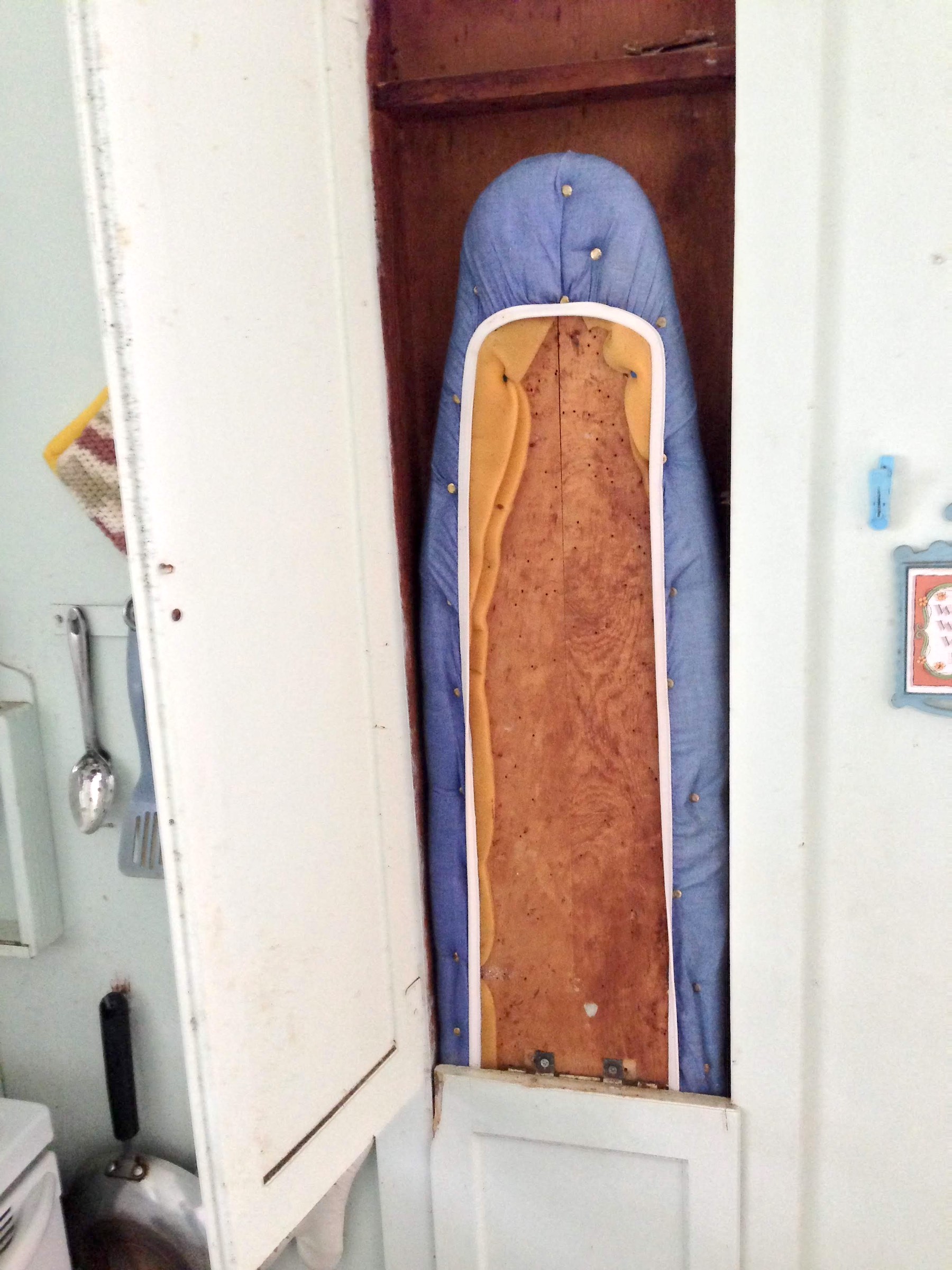
Did you grow up with one of these?
The built-in ironing board in the kitchen was probably a welcomed architectural feature back in early 1942 when my parents bought this small 3-bedroom, 1-bath house measuring just under 1,000 square feet in Kahala.
The ironing board folded into it’s own small closet and could be hidden behind its own door, but was easily pulled out into place for use, which felt to me like it was very often.
The memory of it came back to me yesterday for some unknown reason, and I began to wonder whether this was a common feature of 1940-era Hawaii houses? Was this built-in a throwback or a modern convenience?
The house remained relatively unchanged over the 71 years my mother lived in it. The ironing board remained throughout. After my mom and dad were gone, Meda and I had the house rebuilt before moving here from Kaaawa, in part because it was old and a wreck, in part because we needed to make it different enough to discourage their ghosts from wandering the hallways. Yes, a joke, perhaps, but then again, a motive for making small changes. We rebuilt mostly in its original footprint, but enlarged by kitchen by pushing out the kitchen wall toward the street about six or eight feet. Our more modern sensibilities could not have dealt with a kitchen so small that there was no room even for a microwave oven, much less any of the other things that find their way into contemporary kitchens.
But while the house stayed the same, the neighborhood around it has changed dramatically, and not necessarily for the better.
Gone are the croton or panax hedges between homes along the street, which have motly been replaced by walls or tall fences. In the old days, you could just slip through the hedge to visit a neighbor. Now walls have largely severed connections between neighbors, something my mother was especially depressed about in her later years.
Our house now has walls on three sides, erected by those neighbors when they build large new homes. But in front, towards the street, we’re still happy to tell people to look for the house without a wall or gate in front, just a colorful hedge.
Back in the day, there were farms immediately behind the houses along this side of Kealaolu Avenue. Taylor’s chicken farm was just up the street at the corner of Farmers Road, and pig farms graced the interior of Kahala, further along Farmers Road in the direction of Diamond Head. On Kealaolu, many of the other existing homes were providing housing for war workers, and for those who serviced them, like the “working women” my dad said lived next door.
In any case, I had the good sense to take photos of each room of the house before the crew from Re-use Hawaii moved in and dismantled it, in preparation for our rebuild.
And so the image of the built-in ironing board is captured for posterity. There weren’t a lot of drawers for storage, so knives, cooking utensils, and a few pots graced the walls. Plastic and glass items on the floor were ready to be recycled. A basket hanging on the wall was where used plastic bags went, to be reused when needed. A plastic trash can sat in that same location for as long as I can remember. My earliest recollections were taking kitchen garbage out into the back yard where it was burned in a metal bin. That ended when the city started collecting trash and open air trash burning in the back yard became a thing of the past.
And we didn’t try to recreate the built-in ironing board. To tell the truth, neither of us have ironed anything in decades. We managed to avoid jobs where wrinkles were frowned on, and manage to shake enough of them out after washing and drying that we can get by, although perhaps with a bit more rumpled look than ironing might have achieved.
And if you’re wondering about the small plaque seen in those photos on the wall of my mother’s kitchen, it read: “Wonder Woman Works Here”.

Discover more from i L i n d
Subscribe to get the latest posts sent to your email.
The early 1950’s Hicks home that I used to live in on Saint Louis Heights had one of those built in ironing boards in the kitchen too.
Hicks homes in Hawaii are classic. Always fun explaining their single wall construction, with tofu block foundation and canec ceilings to a mainland buyer. The only thing they understand is redwood walls. And then there is the trace amounts of arsenic in the canec ceilings which is made out of a sugar cane byproduct called bagasse. I have seen some really nice remodels of Hicks homes and consider them very sustainable.
Brings back memories of the big metal washtub loaded with Vano (starch) for dipping my khaki pants and white shirts which were the uniform at Star of the Sea School in the early 1950s. Ironing the clothes without scorching the starch was an art. Mom had mastered it.
My home was designed by Ossipoff in ‘53 and it has one of those built in ironing boards.
My sister-in-law owns an older home in Palolo which featured one of those ironing board closets. She had it converted into a spice and medicine cabinet.
YES we had one in Kaimuki. Then again in an apartment in Berkeley, CA. My 1953 home in Florida has a suspicious shelf area that was probably used for an ironing board. And yes, you are so right. I used to iron a LOT. And now? Nothing.
We had one across the street, but a little more high end I have to say. Had second, smaller pull down for sleeves.
Yep, our house in Great Falls, Montana, had an ironing board closet, very similar to the one in your picture, Ian. The house was not at all new, maybe built in the 1920s.
I used to work for the State’s public housing agency. In the 90’s, I was to oversee a complete remodel of a dilapidated project in Kaneohe built in the 1960s. I walked thru the units after the tenants moved out. Opening a kitchen drawer, there was a removable silverware tray. Made of wood, it had partitions to separate forks, spoons, etc. A carpenter made it, it was part of the original home. Today, you’d pay $5 for a plastic silverware tray at Walmart.
Ian, I don’t know if you recall, but I interviewed your parents at the house in 2006 for one of my first stories at PBN — it was about the big houses sprouting up around theirs — and while I do recall the croton hedge, I don’t remember the ironing board. Our house in Kaneohe was built in 1958 but no ironing board.
Yes, i so enjoyed your story that I have linked to it here many times in the past. You caught their feelings of being between generations, and the loss of the former, more casual, character of their neighborhood. Thank you for those observations!!
You;re welcome. I remember your parents well, such nice people.