
In a “Motion in Limine” filed in federal court on Monday, November 13, attorneys representing Michael J. Miske Jr. asked the court to exclude testimony of five men named in “an HPD Report of the missing person Rick Calhau, wherein the witnesses were identified,” because the case is not part of the current charges, it took place decades ago, it occurred years before the government even alleges that Miske formed a racketeering organization or “enterprise,” and it would impermissibly prejudice jurors against Miske and his co-defendants.
The motion is one of dozens of similar motions filed last week by defense attorneys and prosecutors (mostly by the defense side). The motions seek to exclude prejudicial, irrelevant, or inadmissible information that could unduly and improperly influence the jury if presented during the trial. Prosecutor’s motions seek to quash objections to certain evidence which would otherwise likely be objected to during the trial.
A hearing before Judge Derrick Watson is scheduled for December 8 to consider the motions.
Calhau vanishes
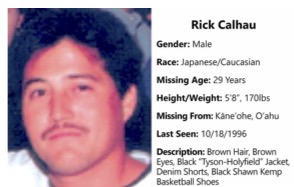 The Honolulu Advertiser reported several days after Calhau’s disappearance that he left his Kaneohe home just after 10 p.m. and told his wife he was going to see friends in Kalihi, but would be back in an hour. He was wearing “a black jacket with “Tyson-Holyfield” printed on it, blue denim shorts, and black Shawn Kemp basketball shoes,” according to reports at the time. He was 29.
Calhau never returned home. His truck, a brown Ford pickup, was found the next morning in front of Savior Lutheran Church in Aiea.
He was declared legally dead in 2004.
In their memo to exclude testimony from the five men, Miske’s attorneys said they believe prosecutors “might be intending to elicit testimony from them alleging Miske was involved in Calhau’s disappearance. If so, defendants move to exclude it.”
Testimony implicating Miske in Calhau’s disappearance would be stories from witnesses with strong motives to falsely implicate Miske on a matter so old the evidence necessary to confront them is long gone, which would constitute unfair prejudice to Miske’s Sixth Amendment Confrontation Clause rights. This uncharged conduct would dominate the trial. The risk that the jury would consider this evidence as probative of Miske’s guilt on Counts 2-6 and all defendants’ guilt on Count 1; in other words…would be enormous.”
Miske is now 49. Calhau disappeared when Miske was 22.
In the process, the memo discloses information about the Calhau case that was not previously in the public record.
Rumor and speculation
“Rumors about his disappearance ranged from jealousy, another woman, drug deal gone bad, drug dealing territorial, and the fact that he just left the state,” the motion states, citing a memo by a detective written several months after the disappearance.
“Calhau was identified as a drug dealer,” according to the motion. The first person he was planning to see that night was one of his drug suppliers, and the second owed Calhau money. The latter is one of the five witnesses named in the motion. According to the motion, sand was found on this witness’s feet, as well as in Calhau’s truck, and he reportedly flunked a polygraph test.
There were also reports that Calhau was having an affair with the girlfriend of another of the witnesses, who was a well known local boxer until an arrest on burglary charges apparently cut his career short.
A year after Calhau’s disappearance, the same detective sent a memo to the prosecutor, stating in part: “I know that Mike Miske is not involved.”
But 16 years later, Honolulu police announced they had received new information about Calhau’s disappearance, reopened the cold case, and again solicited information from the public.
However, no charges resulted, and whether any real progress was made remains unknown.
“Miske also knew Calhau,” the motion acknowledges. “Like others, Miske’s possible involvement was also the subject of rumor and speculation.”
“Miske also knew Calhau.” A classic understatement.
Friends and associates
In May 1995, soon after getting a break on earlier auto theft charges in a plea deal with prosecutors, Miske, then 21, was in trouble again, this time after being stopped for speeding while driving a car registered to Calhau.
This description is excerpted from my story published just a month after his indictment and arrest on racketeering charges in 2020 (“From Early On, Miske Was On The Path To A Life Of Crime“).
Despite receiving what in retrospect looks like a very lucky reprieve — probation instead of prison for his multiple convictions — Miske almost immediately got himself in serious trouble once again.
On May 17, 1995, just two days after his plea deal on the earlier charges was approved in court, a police officer stopped a black 1992 BMW four-door sedan seen speeding near Castle Medical Center just after 8 p.m. The officer asked the driver, later identified as Miske, for his license, registration and insurance card.
“The driver opened the glove compartment and a package fell out. The driver hid the package, removed the key from the glove compartment lock and began to start the car,” HPD Ofc. David Alices recounted in a later police report on the incident.
Alices said that when he went to the driver’s side of the car, the driver grabbed his arm and drove away, dragging him about 20 feet before he fell. The officer was treated at Castle for “a deep contusion to his left shoulder” which was considered by the examining doctor “to be a serious bodily injury,” case notes show.
The registered owner of the car, Rick Calhau, showed up at the Kaneohe Police Station about 2:30 a.m. to report the car had been stolen from behind his home. Calhau was a 28-year-old car enthusiast and the owner of The Tint Shop, an auto glass tinting company.Calhau told police Mike Miske was “a good friend.” Calhau said Miske had driven the car before, but did not have permission to take the car that night.
Calhau told police Miske had left Oahu, but that he might know who had been driving the car. He refused to name the driver, and declined to take a lie detector test as suggested by police.
Calhau then said he wanted to speak to his attorney before making any further statement. He “then called a person named ‘Bodie’ to get the number of his attorney,” according to a police report on the incident.
The attorney was Reinhard Mohr, who explained to police he was representing the driver of the car and not Calhau.
“Bodie” was identified by police as Bodie Suter, “a known associate of Calhau” as well as the same person charged with Miske in the car theft and switch of the red Hondas two years previously.
After police positively identified Miske as the driver who had dragged officer Alices, a Crimestoppers news release was circulated which included the 21-year-old Miske’s photo. Miske was arrested early in the evening on May 26 at a home on Maunawili Road. He told police he was now a “self-employed glass tinter.”
On June 14, 1995, Miske was indicted on charges of kidnapping, a Class A felony, the most serious category of criminal offenses which carry the most serious potential sentences; first-degree attempted assault, a Class B felony; and speeding, a violation. He was released on $25,000 cash bail posted by his mother, Maydeen Stancil, court records show.
These were the most serious charges Miske had faced to date. The case was set for trial in September, and Mohr, his lawyer, began working on another plea deal.
On Aug. 25, 1995, while awaiting trial on the kidnapping and assault charges, Miske was arrested again for second-degree terroristic threatening. Arrested in the same incident, but charged separately, was Rick Calhau, the tint shop owner whose BMW Miske had been driving.
Charges against both men were eventually dismissed once again when the complaining witness, not identified in court records, failed to appear.


At the time of his arrest in this case, Miske described himself as a “self-employed auto tinter.”
He was known to be working at The Tint Shop, which was owned by Calhau.
In November 1998, just two years after Calhau’s disappearance, Miske registered the trade name, “The Tint Shop,” after Calhau’s registration had expired. Miske’s Tint Shop was registered at 916 Queen Street, just a short distance from the building at 940 Queen Street that within a couple of years became the office of Kamaaina Termite and Pest Control, Miske’s first successful business.
Miske was still on probation at the time.
So it appears Miske and Calhau were good friends and were working together in the tinting business. They were arrested together for terroristic threatening. Miske drove Calhau’s BMW. And he took control of the trade name Calhau had used for his tinting business.
But whether any of the rumors or speculation about Calhau’s fate have any truth remains unknown, and whether any of this will be allowed to be presented at the upcoming trial has yet to be determined.
Discover more from i L i n d
Subscribe to get the latest posts sent to your email.
This case, I know it’s still early, but so far it reads like the Trilogy of the Rings ! We, your readers, are filled with significant facts about this sprawling case.
Am impressed that you our author, are so tenacious and thorough.
Piece by piece…
Your work is brilliant and relevant.
Mahalo!
What can I say? Thank you.
This story, like all of yours, is much appreciated.
Rick was my 1st. Cousin