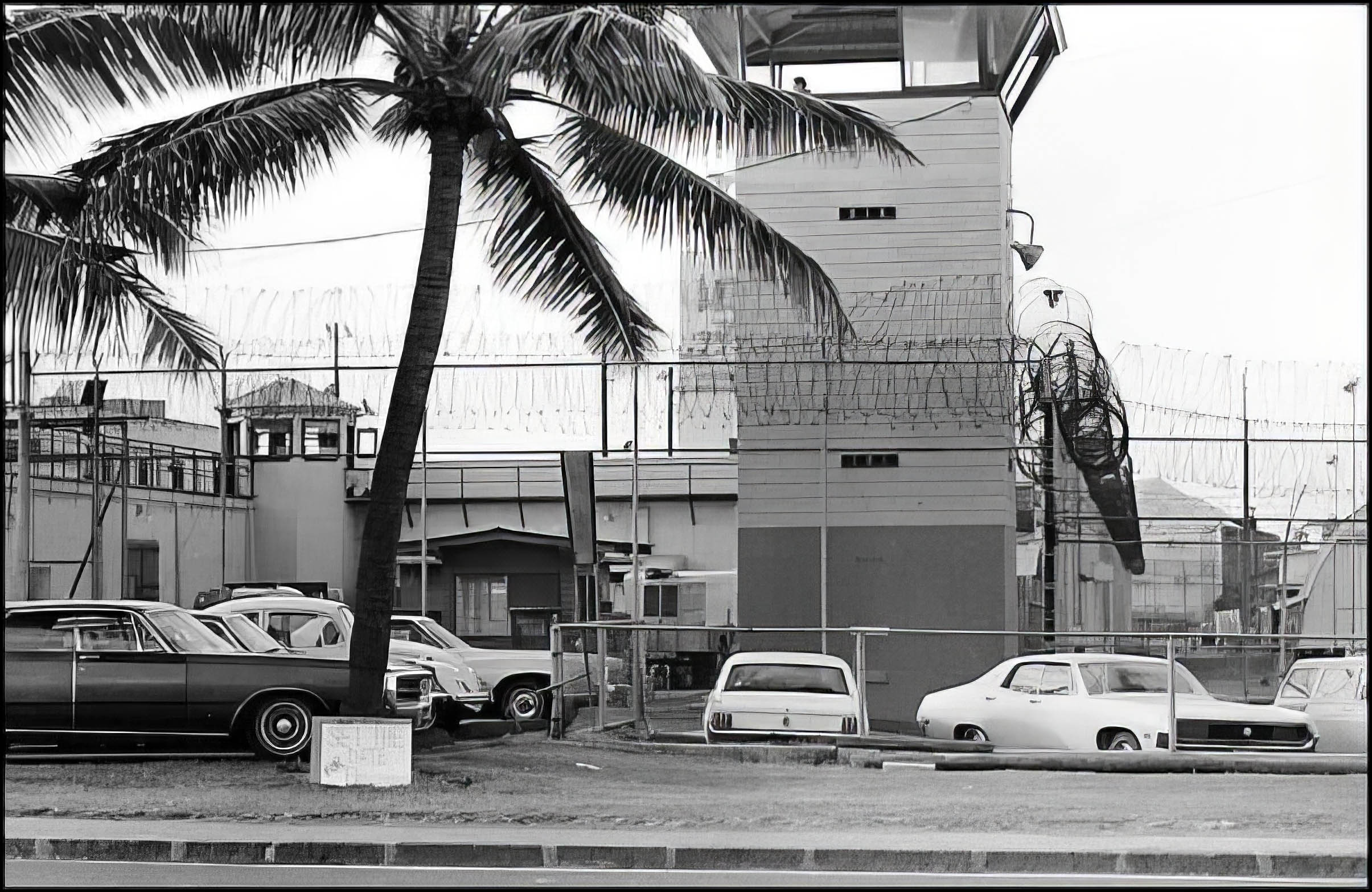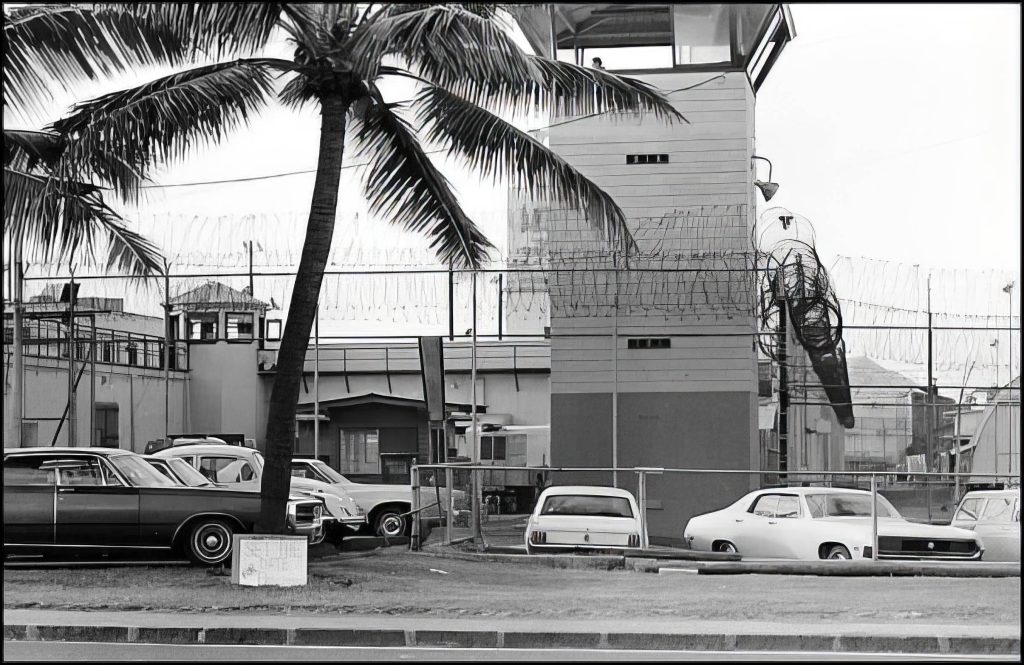
Older part of OCCC during an extended “lockdown” several months after the Dec 1981 shakedown
[Part 1 of this tale, describing the shakedown and our efforts to gather information about incidents of excessive force, was posted on Saturday.]
This is where it got interesting
After drafting our brief report on the shakedown violence, Meda and I followed up with our contacts in the religious and Hawaiian communities, sharing what we had learned and discussing ideas for what could be done next.
Randy Kalahiki was one of those we reached out to. We sought out Randy because of his multiple close connections in many parts of the Hawaiian community as well as the legislature and other centers of power. The report is addressed to Randy at the Native Hawaiian Law Project of Legal Aid of Hawaii. This may have been while the federal tax exempt status of the Native Hawaiian Legal Corporation, incorporated in 1978, was still not fully approved.
The Hawaiian community had, and continues to have, a significant interest in prison policy because Hawaiians and part-Hawaiians are incarcerated at disproportionately high levels compared to their proportion of the population. A 2025 journal article reported Hawaiians make up 39% of Hawaii’s prison population but only 25% of the population, a situation that appears little changed over the past four decades.
Randy told us the Council of Hawaiian Organizations already had an appointment with then-Gov. George Ariyoshi regarding another issue, but said they would be willing to use the occasion to deliver a copy of our “report” on the shakedown violence. We quickly delivered a copy to him, as these were the days before email or home fax machines.
And Ariyoshi was no stranger to Randy, who had been a friend of his predecessor as governor, John Burns, and had known Ariyoshi himself since they were kids.
Randy’s daughter, Alicia, explained in an oral history interview George and Randy had met when a young George picked up clothing for his father’s business.
“George’s father had a laundry business, and George used to come by to my grandmother’s house and collect clothes for dry cleaning,” Alicia said in the interview. “My grandmother would send out the whites to be starched and ironed and whatnot.”
In December 1981, Ariyoshi was gearing up for what was expected to be a brutal election rematch against arch rival, Honolulu Mayor Frank Fasi. The two had gone head to head in the bitter 1978 Democratic Primary. In 1982, Fasi avoided a primary clash by running under the “Independent Democrat” label.
The Washington Post reported that earlier campaign included “the burning down of a Fasi headquarters on Maui, the beating up of a pro-Fasi poll-watcher and the withdrawal of a third candidate who said his life had been threatened,” with each side accusing the opposing candidate of being too close to “organized crime.”
The “quiet and effective” governor was angry
Ariyoshi powered his 1978 reelection with a new campaign slogan, “quiet and effective” which managed to frame his low-key approach to governing as a stark contract to Fasi’s loud and boisterous public persona.
Randy phoned us with an update following the meeting with Ariyoshi.
“The governor didn’t take it well,” he explained.
Randy said he was taken aback by Ariyoshi’s angry response, which was strong enough that it left Randy fearing we could be targeted for retaliation.
Then we learned we weren’t the first to hear this news. Before calling us Randy had contacted Roy Ryder, an organized crime figure who had deep personal and multi-generational family roots in Kahaluu.
Randy said he had explained the situation to Ryder and described Ariyoshi’s reaction. He then asked for Ryder’s help in protecting us if he heard of any “contracts” or other suggestions on the street that harm was being directed our way.
At the time, I really didn’t know Roy Ryder from Roy Rogers, although I had heard of him, as he had been in the headlines for years.
During the turbulent 1970s, Ryder emerged as a prominent figure in Hawaii’s organized crime landscape, operating within the island underworld before becoming a pivotal insider witness for law enforcement.
Ryder testified he had joined Wilford “Nappy” Pulawa’s organized-crime syndicate in 1969, acting as the regional leader/enforcer for the Windward side (Kahaluu, Kaneohe, Kailua, and up toward the North Shore), while answering to and coordinating with top syndicate bosses in Honolulu like Wilford “Nappy” Pulawa, Bobby Wilson, and Henry Huihui.
As federal and state authorities intensified their crackdown on the local syndicate, Ryder—alongside fellow operative Clarence Handa—flipped and agreed to testify against their associates, taking the stand in landmark trials against the powerful syndicate’s leaders.
His testimony pulled back the curtain and publicly revealed the syndicate’s internal workings, racketeering operations, and violent disputes, marking a defining chapter in the legal efforts to dismantle organized crime rings across Oahu. But he later recanted much of his testimony, undermining several prosecutions, and leaving Ryder with a well-established reputation as an admitted syndicate insider whose credibility was now badly compromised.
Randy’s disclosure and Ryder’s involvement obviously came shock to us, and we had no relevant past experience or direct knowledge of local organized crime to evaluate the validity of the perceived threat. We did have a close attorney friend who represented some crime characters, and had heard his tales of threats from crooked cops and dangerous clients. But we had no reason to question Randy’s assessment of the seriousness of the situation.
We were nervous and on alert for several days but nothing ever happened that we could tie to the incident. We never learned whether any threats towards us had ever been detected, much less quashed by Ryder’s intervention. After a few days of worrying, we simply returned to our business as usual.
Validation
It took a long time, but eventually there were several investigations of the 1981 shakedown, including one by a special Senate committee chaired by Sen. Dante Carpenter that held extensive public hearings.
The most detailed and extensive findings are contained in a report by the Office of Ombudsman Nelson Doi in September 1983.
Among the Ombudsman’s summary findings:
There was insufficient evidence that unreasonable force was used against 59 of the 103 inmates; there was sufficient evidence that unreasonable force was used against 44 of the inmates. Of these 44, 18 were treated for injuries such as bruises, contusions, lacerations, and abrasions.
The 103 inmates made 121 allegations; there was sufficient evidence that unreasonable force was used in 40 percent of the allegations.
See:
Report written immediately after the shakedown by Ian Lind and Meda Chesney-Lind
Document including the above report plus misc. inmate testimony and other items, good background.
Investigaion Of Allegations Of The Use Of Unreasonable Force Against Inmates During The Shakedown Of The Oahu Community Correctional CenterFrom December 14 Through December 18, 1981, Office of the Ombudsman, September 1983.

 Kali was first, I think, right there waiting to sniff everything that I introduced. Kiko was right behind her. Bessie, I knew, would be up in her perch in the pantry. So I called Kinikini, who had failed to immediately appear. As soon as I did, he came rocketing from the direction of our bedroom and gave me a warm greeting.