Category Archives: General

Puzzle solved with an unexpected twist at the end

In the immortal words of Yogi Berra, it’s deja vu all over again!!

While I was spinning my wheels yesterday afternoon, several readers were doing their due diligence and solving the puzzle.

A reader commenting as “Joel” was the first to point out late Sunday afternoon that I went through this same exercise in a “Throwback Thursday” post almost exactly 10 years ago!

“Hi Ian, I think the consensus the last time this was discussed is that it’s the contessa taken from hale manoa,” he wrote in a comment.

Honestly, I had no recollection that this was the second time around on this littel mystery, but it’s true!

And back in 2016, several people quickly recognized the location.

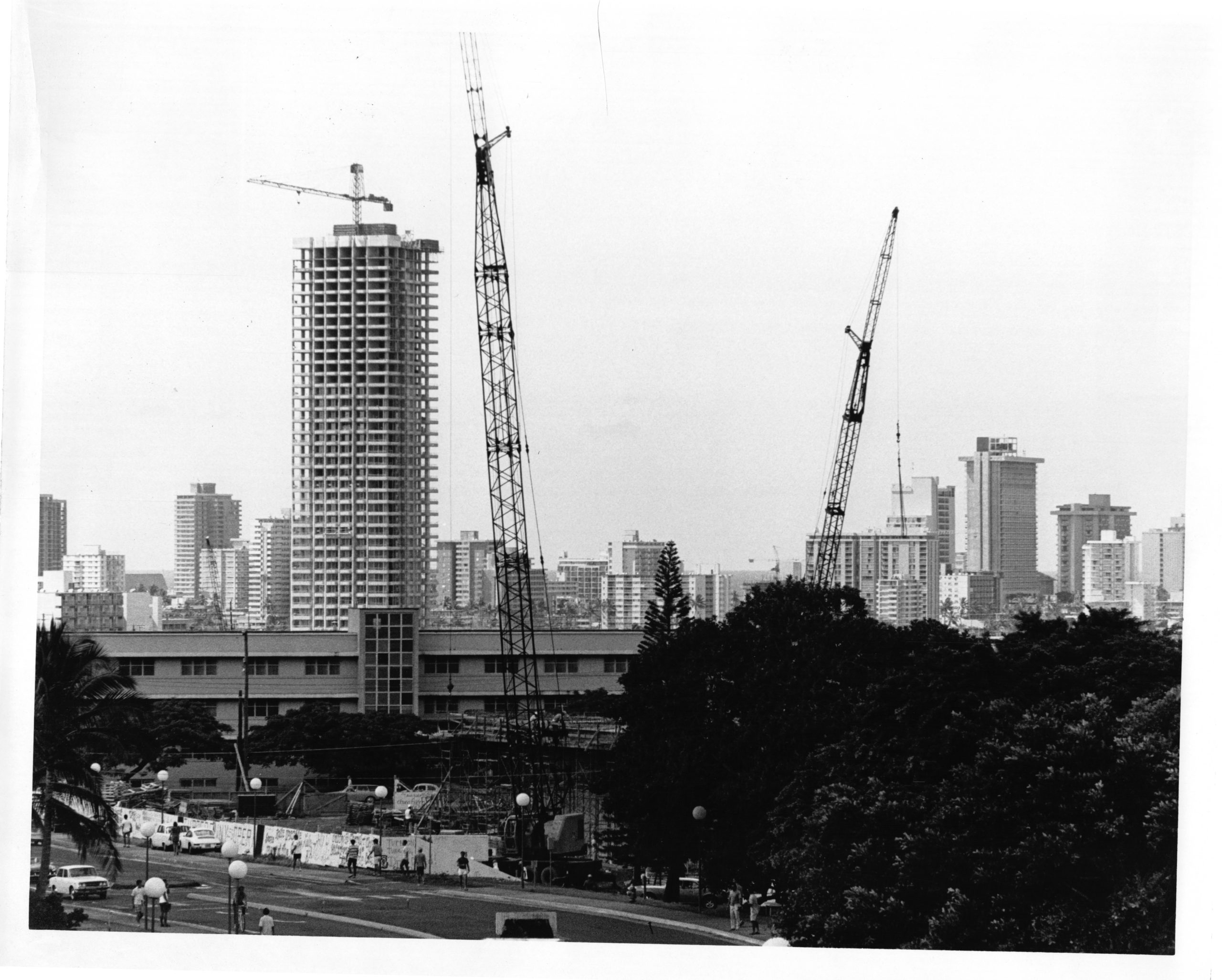
The photo is taken from Hale Manoa at the East West Center. For a period in 1970, I was the primary photographer for the East West Center, paid as a student worker. It was a lot of fun and gave me my own darkroom to work and play in. I must have spent some time in the Hale Manoa living quarters and took this photo of the view looking down toward Waikiki.

Screenshot

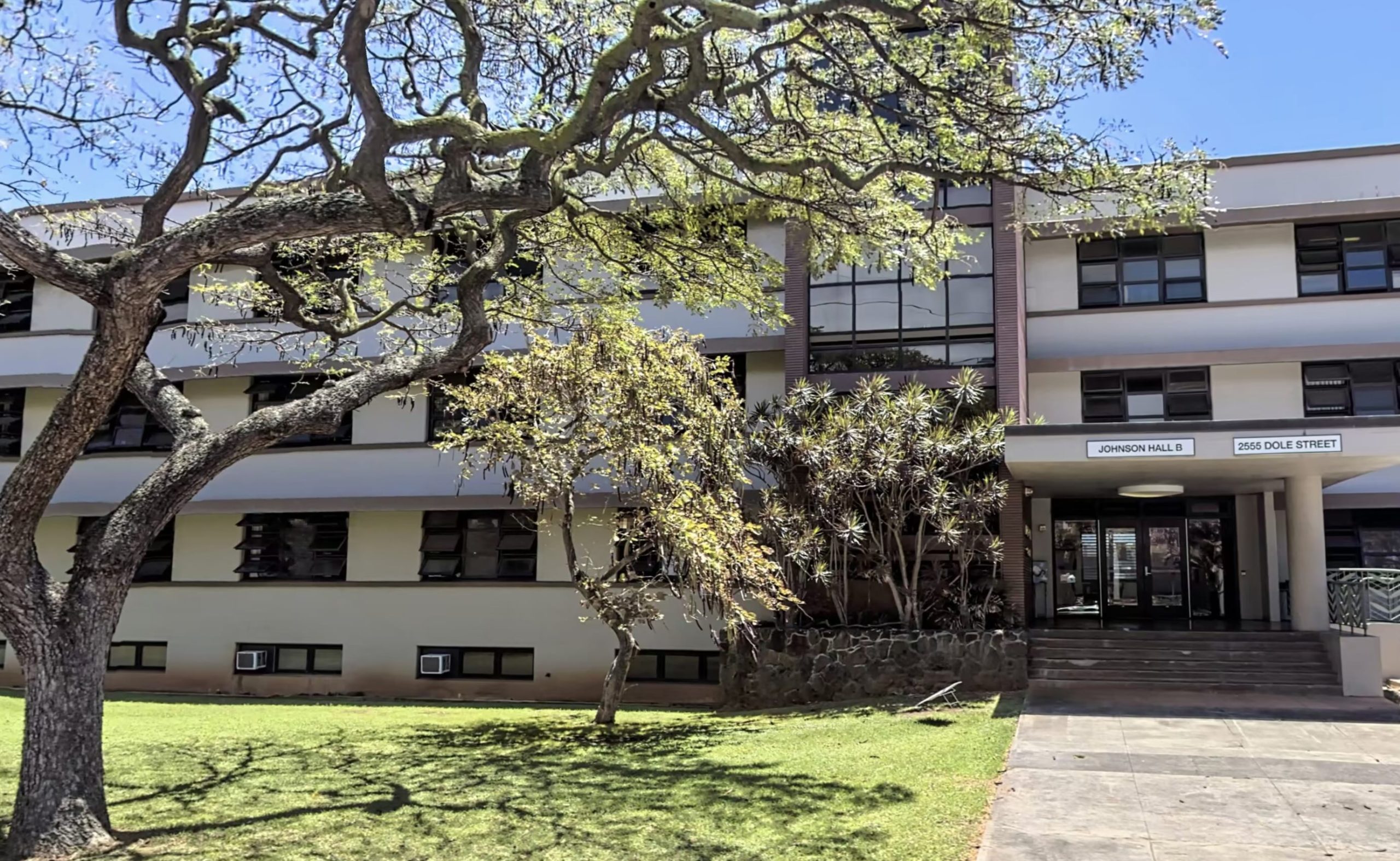
The street is East West Road, heading towards Dole Street, where the low rise building shown is Johnson Hall B, a student dorm.

The building under construction across the street, at the corner of East West Road and Dole Street, is the UH enginerring building, Holems Hall.

And at the very bottom of the photo, in the center, is the back of the sign welcoming welcoming visitors to the East West Center.

And this Google Map shows the approximate line of sight from Hale Manoa to the Contessa down on King Street, where construction appears to have been nearing completion.

Sometimes tangents can be interesting

Scanning old snapshots after removing them from the plastic sleeves in large blue binders takes much longer than it should because, of course, I look at the photos and all too often get distracted something or another.

This seems to lead me to go wandering off onto tangents where the foibles of decades-old memories have to be corrected with a bit of investigative effort. Luckily, I’m mostly retired and free to go off on tangents, which can also be opportunities to learn something.

Here’s a simple–or perhaps a not so simple–example. I’m sorry the post is a little long, but I kind of got into explaining the process it required to get the job done.

I just finished scanning another several hundred photos from 1997, easy to date because some are stamped on the picture by the camera when it was taken, others have a date added on the back when printed, and still others are not dated but obviously fit in the dated sequence.

Alumna of Merit

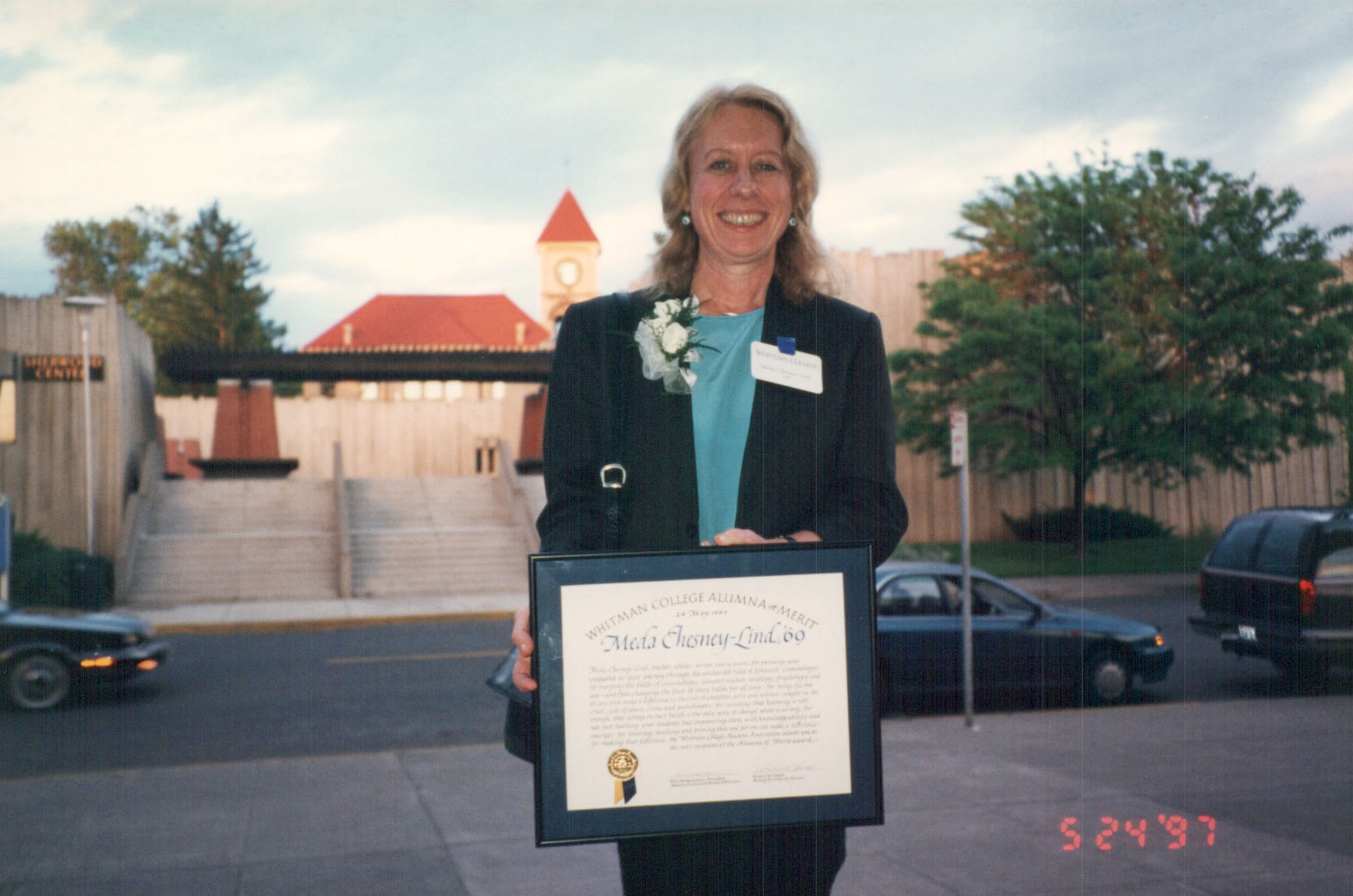
In May 1997, Meda and I flew to Portland, Oregon, spent a night or two, and then rented a car and drove along the Columbia River and up to Walla Walla, Washington, where Meda was presented the “Alumna of Merit” award from Whitman College. After several days in Walla Walla, we drove back to Portland and spent a bit more time before flying home.

There are about 100 photos documenting the trip from beginning to end, and I can identify where each was taken, except for one.
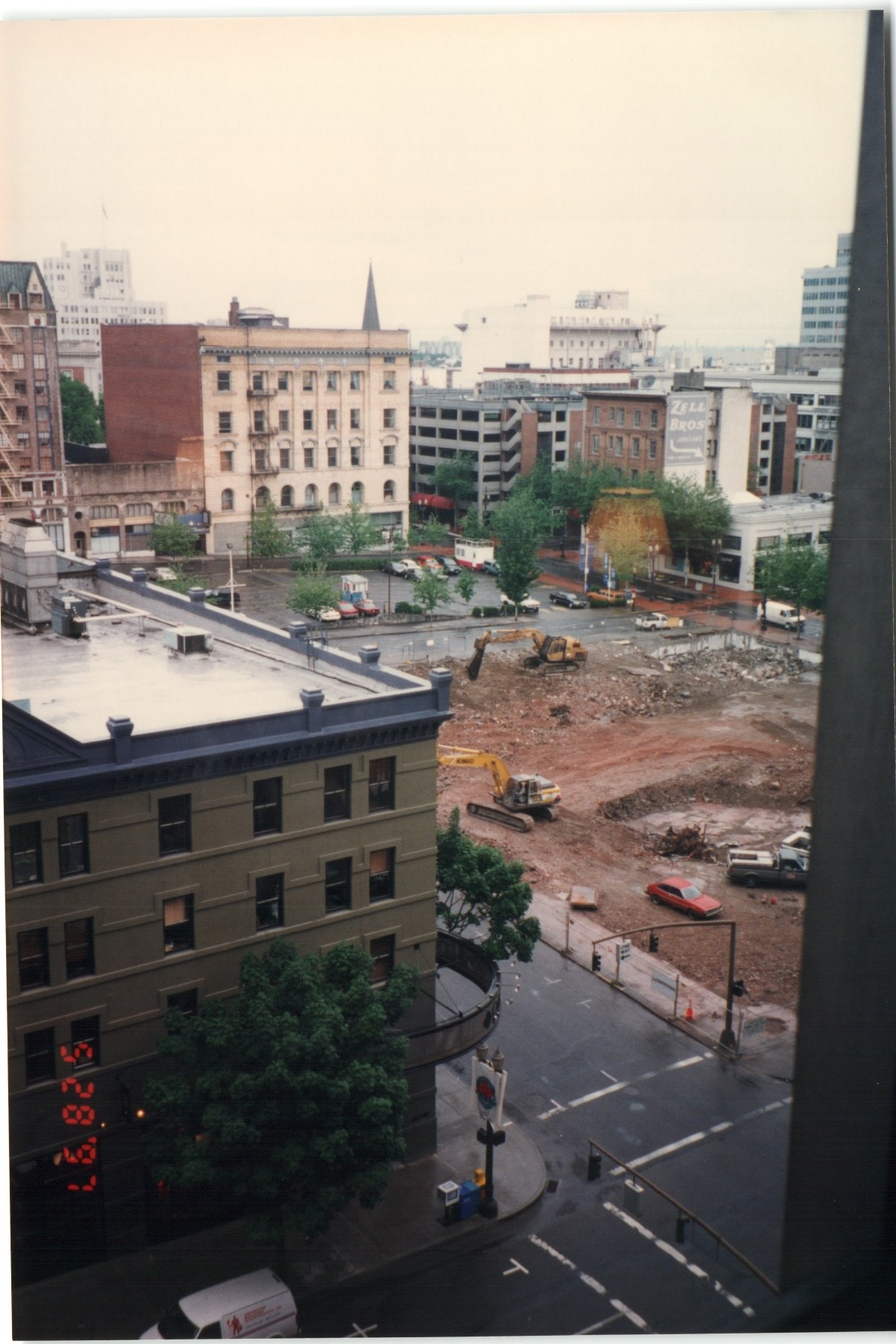
It’s an urban scene, apparently in downtown Portland. A number of buildings and streets look vaguely familiar but I can’t specifically place them. Somehow this drew my attention, and I set out to find where the picture was taken.

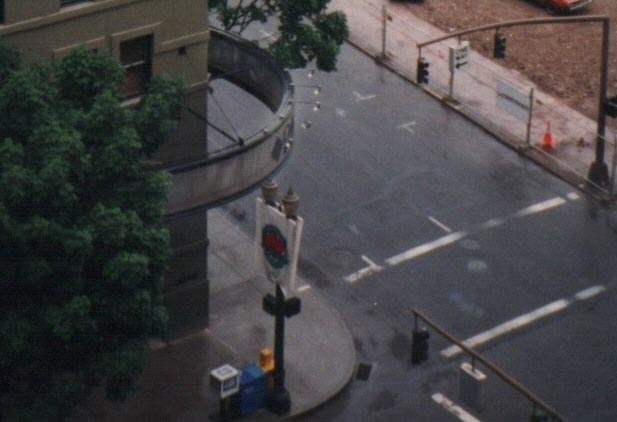
There are several clues in the photo. There’s a sharp spire visible over a building in the center. Faded lettering can be seen on another building, “Zell Bros” with an arrow pointing down. There is a large area, perhaps a whole city block, where preliminary site work is being done for a major construction project. And at the bottom of the mystery photo, the building on the corner across the street has an unusual curved sign.

The photo appears to have been taken from a high rise building, most likely the hotel where we were staying.

Not too much to go on, but I know a bit about online sleuthing, so off I went.

The first step was to upload the mystery photo to Google, and then use Google Lens to search its memory banks for the scene. I’ve had about a 50% success rate on previous searches of this kind, so it’s always a good starting point.

Within seconds, Google returned an answer, but it was incorrect on its face.

According to Google:

The image provided, dated August 28, 1997 (8.28.97), shows a construction or demolition site in Seattle, Washington, likely the future location of the Civic Square development.

The site, located between Third and Fourth avenues and James and Cherry streets across from Seattle City Hall, was the former location of the Seattle Public Safety Building, which was demolished in 2005.

Google had the wrong city, and the wrong time frame (2005 instead of 1997).

My next step was to locate the hotels where we’ve previously stayed in Portland, and check the surrounding areas looking for a nearby building that might have been starting construction back in 1997.

We’ve spent a lot of time in Portland over the years, and are pretty familiar with parts of the city, including the downtown area. Meda’s family moved to Portland when she was starting high school, and after we got married we returned frequently to visit her mother, who had by then moved to a home in the Southwest Hills. Many days we would ride the bus from up in the hills down into the center city, and just wander around. Her brother still lives in Portland, along with several old friends, so we have continued to return once or twice a year.

I did recall we had stayed in several different hotels over the years. University Place, on Lincoln Street on the edge of the Portland State University campus. The Marriott Center City (or was it City Center?), now renamed the Marriott Bidwell, on Broadway. The Duniway on 6th Avenue. And the former Westin, now the Dossier Hotel, on Alder Street and Park. The Paramount, on Taylor and Park. And after interrogating my memory for a while, I finally remembered staying at a Four Points Sheraton on Morrison near 1st Street, which is now known as Hotel Rose.

A quick look at the area surrounding each hotel using Google maps didn’t produce any “aha” moments, but then I returned to the Google photo search results and looked beyond its AI summary to examine photos of potential matches it offered up.

And one of those photos showed a large excavation identified as the future site of the Fox Tower, a 27 or 28-story commercial building across Broadway from Pioneer Courthouse Square. It’s ground floor is home to a Regal 10-theater complex.

A separate search found the new Fox Tower opened in 2000, so preliminary site work could easily have been underway in mid-1997.

And, most important, the building site is just across the street from the Paramount Hotel, one of the places we’ve stayed.

I was getting close, but examining the photo, and comparing it to a map of the area, showed it couldn’t have been taken from the Paramount after all.

I was venting about this inconsistency when Meda added a new wrinkle by telling me we had stayed at the Portland Hilton once or twice.

Aha! Although the Hilton wasn’t one of the hotels I remembered, it the last piece needed to complete the puzzle.

The photo, is seems, was taken from our room at the Hilton which looked out onto the corner of SW Taylor and Broadway. All the angles suddenly made sense, as we looked across to the construction site for Fox Tower, on the opposite side of Taylor Street.

And two more clues also fell into place, confirming the view is from the Hilton.
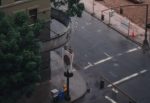
Screenshot

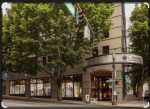
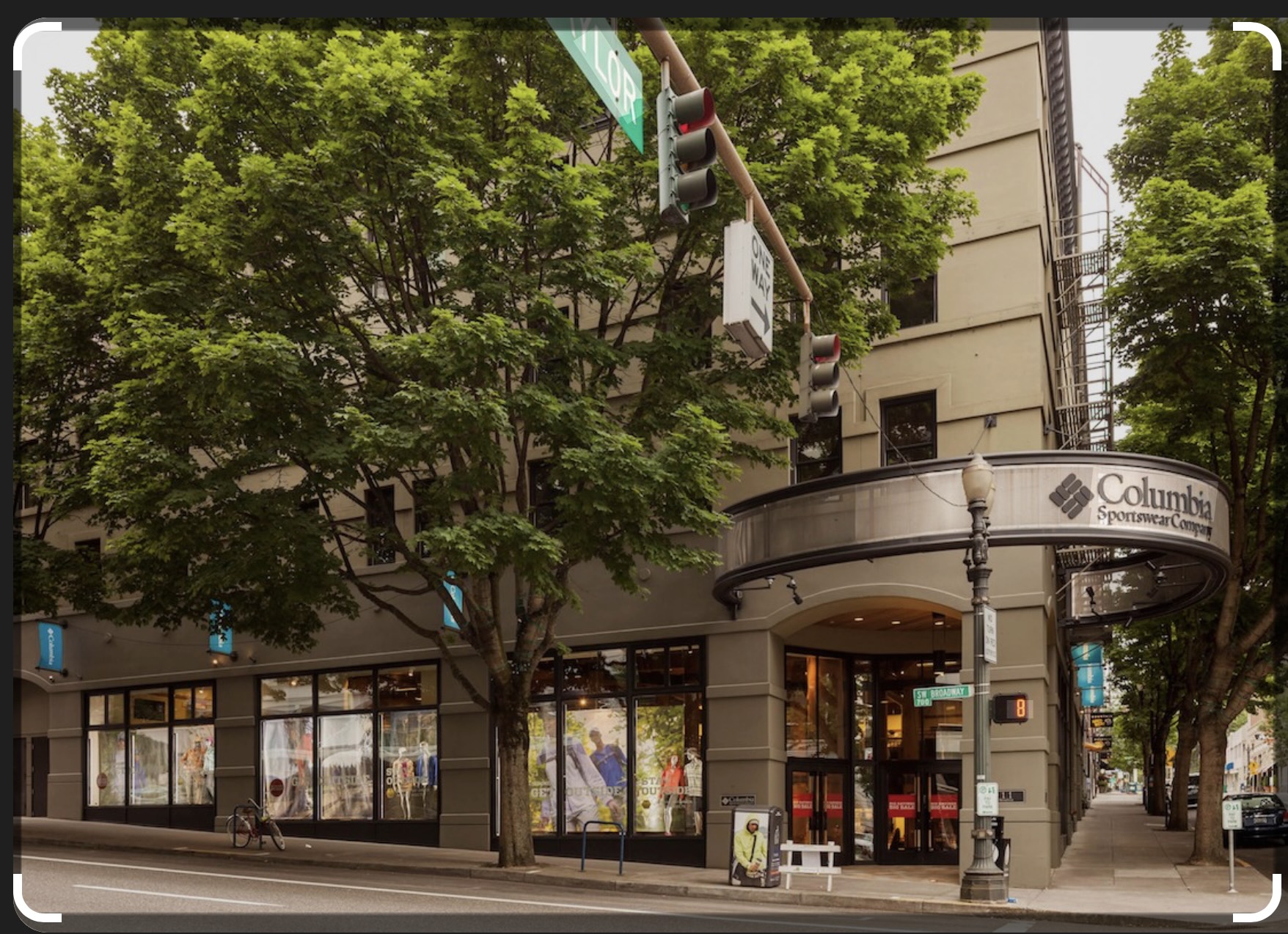
At the bottom of the mystery photo, you can see a distinctive curved sign across the building on the corner. A quick online search shows the United Carriage Building is located on that corner, and the curved sign is still in place!

And that spire which shows up in the mystery photo? It turns out to be part of the First Presbyterian Church at the corner of SW 12th and Morrison. Right in the line of sight from the Hilton.

So finally all the pieces of the puzzle have fallen into place. Mystery solved.

Whew.

Amazon vs. Google for photo storage

First, a reader’s scanner recommendation in response to yesterday’s post about my onging photo scanning project added some good detail. I’ll just quote this bit of it.

For 5+ years, I have used a Fujitsu Scansnap ix500 document scanner that comes with a mylar carrier sheet (you can buy additional ones at B & H, Amazon, etc). The carrier sheet lets you scan odd-shaped & fragile items more easily. There are more recent scanner models available but that ix500 is an absolute workhorse. I have scanned tens of thousands of documents with it. It does a decent job with photos though of course you?d want to use better equipment for quality results.

I used the same scanner for about a decade before it needed to be replaced. I used it as an opportunity to upgrade slightly to the ix1400, now sold as the Ricoh Scansnap ix1400.

I have found that the Vuescan software pairs easily with the Scansnap and most other scanners, after getting past a short learning curve. It makes a project like this much easier.

I’m sure readers would be interested in any other suggestions of scanners for a project like this, so please share.

My next issue was where to upload the photos. Amazon Photos competes in this space with Google Photos, both are reasonably good, but both have foibles and limitations, which I’ve been rediscovering with the first thousand scanned photos.

While I’m in the learning stage, I’m uploading to both systems, and making another copy saved on a suitably sized local drive.

Amazon is sometimes described as offering “free” photo storage. Well, not quite. Unlimited photo storage is free IF and only as long as you an Amazon Prime member, and are ok with the user interface used to organize and find photos once they’re successfully uploaded. A prime account currently costs $139 per year, but includes Prive Video and music streaming, as well as fast delivery and a few other benefits.

Google has a free plan that offers a total of 15 GB storage, but that’s not just photos. The total includes Gmail, attachents, and files on Google Drive. It’s free, but most users will quickly outgrow it. Meanwhile Google’s high level plans start at $199 per year (or $19.99 per month) for a total of 2 terabytes of storage, and go up from there. But these plans also include Google’s Gemini AI assistant, NotebookLM (which is based on Gemini), and other benefits. I have been making use of NotebookLM in reporting projects, so have moved up to the 2T plan.

One big difference is that Amazon Photos can be stored in full resolution, and overall storage is currently unlimited. With Google Photos, however, total storage is limited by your data plan. Lots of big photos, expect a bigger monthly bill. Users are given the choice of saving photos at their original resolution, which takes substantially more space, or saving in compressed format with some loss of quality (images are compressed to 16MP and videos to 1080p to save space).

Then there are the issues of organizing and accessing your photos once they are safely in either the Amazon or Google cloud. I’ll continue this tomorrow.

For the record, I scanned another album today, but I have to admit there were only 197 photos. I spent much more time trying to get a better understanding of the Amazon and Google systems than scanning and uploading! And today’s album was easier to get through because the plastic sleeves were in better shape and the photos were much easier to remove for scanning.

Before the internet, there were clipping files

I’ll just attribute this question to the spring cleaning reflex.

I spent the past two days scanning an old blue binder’s worth of snapshots dating back to the period around 1987-1988. I can pretty confidently assign the dates based on the photos of our cats, including our first pair of calicos, Miki and Kua. We adopted Miki on Christmas 1986, and Kua in July 1987, while living in a townhouse project near Kahala Mall. And by May 1988, we had bought a house in Kaaawa and were in the process of moving. Photos of Kua as a kitten, and as a young cat, were scattered through this album, making the dating a relatively easy task. These photos all fell in that window of time, between mid-1987 and mid-1988.

And while pulling out the photo albums, I looked through other boxes containing miscellaneous files.

I’ve got boxes and boxes of old file folders containing notes, correspondence, documents, and newspaper clippings about a variety of topics. Back before the internet and readily available news databases, if you wanted to follow an issue, you clipped and filed news stories. Or you went to the library and worked your way through newspaper microfilms. I spotted a couple of thick folders of Kahoolawe-related clippings from 1976-1980, but there are many others. Underscore the “many.”

Throughout the 1970s, 1980s, and most of the 1990s as well, this was the way it was done. Read, clip, and file. And if I misplaced a file and needed to recreate that history, about the only recourse would be to go through those newspaper microfilms and their printed indexes to essential recreate the clipping file.

Today, of course, it’s quite different. Those clipping files are not an indispensable resource. An account with Newspapers.com now makes it simple to find news stories about a topic within a specified range of dates.

So here’s my problem. I would like to scan these old files, organize the scans, and dump the original paper copies. With written notes, letters, or documents, that’s easy. With newspaper clippings, not so much. It’s hard to feed them through the scanner I’m using, and they are often oddly shaped to fit into empty blocks on a newspaper page, or continued from one page to another. Scanning isn’t impossible, but with lots of clipping it would be a miserable task.

But I’m reluctant to just get rid of the files, even though I know that these copies can easily be replaced via an online search. But the clipping files represent an already curated version of the news. I wouldn’t have simply clipped every story on a topic. I would read and judge whether it was worth the time to clip and save. And looking back, it seems to me that knowing what I though was valuable at that time is important. It tells me about the nature of my interest in the topic independent of any notes the file might contain.

So…just throw out the clipping files? Put them back into the boxes and into storage again? I’ve considered making notes of the stories–headline, publication, date–and then throwing them out. But, again, a time consuming task.

Any suggestions on how to approach such a project?