
Don’t miss Civil Beat’s year-end edition of The Sunshine Blog which reviews a critical new legal opinion dinging the Honolulu Police Commission for chronic failure to follow the state’s Sunshine Law.
The 20-page opinion by the Office of Information Practices took 3-1/2 years to process a complaint from R. Brian Black, executive director of the Public First Law Center (formerly known as the Civil Beat Law Center for the Public Interest).
The OIP opinion doesn’t beat around the bush. Here’s its summary of the issues and its legal findings.
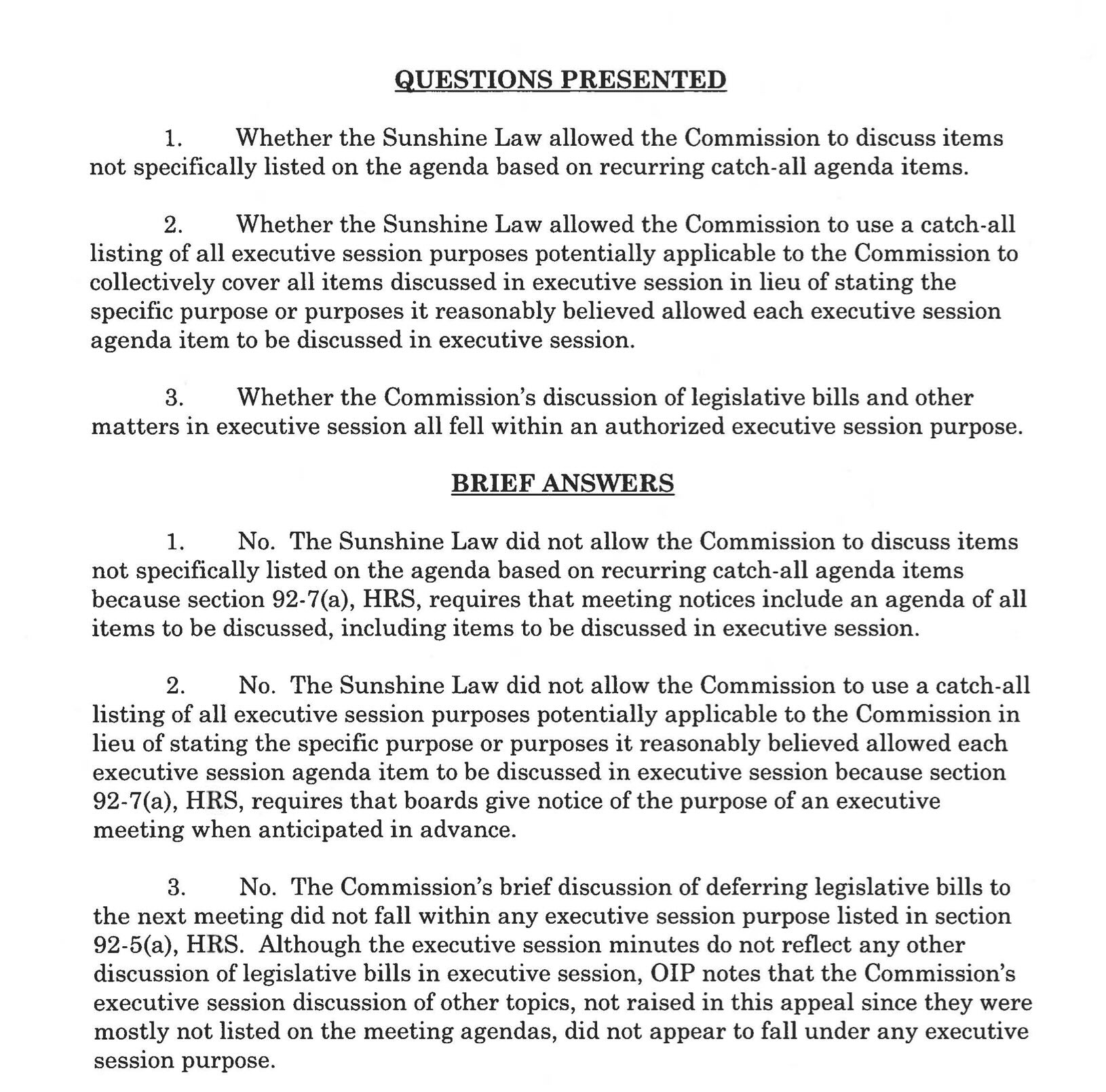
Screenshot
The Sunshine Blog also called attention to a disturbing fact.
Two of the commissioners — who have been on the panel for years — are attorneys with deep experience in public policy and, yes, the Sunshine Law. Commission Chair Doug Chin is a former state attorney general and former managing director of the city of Honolulu. Commissioner Carrie Okinaga is a former Honolulu Corporation Counsel under three different mayors, a former Honolulu rail board chair, and is currently the chief counsel for the University of Hawai‘i. So you’re telling The Blog neither of those two knows the rules for how to write an agenda?
The commission is assigned it’s own attorney, a deputy corporation counsel whose job is to see that they obey the law. It seems that Corp Counsel needs a full refresher course in the Sunshine Law and the public interest.
One sad fact is that it’s very unlikely the Honolulu Police Commission isn’t the only one on the wrong side of the Sunshine Law.
What about the other city boards and commissions? The Police Commission is pretty high-profile agency which for years as been flouting the law and getting away with it. Were other boards given equally free rein to play loose with the Sunshine Law rules?
Is the failure to follow the Sunshine Law one reason that three former top city officials, including a former Corporation Counsel, are now awaiting trial in federal court on charges stemming from ramming through a retirement deal for the disgraced former police chief Louis Kealoha? If the Sunshine Law had been routinely followed, forcing the public’s business into public view, would their behind-the-scenes dealmaking been possible? Might a robust Sunshine Law regime have prevented the actions that allegedly violated federal law?
In any case, do take a look at the Civil Beat column, which includes a full copy of the OIP opinion.
Those who are interested might want to take a look at other informal OIP Sunshine Law opinions.
Discover more from i L i n d
Subscribe to get the latest posts sent to your email.
It’s why corruption exists so prominently in Hawaii.A lack of integrity !
Good stuff. Mahalo.
Definitely many boards and commissions often violate not only the Sunshine Law, but the ordinary and virtually universal rules of parliamentary procedure. It takes ordinary serving members’ awareness and outspokenness to enforce rules – democracy is a feature of the whole society, not just a few election days. As Thomas Jefferson wrote to Abraham Baldwin in 1802, “It is only by having a law of proceeding, and by every member having the means of understanding it for himself, and appealing to it, that he can be protected against caprice and despotism in the chair.” Unfortunately many Boards and Commissions pay little attention to their own rules, or neglect to enact special rules of order. The result is an active chair and an acquiescent membership sometimes resulting in wrongs: violations of members rights and the public trust.
I have always said that law school is learning how to lie and get away with it.
HART has been in violation at times with the “CEO Update” item.
I was glad to see the opinion made it very clear what the Sunshine Law covers with respect to the questions asked. They also footnoted an exception for neighborhood boards, which is important to understand.