
A friend contacted me recently expressing interest in whether any legislators own stock in Hawaiian Electric that would create a financial conflict of interest if they participate in discussing or voting on any proposed bailout plan to aid the company.
Fair question. Do any legislators, or other public officials, have investments in Hawaiian Electric?
Luckily, there is a way to find out. But it is neither quick nor simple.
Financial disclosures
Public officials, including elected officials, appointed department heads and deputies, and members of a number of key boards and commissions, file financial disclosures with the State Ethics Commission every year. These are public records, and the information is available online.
The information required to be reported includes sources of income over $1,000 received by the person filing the report, as well as their spouse and any dependant children, real estate owned or transferred with the prior year, positions held in businesses or nonprofit organizations (“officership, directorship, trusteeship, or other fiduciary relationship”), as well as creditors and a couple of other types of financial information.
The law also requires disclosure of:
The amount and identity of every ownership or beneficial interest held during the disclosure period in any business having a value of $5,000 or more or equal to ten per cent of the ownership of the business and, if the interest was transferred during the disclosure period, the date of the transfer; provided that an interest in the form of an account in a federal or state regulated financial institution, an interest in the form of a policy in a mutual insurance company, or individual items in a mutual fund or a blind trust, if the mutual fund or blind trust has been disclosed pursuant to this paragraph, need not be disclosed….
That means that if the official owns stock worth $5,000 or more in any company (or equal to 10% of the business) then it has to be reported. It is reported in a category, “Business Interests.”
Business Interests
Okay. So let’s go looking for disclosures about stock of Hawaiian Electric Industries, the parent company of the electric utilities on all islands except Kauai, which is listed on the New York Stock Exchange.
Go to the ethics commission website, click the link for “Public Data,” then click through to “Public Records,” which gets you to the home screen of the Hawaii State Ethics Commission’s Public Documents System.
Yes, the system is cumbersome and it does take quite a few clicks to get to this point. But now you see the categories of records listed across the top of the page.
To find stock holdings of public officials, choose the drop down menu under the header “Financial,” and make your choice. I clicked on “All Financial,” which serves up information for the several years that are available.
Then you’re presented with a long list that scrolls and scrolls. It lists all those filing public disclosures and the date each was filed.
Now, it gets a little tricky here.
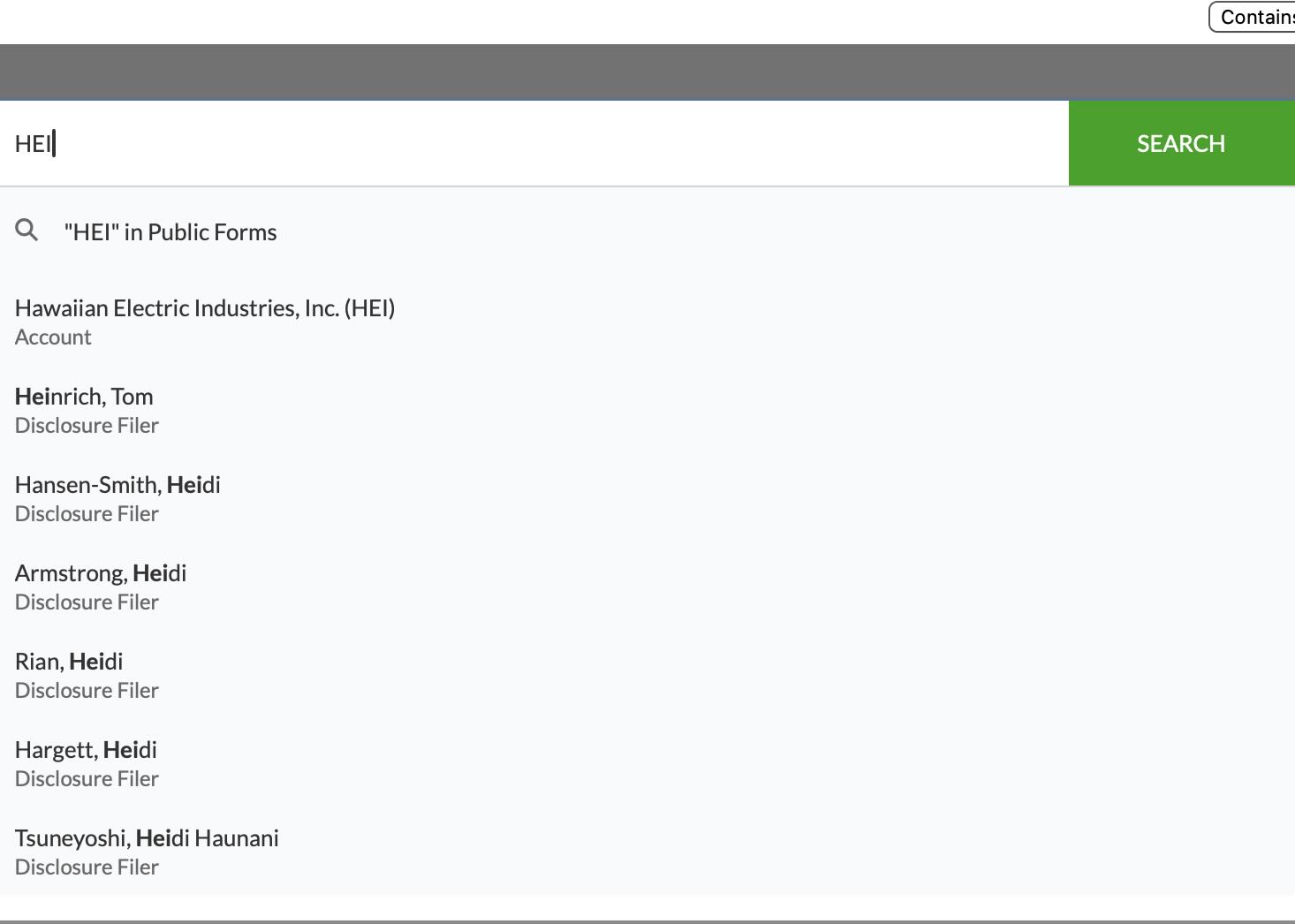
In the large search box at the top of the page (to the right of the state seal), type in “HEI,” the stock symbol for Hawaiian Electric Industries. You’ll see a list of choices like this.
Screenshot
We’re getting close
Now click on the top line, next to the little magnifying glass symbol, “HEI” in Public Forms.
At this point, a list of the “most relevant” financial disclosures in recent years that include “HEI” are listed.
It’s a short list, and none of these are or were member of the Legislature.
Go ahead an click on link, “Show More”, on the upper right. This should show you a list of all filings that mention HEI.
Notice at the bottom that it also pick up name that include the letters “hei”, in this case, stock of the food giant “Kraft Heinz,” owned by Randy Moore.
I would suggest repeating the search for other related terms, “Hawaiian Electric,” “HECO,” “MECO,” “Maui Electric,” “Hawaii Electric,” “HELCO,” and so on.
These will give you a broader view of how Hawaiian Electric influences the legislative process through gifts, lobbyists, and so on.
But we now have at least a tentative answer to our initial question. No legislators filed required financial disclosures reporting ownership of Hawaiian Electric stock, according to ethics commission online records.
And, of course, you can search for anything that interests you. Who has loans from a particular bank? Who is invested in AI tech? Did anyone make money on the sale of Hawaiian Air? Use your imagination and pursue your own interests.
Discover more from i L i n d
Subscribe to get the latest posts sent to your email.
Ian thank you for this detailed tutorial.
One of the three members of the Public Utilities Commission is a an attorney that represented HECO to get rate hikes approved. Then Gov Ige nominated her.
If they are smart the stock will be owned through an LLC, a trust, or a mutual fund of utility stocks. Legally, they are supposed to report. But a search for the legislator’s name wouldn’t necessarily turn up anything.
The stock symbol for Hawaiian Electric is HE
Most legislators are not so stock wealthy as in previous generations. The more significant factor influencing legislators would be donations from contractors and professional consultants doing work for HE.
The old rich Legislature is a thing of the past and deceased rich folk have been replaced by regular low paid attorneys with huge mortgage and children attending Punahou at $31k per year. The late Rep. John Medeiros brother in law of Joe Pao of Windward Partners, He also owned Las Vegas strip lands or Sen. D. G. Andy Anderson are no more.
The legislature is now a “hand to mouth” group on a stringent ration of donations from Unions and Hawaii Powerful Companies.