
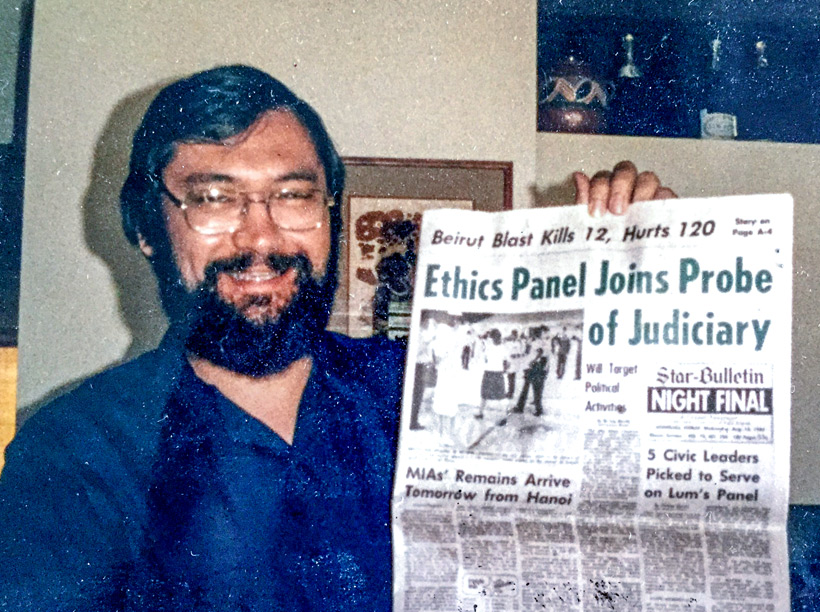
 It was a surprise to wander over to Civil Beat this morning, one of my first stops online these days, and see an old photo of myself blazoned across the top of this week’s Sunshine Blog post (“The Sunshine Blog: The Ghost Of Fat Boy Okuda”).
In the photo, I’m holding a copy of the Honolulu Star-Bulletin of August 14, 1985, announcing that the State Ethics Commission was initiating an investigation into lobbying activities of the state Judiciary. At the time, I was state director of Common Cause/Hawaii, and we had issued a report calling out the courts’ lobbying activities as likely illegal.
The Sunshine Blog commented:
It turns out that the issuing of gold-shield badges to non-law enforcement officers has quite a colorful history in the islands and, despite the scandal and corruption associated with the practice in years gone by, continues today.”
It seems the Sunshine Blog stumbled over this long-ago scandal when it began questioning the practice of issuing offical-looking badges to members of certain commissions. The practice harkens back to the good old days of “Hui o’Kokua,” the lobbying organization created inside the state judiciary sometime in the late 1970s or early 1980s to lobby for its budget. The organization, led by the deputy administrator of the courts, Tom “Fat Boy” Okuda, built strong personal and political relationships with key legislators by providing campaign support including catering for their fundraisers, administratively dismissing traffic citations on request, and passing out sheriff’s badges to a group of legislators, allowing them to carry firearms and park for free at the airport and other venues, among other benefits.
Anyway, do check out today’s Sunshine Blog, which reprises much of the scandal and brings it up to date.
But it only tells part of the story. I’ll be back later to tackle more of the tale.
Discover more from i L i n d
Subscribe to get the latest posts sent to your email.
Thanks, Ian! That was a huge scandal back in the dayl.
Not all badges are about vanity or backdoor favors. Years ago, I had one of the sheriff association badges from the Okuda era—like many longtime supporters of law enforcement. These weren’t about pretending to be police or claiming privilege. It was more like the Navy League or police support foundations—people showing civic support.
The idea that some badges granted special perks may be true in some cases, but that was never my experience. And there were multiple types of badges at the time—each with different meanings.
Today’s correctional oversight badges aren’t throwbacks to “Fat Boy” days. They’re practical credentials for gaining access to secure facilities. They don’t say “police” or “law enforcement,” and they function much like an ID—but more visible and quickly recognized in high-tension environments like jails.
Hawai‘i’s history rightly makes us cautious. But not every badge is a threat to public trust. Sometimes, they’re just tools for people doing hard work in tough places. Let’s not turn every gold seal into a symbol of corruption.
You are a legend
And you are so kind and generous!
So… a Civil Beat fan sends in a photo of one of these badges, seemingly out of the blue, causing the whole story to resurface, revealing that this method to influence (the issuance of gold shield badges to non-law enforcement officers) continues? Potentially, I imagine you could find this somewhat irksome.
Interesting that (back in 1985) you had found an ally in Fred Hemmings, of all people. (Strange bedfellows, as they say.)
I’ll be looking forward to your follow up.
Definitely strange bedfellows!! But he was willing to say things publicly that others were afraid to touch. In the moment, I really appreciated Fred’s guts on this one.
Whoa! Way back machine memory! I was one of the Judicial Clerk’s at Mr. Okuda’s trial and it was eye-opening. The deference he got from everyone except the judge’s chambers of course was extraordinary. It was almost as if he was a celebrity. Since I didn’t know who he was I was unimpressed. But when his clerks received harsh sentences I couldn’t bear it. They were just doing their jobs, told specifically to do these things by their boss, so I felt he should have taken all the heat and protected them. In my estimation, he was a terrible person, an even worse boss, and not deserving of the respect he was given.