
In a post late last month, I promised to be back with more of the story of Tom “Fat Boy” Okuda and the Judiciary’s lobbying organization that was active in the early to mid-1980s (Another bit of Hawaii’s “colorful history”).
So here’s a bit more of the context of that “colorful history,” literally in this case.
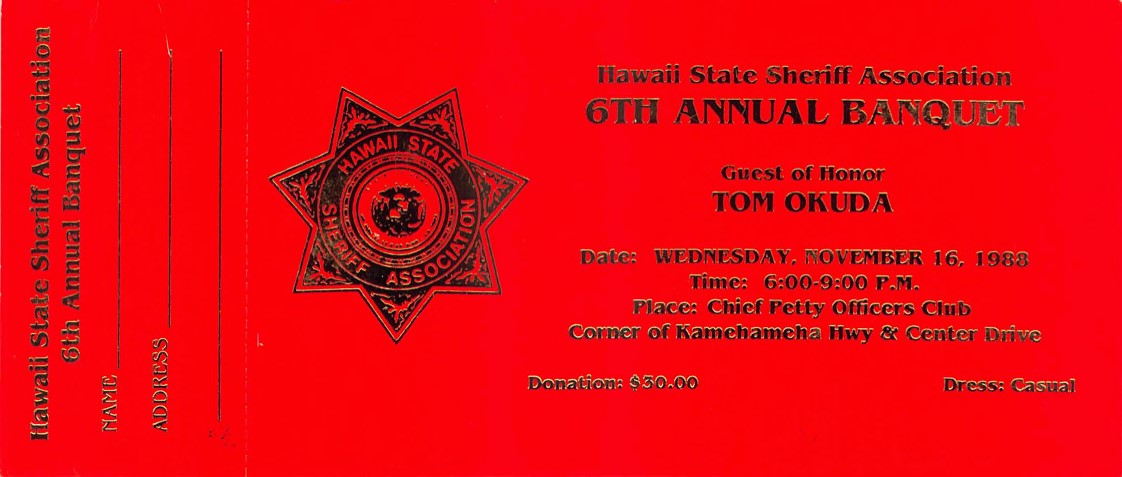
Digging around in my digital archive of scanned documents, I happened to find a ticket to the 6th Annual Hawaii Sheriff Association banquet honoring Tom “Fat Boy” Okuda. It was held on November 16, 1988.
The event was effectively a very public “middle finger” to Okuda’s critics that were attempting to apply routine standards of government ethics to Okuda and his organization.
The timeline is interesting.
In July 1985, Common Cause issued a report alleging that lobbying by a group lodged within the State Judiciary violated state ethics laws in a number of ways, drawing attention to a widely known but rarely mentioned political group. At the time, I was executive director of Common Cause in Hawaii, and had authored the report after being tipped off to the situation by several employees working at the legislature and in court offices.
On August 14, 1985, after nearly continuous news reports of further revelations and allegations rocked the Judiciary, Chief Justice Herman Lum appointed a “Blue Ribbon” panel to investigation and report back.
Then in March 1986, the panel released its report, which found Okuda, the deputy administrative director of the courts, had simply invented a new and unauthorized position of “High Sheriff” or “Chief Sheriff), and assigned day-to-day control of the sheriff’s office to a bailiff who Okuda promoted into another invented and unauthorized position of “Undersheriff.”
Together, according to the panel, they pressured court employees and sheriffs to take part in political activities, including sign waving and catering campaign events for favored candidates, often the committee chairs or vice-chairs of the committees that controlled the Judiciary budget. The report, while understated, was devastating.
Through the direct efforts of the “Chief Sheriff” and the “Undersheriff”, Deputy Sheriffs have been directed to participate in politically-related activities which cannot be tolerated within the Judiciary.
Deputy Sheriffs have been assigned to drive legislators to various functions, to provide massages to legislators, and to provide after-hours, “volunteer” services such as parking cars at functions connected with raising money for EGGS, the unofficial Judiciary lobbying group. (See EGGS discussion, infra). They have been directly or indirectly requested to donate money or supplies used in EGGS’ lobbying efforts. Involvement of the Sheriff’s Office in politically-related activities is unacceptable for reasons set forth elsewhere in this report.
Further, the panel report directly challenged Okuda’s lobbying organization, known originally as “Hui o Kokua” and, later, as Employees for Good Government Service, or EGGS.
EGGS asserts that all of its actions are for the sole benefit of the Judiciary. It is claimed that many Judiciary employees gladly and willingly give up their free time on weekends, in the evenings and during their lunch hours to perform these “volunteer” services. While some employees may be glad to serve, many of the Judiciary “volunteers” recruited by EGGS are subjected to various types of pressure to ensure their “willingness” to be “ready volunteers” for this political activity. There have been reports of peer pressure, implied threats of lack of advancement in employment, and subtle suggestions of being reassigned to unpleasant tasks at work for lack of participation. Conversely, there have been reports of promotions of some EGGS’ activists to positions of power within the Judiciary in return for involvement in political activities. There are also reports of direct pressure from EGGS’ activists to subordinates to sell raffle tickets and food tickets to raise money for EGGS’ political activity. Each of these is a threat to ensure participation by Judiciary employees in EGGS’ political functions. This is coercion. The Panel sees nothing “voluntary” about such cooperation with and support of EGGS.
In December 1987, nearly a year before the Sheriff Association banquet at which Okuda was the guest of honor, he had been indicted on 44 misdemeanor charges of fixing traffic tickets and related charges. His trial was scheduled to start in early 1989.
But despite the political optics, or perhaps because of them, the Sheriff Association showed to whom it owed allegiance.
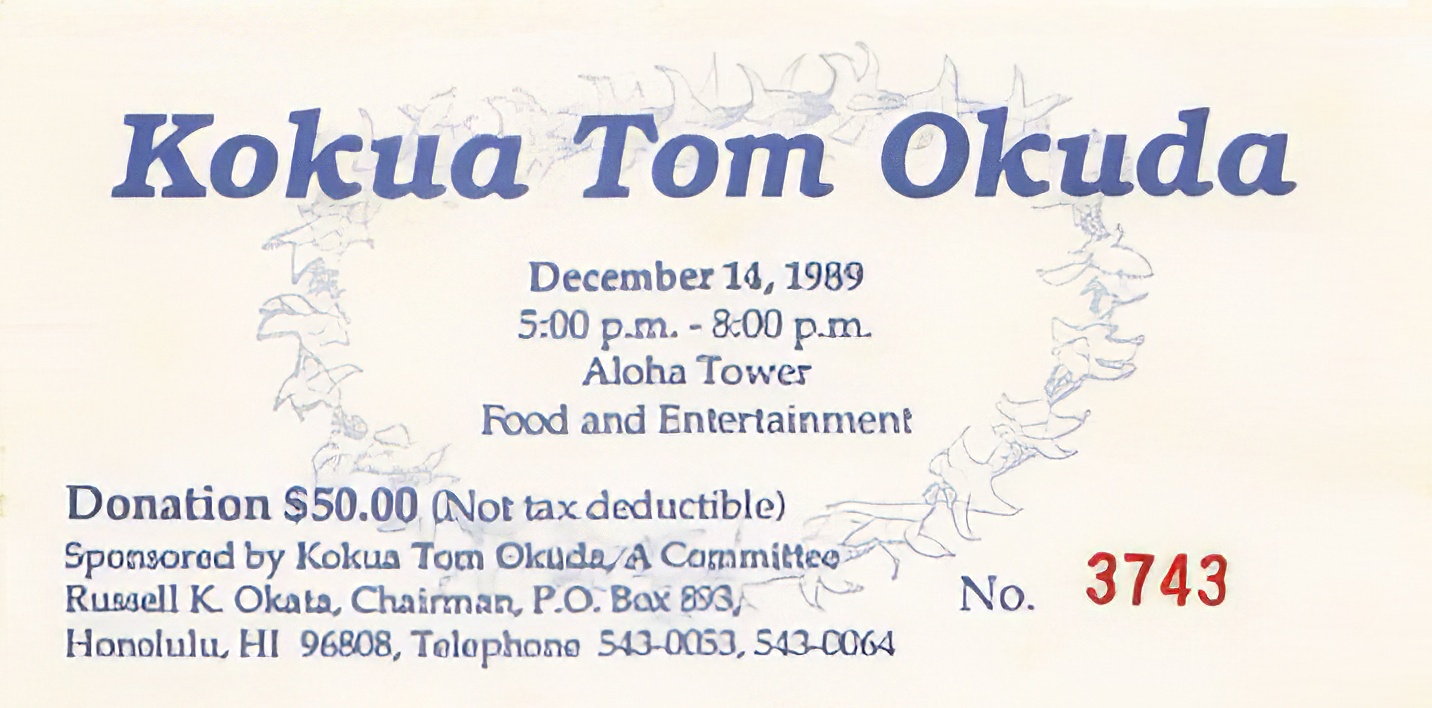 A fundraiser was held a year later to raise funds to pay Okuda’s legal fees, which included two pending appeals of his prosecution and conviction.
The ticket listed Russell Okata, executive director of the politically influential Hawaii Government Employees Association, the state’s largest union, as chair of the event’s sponsor, “Kokua Tom Okuda, a committee.” Okata was widely considered one of two most powerful union leaders in Hawaii, and signalled Okuda’s support within the political establishment.
According to a Honolulu Star-Bulletin story about the fundraiser, between 500 and 1,000 people attended the $50 per person event held on December 14, 1989, six months after Okuda had been convicted on multiple counts of fixing traffic tickets.
According to reporter Richard Borreca’a account:
Last night Okuda’s friends turned out to be some of the leaders in the political and business establishment. Rep. Henry Peters and former Supreme Court Chief Justice William Richardson, who now are both on the board of the Bishop Estate; attorney Wallace Fujiyama; Senate President Richard Wong; Jack Richardson, chairman of the Democratic Party: U.S. Rep. Daniel Akaka; and David Trask, former HGEA executive, all showed up.
On July 5, 1990, five years after the Common Cause report that put the spotlight on the Judiary’s political activities and a year after Okuda’s conviction on 13 counts, the Hawaii Supreme Court tossed out seven of the charges but upheld six charges of fixing traffic tickets. It also upheld Okuda’s sentence, which included discharge from his job as deputy administrative director of the state courts.
Discover more from i L i n d
Subscribe to get the latest posts sent to your email.
Ian,
I’ve read your posts on Tom Okuda with interest. You’ve got a gift for digging up and telling these slices of Hawai‘i’s “colorful history,” and I respect the work you put in.
I knew Tom personally. Whatever one may say about events in the mid-80s, he was also a man who cared deeply about the people around him and about the institution he served. He’s gone now, and can’t give his own account.
When he passed, he was working on a book he titled Killed by Friendly Fire. That tells you something about how he saw his own story — and it’s a story that, unfortunately, he never got to finish.
I’m not here to relitigate every detail. My point is that when someone’s not here to respond, the way we frame their life matters. Complex times, complicated personalities — and more than one version of the truth.
—James Waldron Lindblad
You can say the same thing about most in the “old boy network.” They had the greater good in mind, cared about Hawaii and its people. Some would bend/break the rules but used that greater good to justify their actions. Others within the network turned a blind eye and/or made sure that if things went south, they would not be blamed.
And of course, some were bad apples from the start while others figured out ways of personal enrichment along the way and took advantage of situation.
Utterly disgusting. How much integrity does the Sheriffs org. Have now?
Out of curiosity, was he overweight, or was that one of those ironic nicknames, maybe suggesting his power, where he was actually a skinny guy.
He was overweight, but not dramatically so. He also wasn’t very tall maybe 5′ 5″? Just knowing guys of similar body build in that ethnic group, I’d put him around 200 lbs at most.
You had guts to fight this type of corruption.
At the time, I didn’t really think about it that way. Although I had been warned by a capitol insider, “if you’re going after Fat Boy, you better take him down.” But I never felt totally exposed or vulnerable. Too naive at the time, I guess.
Ian, glad you are writing some of the under recorded history of the Oahu political scene at the end of the last century. I’d like to read more of it. Here on Maui it was less about political corruption per se and more about real estate deals and the interlock between development and politics. In my time as a political/land use reporter public policy was made mostly in Korean bars, at the old picnic tables at ILWU hdq (where many decisions were arranged before they were decided in council chambers) and endless public meetings whose main purpose was to ratify what had already been decided. Almost none of it got written down and almost everyone who was there is dead or very old It would be good to have a record of this underbelly of the then very young state of Hawaii before it is all sanitized and forgotten. Keep it up. Always a fan. Susan