Category Archives: Campaigns

Top individual donors to Hawaii candidates during 2021

Candidates and noncandidate committees (including corporations and political action committees) had a supplemental report of contributions and expenditures due on January 31, 2022, covering the second half of last year.

There are many questions to try to answer from the data reported to the Campaign Spending Commission, which they in turn make publicly available.

I started with a relatively simple question: What individuals donated the most to candidates during 2021, irrespective of their favored candidates.

The answer says quite a bit about the structure of political power and influence in the state, based on the assumption that, well, “money talks.”

There’s a long list of people who contributed a total of $5,000 or more, too long to be of general use. So I limited it to those who gave over $8,000. It’s still a long list, but manageable.

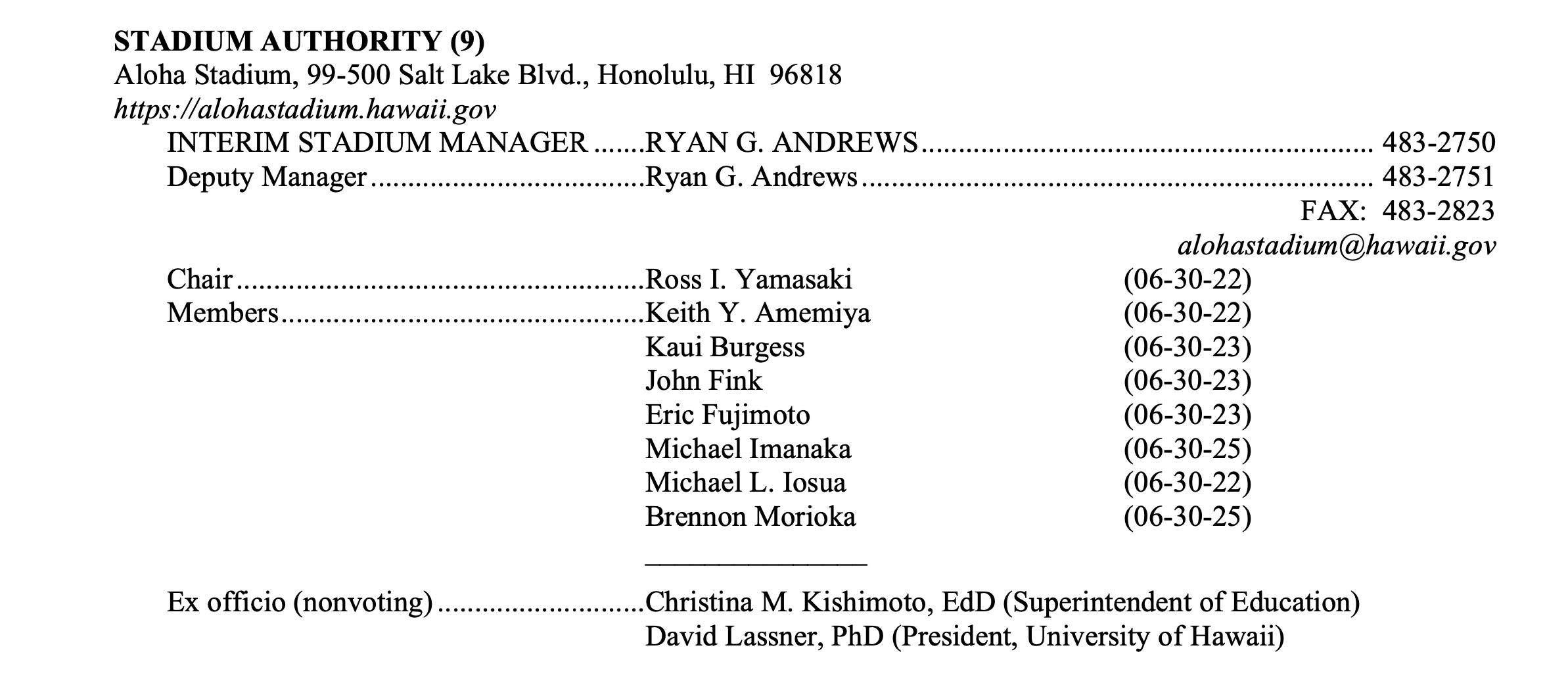
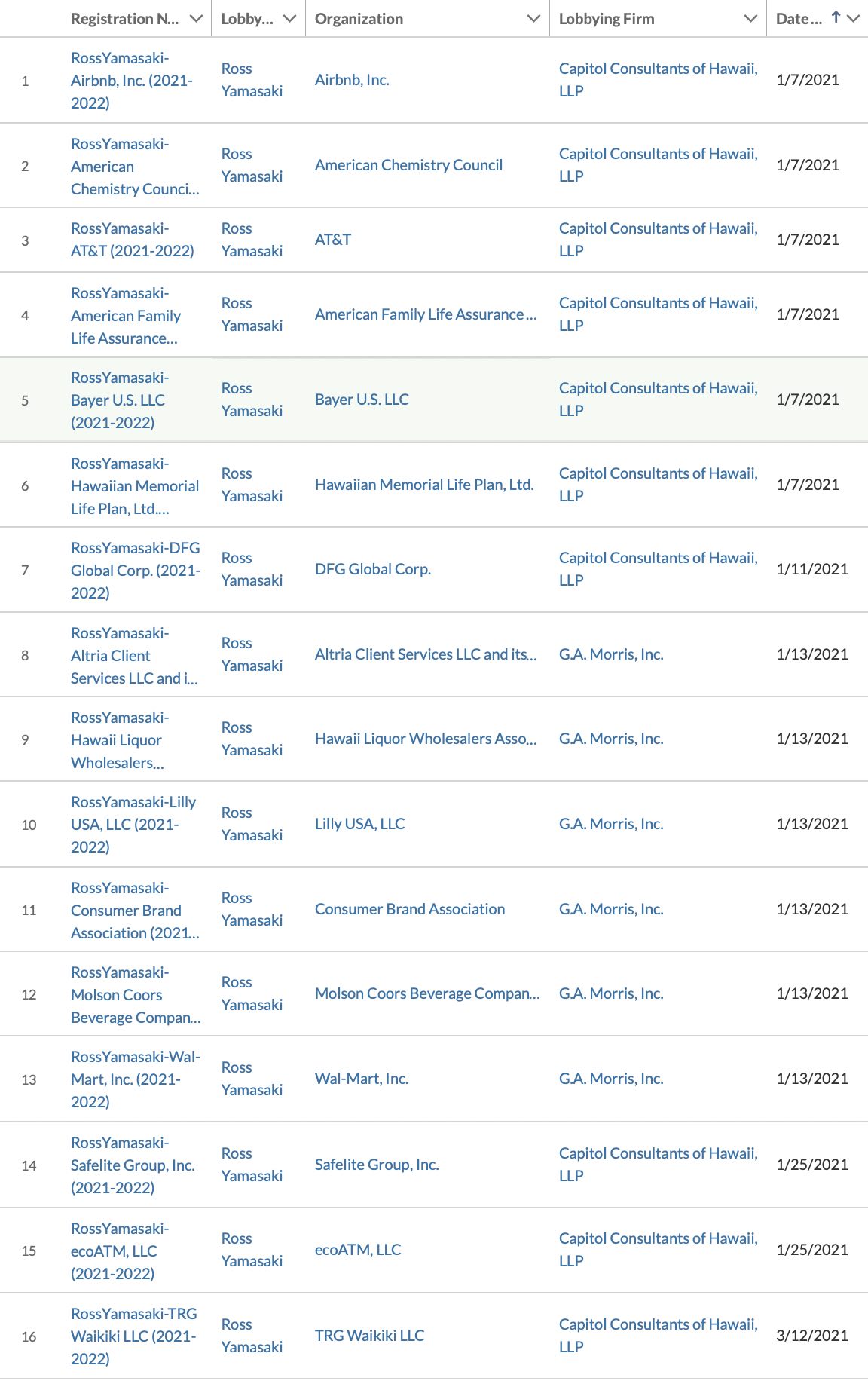
At the top of the list at #1 and #2 are Blake Oshiro ($23,900) and Bruce Coppa ($22,400), principals with Capitol Consultants, which bills itself as the state’s “leading strategic government affairs and business solutions firm.” And Ross Yamasaki, also of Capitol Consultants, ranked at #11, with contributions of $14,750.

Following them at #3 was Kimberley Yoshimoto, an attorney with the firm of Imanaka Asato LLLC, who contributed a total of $18,650. Michael Iosua ($17,730), from the same firm, also ranked in the top ten, while attorney Mitchell Imanaka ($10,750) ranked at #35.

Five R.M Towill officers and employees were among the top 20 contributors, giving a total of $76,000 to candidates.

Keep in mind that these figures don’t represent the grand totals by individuals associated with these firms, but only those who gave over $8,000. A full accounting for each firm will take longer to compile.

I also noticed quite a few husband/wife pairs who would have been included if their contributions were combined. That’s another for the “maybe later” list.

The several relatively prolific contributors by the name of Bert Kobayashi, including Bert A. Kobayashi (Jr. and Sr.) and attorney Bert T. Kobayashi, don’t appear because I had trouble properly separating their respective contributions in time to be included in this post.

Individuals donating the most to Hawaii state and local candidates in 2021 by Ian Lind on Scribd

On politics and money

Here’s one from the history files, a story I wrote for Honolulu Weekly back in mid-2001. The column reviews the previous decade in the administration of Hawaii’s campaign spending laws and, more importantly, their enforcement.

Now that another twenty years have passed, maybe I’ll try to find the time to assess where we are today in the long-term attempts to control the intersection of politics and money.

By the way, Honolulu Weekly was published from 1991 until June 2013, a long and important chapter in Hawaii publishing history.


The more things change
Campaign spending violations abound in Hawai‘i politics.

Ian Lind

Honolulu Weekly, July 11, 2001

The more things change….

Sometimes it seems nothing changes.

July 1991. Honolulu Weekly launched its inaugural issue. And over at the Campaign Spending Commission, which was my investigative “beat” at the time for my newsletter, The Hawai‘i Monitor, then-Gov. John Waihe‘e’s campaign committee was trying to explain why a stack of refund checks it had been ordered to send to contributors who exceeded legal limits had never been cashed, in effect leaving the campaign with an “off the books” slush fund.

July 2001. Ten years later. Honolulu Weekly celebrates its 10th birthday. And the now-defunct campaign committee of former Gov. Waihe‘e is again trying to explain why another batch of refunds were never cashed, and how the resulting $80,000 surplus went unnoticed despite bank statements from two separate campaign accounts that had apparently been mailed to the campaign treasurer’s home every month for years.

That $80,000 would certainly grab my attention if it appeared in a bank account I thought was empty, but I guess the stress of campaign high finance can cause even trained professionals to lose their focus.

On both occasions, 10 years apart, Waihe‘e’s treasurer, a certified public accountant, blamed accounting or computer errors for failing to catch the discrepancies and allowing the hidden funds to accumulate. And, in both instances, the CSC initially raised questions, but failed to pursue them in a timely manner, allowing years to drag by while waiting for the campaign to respond.

There’s a disquieting sense of continuity between these two episodes. Disquieting, I suppose, because they seem so similar despite a backdrop of significant change over the 10-year interval.

Back in 1991, the commission’s executive director was the amiable attorney Jack Gonzales, who supplemented his salary with a law practice specializing in small-time collections, while in his day job aimed to keep politicians’ campaigns within legal bounds. At least that was the job description.

If a campaign or contributor were caught operating on the far side of those legal boundaries, Gonzales believed in simply correcting the problem without assigning blame or doling out punishments. If special interests gave more than allowed by law and got caught, “give it back” was the order of the day. Candidates and donors were more than happy to comply, on those rare occasions when so-called “overages” were caught, since there was little risk in trying to get around the law and most violations went undetected anyway.

In Gonzales’ view, disclosure was paramount. He didn’t think it really mattered that the Legislature, under pressure from the public, had passed contribution limits along with penalties for violators, including possible criminal charges. If laws were violated, Gonzales always said, enforcement could be slow and uncertain. Better to just be sure that all transactions were noted in campaign reports, illegal contributions returned and voters allowed to decide for themselves in the next election.

When a slew of contractors, engineers and architects contributed illegal amounts to Waihe‘e’s 1990 reelection campaign, the commission didn’t appear to worry much about it. Just refund the money and let the voters decide, they said. Of course, it was too late for voters to have a say about Waihe‘e, who was not eligible to run again.

I could never figure out whether Gonzales’ laissez-faire approach was a matter of principle or simple practicality, an attempt to stay on the good side of the politicians he was supposed to be reining in.

But Gonzales’ no longer heads the Campaign Spending Commission, because he’s serving an extended sentence in a federal prison in California for his part in a fraudulent investment scheme that bilked a local labor group out of $10 million.

And it’s hard to imagine public officials who diddle with campaign funds or other public coffers ever again enjoying the same wide latitude afforded them in those years.

Today it’s a whole new ballgame, with the conviction of Councilmember Andy Mirikitani just the most recent casualty of a new prosecutorial mood. Other casualties, in recent years, include:

• the late House Speaker Danny Kihano, convicted on federal charges of dipping into the campaign cookie jar and then trying to cover up when a grand jury started looking into the matter;

• Milton Holt, former influential state senator and, at one time, heir-apparent to the Senate presidency, guilty of mail fraud while diverting campaign funds to personal use;

• Maui mayoral candidate and former state environmental official Marvin Miura, and Ross Prizzia, a professor at the University of Hawai‘i’s West O‘ahu campus, convicted of a kickback scheme in which Miura received gifts in exchange for steering consulting contracts to Prizzia;

• Ken Rappolt, former head of Honolulu’s municipal wastewater system, imprisoned for linking the award of nonbid contracts to the receipt of contributions to the mayor’s campaign;

• political fund-raisers Nora and Gene Lum, who gained experience hustling sometimes shady contributions from developers for a string of local candidates and later joined the big time as fund-raisers for the Democratic National Committee, convicted of making illegal campaign contributions;

• former state Sen. Marshall Ige, guilty of campaign violations and facing additional charges of theft, extortion and money laundering;

• Roddy Rodrigues, former aide to Gov. Cayetano during his days in the state Legislature, apparently committed suicide last year after being indicted on federal mail-fraud and tax-evasion charges dating to actions while serving as an official of the labor organization Unity House, charges linked to the same investment scam that took down Jack Gonzales;

• politically influential union leader Gary Rodrigues (no relation to Roddy), facing trial early next year on multiple charges of theft, money laundering and conspiracy after being accused of skimming funds from a series of his public worker union’s insurance deals.

Meanwhile, current Campaign Spending Commission Director Bob Watada has earned a reputation as a tough guy after clamping down on the personal use of campaign funds and taking action against violators, such as the precedent-setting $40,000 civil penalty levied against City Councilmember Rene Mansho for misuse of campaign funds.

So why does the handling of Waihe‘e’s campaign misstep remind me so much of the old days? I think it’s the appearance that the former governor again received special consideration.

Commission records show Waihe‘e was notified in March 1999 that any funds remaining in campaign accounts after July 1 of that year would have to be either returned to the original donors or turned over to the Hawai‘i Election Campaign Fund, which is used to provide limited public funding to candidates who cap their election spending. Prior to July 1, though, funds could be contributed to nonprofit groups.

Waihe‘e duly filed a “final report” indicating the campaign’s last $2,800 had been given away prior to the July 1 deadline, and that no funds remained. But when another $80,000 was found, why wasn’t the full amount turned over to the state election fund, as had already been ordered? That was the recommendation of a commission staffer, according to a handwritten notation in the commission’s files.

Instead, Waihe‘e was allowed to contribute the funds to nonprofit groups, including a whopping $24,000 to a literacy group headed by his wife and another $15,000 to the state Democratic Party.

There might be valid reasons for cutting Waihe‘e some slack, since he’s not a candidate for anything and is no longer in public office, but a review of commission records doesn’t disclose them. [Editor’s note: Waihe‘e is reported to be considering a run for Congress.] There are no investigative files, no records of discussions between the commission or its staff and the Waihe‘e campaign, no notes of what was said or promised, and no indication of whether or not Waihe‘e personally intervened.

Watada was on vacation and could not be reached for comment, but the decision to disregard a staff recommendation, along with an unusual absence of notes, correspondence or other official records, make me uneasy, especially with a costly race for control of the governor’s office on tap next year in which there could be strong temptation to grab competitive advantage by skating dangerously close to the legal edge.

I worry about the old adage, “The more things change, the more they stay the same,” and just hope that over the next decade it’s more of the former than the latter.

A look at Vicky Cayetano’s past campaign contributions

Six weeks ago, Civil Beat reported former First Lady Vicky Cayetano was considering a run for governor in 2022.

On Sunday, the Honolulu Star-Advertiser reported Cayetano is expected to make a formal announcement today.

She filed an organizational report for her campaign committee, Vicky for Governor, on August 18, listing Loretta Sheehan, attorney and former Honolulu Police Commission chair, as her campaign chair, and CPA Gilford Sato as treasurer.

I do not know Vicky Cayetano, and don’t believe I’ve met her, although I’ve known Ben since my days as executive director of Common Cause Hawaii nearly 40 years ago (can it really be that long??? I’m afraid so).

I’ve heard comments from several people who believe Vicky is a Republican, although she intends to run in 2022 as a Democrat. So I decided to look at the evidence, the record of campaign contributions going back 15 years or so. Campaign Spending Commission records available online go back to November 2006, while the FEC database went back to 2004.

For the record, I found no evidence Vicky Cayetano has supported Republican candidates, the Republican Party, or GOP-oriented political action committees.

None. Zero. No evidence.

She has made campaign contributions totaling $42,825 to federal, state, and local candidates in Hawaii since 2006. None went to candidates running as Republicans in partisan races.

I didn’t find any contributions made by Cayetano or her company to any political committees except for two contributions to the Democratic Party of Hawaii federal account in 2009 that were reported to the Federal Election Commission.

Here are the results of my search of records of the Hawaii Campaign Spending Commission and the Federal Election Commission.

Click on either list to see a larger version.

Could an unexpected candidate jump into the 2022 governor’s race?

Chad Blair previewed the 2022 governor’s race in a column over at Civil Beat on Thursday (“Chad Blair: Here’s How Hawaii’s Top 2022 Political Races Are Shaking Out“). Blair highlights the veteran Democrats lining up to campaign for governor and lt. governor, but drew a blank on the Republicans.

And what about the Republicans? Andria Tupola, the GOP nominee three years ago, is now on the Honolulu City Council and is not running for gov. I have no idea who in the party possibly could.

He doubled down on that theme later at the conclusion: “Republicans: Beats me.”

So try this tidbit from the political rumor mill passed on to me recently: How about a Republican ticket with Micah Kane as the GOP candidate for governor in 2022, and Honolulu City Councilmember Andria Tupola, the 2018 GOP standard bearer, for LG.

Landing Kane, a former party executive director, as their candidate would be a coup for the Republican Party, but how that might play out within the fractured party is not at all clear. He was, after all, a Lingle Republican, which could put him at odds with the party’s vocal right wing.

And a quick look at Kane’s recent political contributions show he has not contributed to any Republican candidates or PACs in recent years, while he has given to a list of local Democrats.

That makes me wonder–could Kane be looking at jumping into the Democratic primary rather running as a Republican? Were Kane to become a Democrat, and run in the Democratic primary, it seems to me he would not only be a viable candidate for governor, he has the makings of a strong candidate.

Kane has built an impressive resume. He is CEO of the Hawaii Community Foundation, a position he has held since 2017, and is a director of Hawaiian Electric Industries, parent company of HECO and American Savings Bank. Hawaii Business Magazine named him “CEO of the year” in 2020.

A former political independent, Kane first joined the Republican Party in 1999 when Linda Lingle was party chair. In June 1999, six months after joining the party, Kane was named its executive director. Following Linda Lingle’s election as governor in 2002, she nominated Kane as director of the Department of Hawaiian Home Lands. He served until the end of her second term, and was then appointed as a trustee of Kamehameha Schools, where he served two five-year terms.

Kane has contributed $50,112.91 to state and local candidates since 2010, Campaign Spending Commission records show. More than half of the contributions, $28,426.96, were made since becoming Hawaii Community Foundation CEO in 2017.

All of his campaign contributions to state and local candidates since 2017 have gone to Democrats.

t

And his federal election contributions are similar. He has given $12,300 to federal candidates and committees since 2016, and 85 percent went to Democratic candidates. Kane last contributed to the Hawaii Republican Party in 2016, with two contributions for a total of $1,800. He did not contribute to any Republican Party committees, political action committees, or candidates since the end of 2016.

The Hawaiian Electric Industries website provides a useful summary of Kane’s experience.

RELEVANT PROFESSIONAL EXPERIENCE

President and Chief Executive Officer, Hawaii Community Foundation (statewide charitable foundation, managing over $675 million in assets and distributing more than $62 million in grants in 2018) (since July 2017)

President and Chief Operating Officer, Hawaii Community Foundation (2016 to June 2017)

Chief Operating Officer, Pacific Links Hawaii LLC (golf course owner, developer and operator) (2011-2015)

Principal, The KANE Group LLC (Hawaii-based company focused on land and financing matters for planned community infrastructure and general business development)(since 2010)

Kamehameha Schools ($12 billion Native Hawaiian trust with more than 397,000 acres of land holdings in Hawaii), Trustee (since 2009).

RELEVANT SKILLS & QUALIFICATIONS

Executive management, leadership and strategic planning skills from prior service as Chief Operating Officer of Pacific Links Hawaii and Trustee of Kamehameha Schools and from prior role as Chairman/Director of the Department of Hawaiian Home Lands.

Finance and investment expertise gained through oversight of $10 billion asset portfolio as Trustee of Kamehameha Schools and through spearheading bond transactions as Chairman/Director of Department of Hawaiian Home Lands.

Experience managing complex capital expenditure programs from overseeing development of master planned communities and from managing annual $150 million capital improvement budget for the Department of Hawaiian Home Lands.

Skilled in government affairs, policy development, public relations and crisis management from prior service as Chairman/Executive Director of the Hawaii Republican Party.