Category Archives: Court

Victim files suit for 2017 assault by Miske associates

An accountant who was kidnapped, beaten, and terrorized in October 2017 by two thugs acting on orders from the late racketeering boss Michael J. Miske, Jr., has become the first of his victims to file suit seeking monetary damages from Miske’s estate.

Attorneys representing the accountant, Seung-Ji Robert Lee, filed a complaint in state court on March 3 asking for damages for assault and battery, and intentional infliction of emotional distress. Lee is represented by the law office of Eric Seitz.

“Plaintiff is entitled to recover exemplary and punitive damages against Defendants for their outrageous, malicious, deliberate and oppressive acts in order to punish the wrongful conduct alleged herein and to deter such conduct in the future,” according to the state complaint.

Named as defendants are Miske, through his estate and/or personal representative; two Miske associates, Wayne Miller and Jonah Ortiz, who carried out the kidnapping; Tony Young Ho Kim, a Honolulu investor and business owner who sought Miske’s help in recovering nearly a million dollars he believed Lee had stolen; and Preston Kimoto, a manager for two Miske-owned pest control companies, who delivered Kim’s request for help recovering the money to Miske, who in turn ordered Lee’s kidnapping.

In a separate motion filed in Honolulu’s Federal District Court, Lee’s attorney asked for court approval to intervene in a civil forfeiture lawsuit in which the government is claiming the right to seize an estimated $25 million of Miske’s assets because they can be traced to Miske’s racketeering enterprise.

Miske’s personal and business assets have been encumbered by the federal government since his initial indictment and arrest in July 2020. The motion argues that Lee must be allowed to intervene in the forfeiture case “to vindicate his interests in and rights to restitution and civil damages against…Miske.”

Miske was convicted last year on 13 charges, including Lee’s assault and kidnapping, following a 6-month jury trial. Several of the charges carried mandatory minimum sentences of life in prison.

However, Miske was found dead in his cell in Honolulu’s Federal Detention Center on December 1, 2024, just weeks before he was scheduled to be sentenced. As a result, the entire criminal case, from the indictments through the trial and jury verdicts, have been vacated under the legal doctrine of abatement ab initio, as if none of it had ever taken place.

The action also vacated a pending criminal forfeiture, and the government refiled their claim in civil court seeking to seize the same set of assets.

Atlas Steel

Lee’s kidnapping and assault resulted from a business dispute between Lee and Kim over the latter’s investment of about $1 million in Atlas Steel, a local manufacturer of steel building products.

Seung-Ji Robert Lee was born in China, lived in Korea until he was 18, then lived in Brazil for six year before arriving in Hawaii in 1970. He studied at the University of Hawaii, where he received a bachelor’s degree in business administration in 1980. He was licensed as a certified public accountant in August 1985, and his license remains active, according to state records.

In the late 1990s, Lee had seen potential profit in the trend toward using light gauge steel studs to frame houses and buildings instead of wood, which is vulnerable to termite damage. Lee incorporated a new company, Atlas Steel, in 2000, and began producing and selling steel products in about 2005.

By this time, two other people had invested in the company and became shareholders. One of those was Tony Young Ho Kim, who was one of Lee’s accounting clients. Kim made an initial investment of $450,000, matching Lee’s own initial investment in Atlas Steel, according to Lee’s testimony during Miske’s trial. The second outside investor died, leaving Lee and Kim as the company’s only shareholders.

Tony Kim and his wife had come to Hawaii from Korea in 1977. Starting with a cart selling puka shell jewelry in Waikiki, they eventually owned several retails stores in Waikiki, including Jewels of Hawaii in the Hyatt Regency Hotel, and Ala Moana Golf Shop in Ala Moana Center. In 2003, Kim and his wife formed KMC Broadcasting LLC, which purchased KHRA-AM, one of Hawaii’s two Korean language radio stations. Kim sold the station for a reported $790,000 in 2008.

Risky Business

When Lee started Atlas Steel, there had been only one other small firm manufacturing similar products in Hawaii. But in 2001 that company was purchased by Dietrich Industries, part of Worthington Enterprises, a national firm with deep corporate pockets.

“When they moved in they brought six new machines and built the big factory,” Lee testified. By the time Atlas began production and sales a few years later, it found tough going.

“And from the beginning we were struggling,” Lee said.

Lee, who also served as testified that he sold his house and reinvested the proceeds to strengthen Atlas’s finances, bringing his stake in the company to over $1 million.

“That was my lifetime savings,” Lee said.

When the company later applied for a $700,000 Small Business Administration loan, the agency asked Kim, who had more financial clout than Lee, to personally guarantee the loan. He agreed.

Atlas was forced to file for bankruptcy in January 2013, reporting less than $100,000 in assets, and between $1 million and $10 million in total liabilities. Although the company reorganized and emerged briefly from bankruptcy, hoping to cut costs enough to survive, it finally went out of business at the end of 2015.

The bankruptcy forced Lee’s accounting business into foreclosure, and his interest in the LLC was sold for $20,000, according to the 2021 report of the court-appointed receiver.

Debt collection

I’ve written previously about Lee’s kidnapping and assault, so this is just a brief summary of what happened.

Tony Kim lost about $970,000 of his investment when Atlas Steel closed its doors, and believed that Lee, who was president and sole officer of the company as well as a CPA, had embezzled the money. Kim told his daughter Lee had forged his signature on documents, allowing Lee to steal about a million dollars.

Kim allegedly threatened and harassed Lee for the return of his investment, but was rebuffed. Then in the summer of 2017, Kim’s daughter, Sunnie Kim, had lunch with Preston Kimoto, a manager for Miske’s Kamaaina Termite and Pest Control, and at least one other Miske company. The two had known each other previously through mutual friends, but had not been in touch for several years.

Sunnie Kim wanted to arrange termite treatment for a home, but also asked Kimoto if he knew anyone who could help her father get his money back. She agreed to pay half of whatever money was recovered, which Kimoto believed was the going rate for collecting a debt through extra-legal means.

Kimoto later testified that he simply asked Mike Miske to “talk to the guy,” apparently thinking such a direct request could persuade Lee to refund Kim’s investment. Instead, unknown to Kimoto, Miske assigned the task to an old friend and associate, Wayne Miller, who proceeded to plan and carry out Lee’s kidnapping.

Kimoto didn’t learn about the kidnapping until Miller called and asked what he should do since they had the accountant who, despite the assault and threats, insisted he didn’t have the money.

“At that point,” Kimoto testified. “I was in shock. I didn’t know what had transpired, because my understanding was that Mike was going to go and talk to him, not kidnap the person.”

Miller then drove up to Miske’s office on Queen Street, got out of his car, and greeted Miske and Kimoto, who had just returned from the gym.

“The guy better not be in the fucking trunk,” Miske told Miller.

“He’s not in the trunk,” Miller replied.

And Mike made him open the trunk to prove it.

The trunk was empty.

See:

Latest Plea Deal In Miske Case Reveals New Details About 2017 Kidnapping, Civil Beat, July 24, 2023

Trial testimony began with Count 11, a “conspiracy to commit kidnapping,” iLind.net, January 24, 2024
Another Miske defendant will serve nearly 9 years

Harry “Harry Boy” Kauhi, who pleaded guilty more than three years ago to being part of Mike Miske’s racketeering organization and taking part with several others in the 2016 armed robbery of Nick Carignan, was sentenced on Tuesday to 106 months in federal prison on each count. The sentences will run concurrently, and he will have to serve three years on supervised release after completing the prison sentence.

Judge Derrick Watson made no recommenation as to where Kauhi should serve his sentence.

The sentence represents a 1-level reduction from the applicable federal sentencing guidelines for taking responsibility for his crimes.

Kauhi, who pleaded guilty in January 2022, was the third of Miske’s 12 co-defendants to plead out and cooperate with prosecutors. All the other co-defendants eventually cut pleaded guilty prior to the start of Miske’s trial in January 2024.

Kauhi, 45, started selling drugs while in elementary school in Waimanalo, and ultimately sold over 100 pounds of cocaine, crack, and meth, according to his testimony during Miske’s trial.

He was convicted and served a seven year sentence for firing a handgun at another group during a late-night clash at Sandy Beach in 1999.

In about 2015, he was recruited into the Miske organization by Wayne Miller, who at the time was Miske’s top lieutenant.

Kauhi admitted he took part in several murder-for-hire plots, and had accepted thousands of dollars from Miske via Miller in 2016 to kill a Waimanalo man suspected of providing information about Miske to law enforcement.

During Miske’s trial, Kauhi testified he accepted an $8,000 down payment, but took no further action.

“I kept pushing it off and telling them when I was ready I would do it,” Kauhi said, but said he actually had no intention to carry out the hit.

Kauhi said he later found out that before he was arrested in July 2020, Miske had “put a hit on me on the streets,” apparently fearing Kauhi might cooperate with authorities.

Kauhi, 45, testified he was not associated directly with Miske, but was involved through his longtime friendship with Wayne Miller, and his ties to Jacob “Jake” Smith.

Kauhi was one of several Miske associates who landed jobs in the movie industry through Miske’s contacts. Kauhi testified he got a job in the Teamster’s movie unit in 2015 through Miske’s friend, Sudee Dahl.

“Mike Butenbah told me the reason why Mike Miske got me into the movies is to keep us close and use us when he needed us,” Kauhi testified.

Only three of Miske’s co-defendants are still awaiting sentencing: Lance Bermudez, Norman Akau, and Delia Fabro Miske.

See:
Kauhi’s Guilty Plea Strengthens The Conspiracy Case Against Mike Miske, Civil Beat, January 6, 2022

Maryland Judge blocks enforcement of anti-DEI orders as unconstitutional

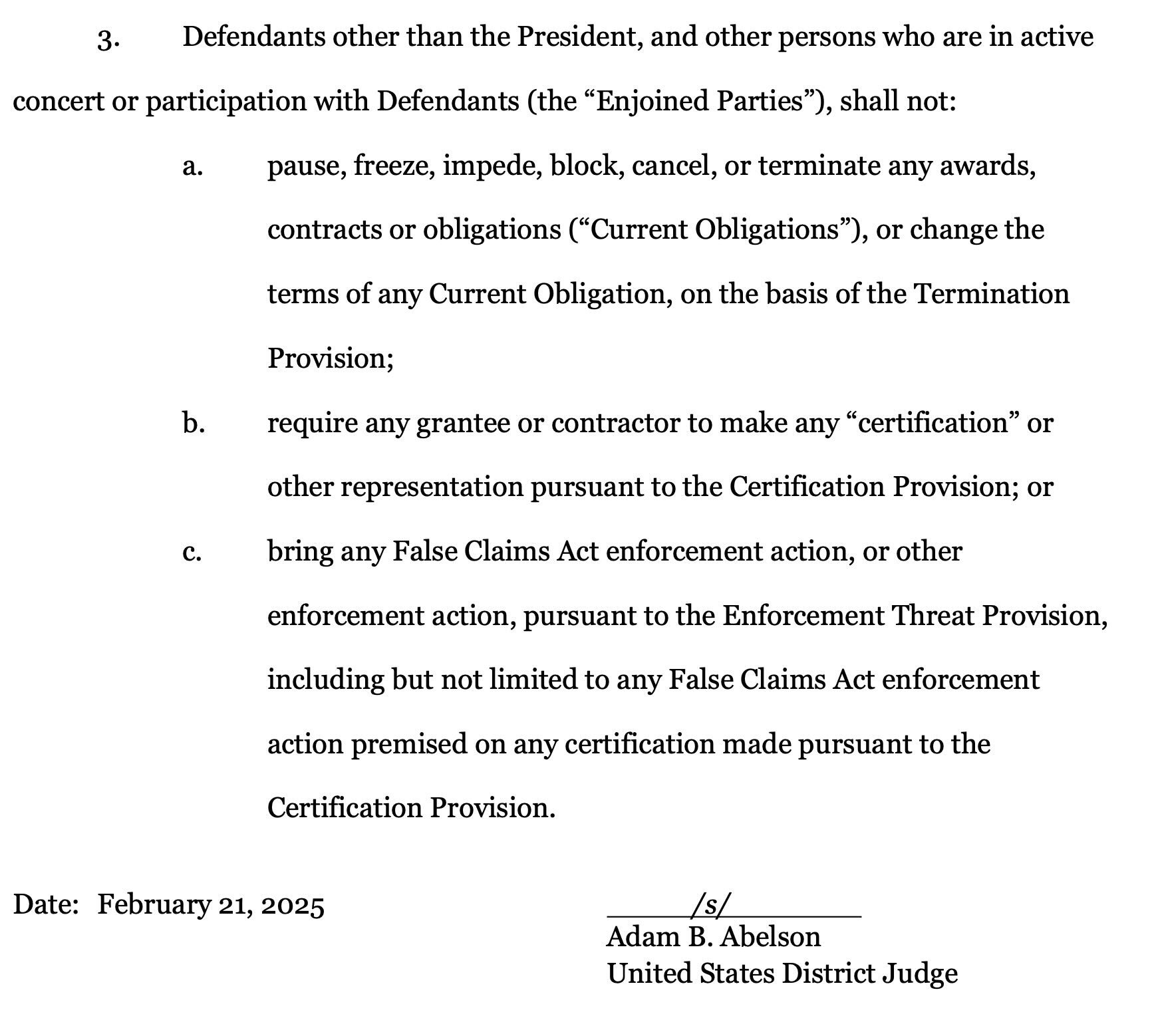
Last Friday, a federal judge in Maryland issued a preliminary injunction blocking major parts of Donald Trump’s anti-DEI (Diversity, Equity, Inclusion) orders.

The injunction provides, in relevant part:

Screenshot

The injunction is based on the judge’s finding that these executive orders are likely unconstitutional because they are unconstitutionally vague, or trample on the First Amendment’s right of free speech.

His legal findings are spelled out in a 63-page opinion which provides a tutorial of sorts in constitutional law. To understand why the Trump directives appear to be unconstitutional, I suggest reading through the first section of the opinion, and then perhaps look at specific sections that spell out the legal case in more detail.

This particular case was brought by several plaintiff organizations: The National Association of Diversity Officers in
Higher Education; American Association of University Professors; Restaurant Opportunities Centers United; Mayor and City Council of Baltimore, Maryland.

Each plaintiff provided specific examples of how the rights of their members were being violated by the Trump administration’s actions.

Judge Abelson’s opinion granting the motion for preliminary injunction appears below.

If you’re interested, I have also posted the original complaint filed February 3, 2025, and the plaintiff’s memorandum of law supporting their request for preliminary injunction.

Dozens of similar lawsuits have been filed across the country and are slowly making their way through the courts. A simple way to follow their progress is via the Trump Administration Litigation Tracker posted by Lawfare Media.

Memorandum Opinion Granting… by Ian Lind

More Miske associates sentenced

Three more Miske associates who previously made deals and pleaded guilty have appeared before Chief Judge Derrick Watson over the past two weeks for sentencing.

The first was Tricia Castro, 53, Miske’s longtime accountant. She pleaded guilty in June 2021 to a single count of conspiracy to defraud the United States “for the purpose of impeding, impairing, obstructing and defeating the lawful governmental functions of the IRS in the ascertainment, computation, assessment, and collection of revenue, namely, income and employment taxes….”

The charge carries a maximum sentence of 5 years in prison and/or a $250,000 fine, plus supervised release of up to three years.

According to her plea agreement, Castro was an accounting manager at AATS, LLC from 2009 to 2016, then was a partner at Egami & Ichikawa CPAs, Inc., until 2018.

Castro conspired with Mike Miske, Delia Fabro Miske, and Jason Yokoyama to “conceal funds and income from the IRS” by preparing and filing false tax returns, according to her plea agreement.

In a heavily redacted sentencing statement filed in court several weeks ago, Castro’s California-based attorney, Edward M. Robinson said Castro does not deny that her illegal activities “had far-reaching consequences,” he objected to the conclusion of the government’s presentence report that Castro was “motivated by apparent greed…”

Robinson said she had been paid a “salary as a CPA and did not receive any additional compensation or benefit of any kind for her tax preparation work that gave rise to her criminal prosecution.”

According to statements by people who knew her, Castro was “thoroughly devasted and remorseful” following her arrest, and “”[f]illed with frustration, anger, disbelief, and guilt.” This apparently led to mental health issues, which Robinson referenced only obliquely, as well as continuing “vulnerability.”

But Castro “has taken responsibility for her role and actions and is deeply ashamed of them,” according to the Reverend David J. Gierlach. “I believe she has completed that transformation from who she was to who she is today based on my frequent contact with and observations of her.”

Gerlock’s character reference letter was filed under seal, along with letters from eight others. None has been made public, but Robinson quoted Gerlock’s letter while arguing that Castro should be sentenced to a term of probation, with no prison time.

Castro has become “a shining example of post-offense rehabilitation,” Robinson argued.

During a 50-minute hearing, Judge Watson approved a 1-level reduction from federal sentencing guidelines that had been recommended by prosecutors based on her efforts at rehabilitaton. In addition, Watson found Castro to be a “Zero-Point Offender” under a new provision of the sentencing guidelines which allows an additional 2-step reduction.

Watson then sentenced Castro to a 6-months imprisonment followed by 6-months home detention, and three years supervised release. Watson recommended she serve her sentence in one of two federal medical centers. He further recommended she undergo a mental health assessment and any necessary treatment, and also receive Vocational and Educational Training.

Watson also ordered $437,608.80 in restitution, apparently the estimated amount of tax avoided through the preparation and filing of false tax returns. The judge ordered the parties to discuss whether the restitution should be imposed “jointly and severally” with Mike (or his estate) and Jason Yokoyama, Miske’s former employee, business partner, and trustee.

Castro’s attorney requested the court to “apportion this restitution liability among Ms. Castro, Mr. Miske, and Mr. Yokoyama in a manner that reflects the level of contribution to the IRS’s loss as well as the economic circumstances of each defendant.”

Next up: A man who considered Mike Miske to be his best friend.