Category Archives: History

Waipahu c. 1947 (Part 2)

Did my grandparents lose their longtime home and property when the federal government condemned a number of Hawaiian homesteads in Waipahu for military purposes after the end of WWII?

That’s the unexpected question that presented itself as I was following up on my post earlier this week that included a short family film of my grandparents’ “new” house, which they moved into late in 1947, about the time I was born.
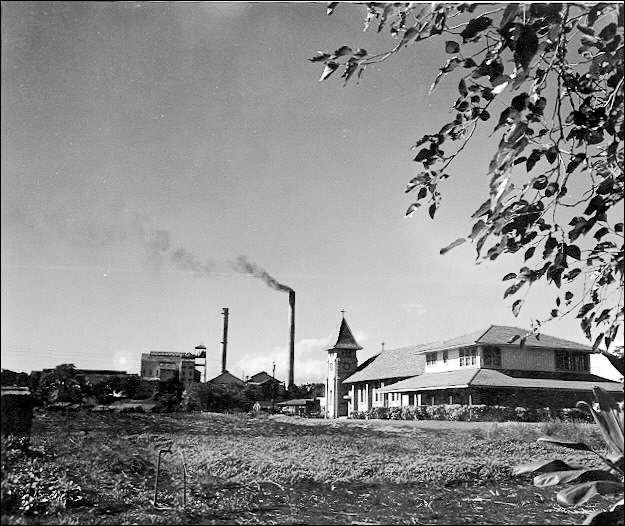
Believed to be part of my grandparent’s property behind St. Joseph Church .

To fill out the history, I then went looking for information on their “old” house, located next door to St. Joseph’s Catholic Church, a Waipahu landmark. And that led to an unexpected find, a series of stories published in the Honolulu Advertiser in 1946 reporting on the impact of what they termed a military “land grab” of more than 15,000 acres of land, including the Navy’s attempt to take lands near Pearl Harbor for “security reasons.”

The first story in the series reported that although the government’s offers of compensation were far below the land’s market value, about 70% of the land owners accept the offers for “patriotic” reasons or due to fear of challenging the government.

The third article in the series (August 20, 1946) noted that several dozen Hawaiian homesteaders were particularly hard hit. And I was totally surprised that my grandfather, Duke Yonge, was listed among those in the West Loch district.

Currently more than a score of
families at Wahiawa, Waipahu,
Waikele and the Pearl Harbor
West Loch area are concerned in
Navy condemnation proceedings
Started almost two years ago.
They received warning notices
that their lands, homes, and
homesteads were “to be taken
for security reasons.” Several
have retained Oliver Kinney as
their attorney….

In the West Loch district, the
following are affected:
Mrs. Kapeka Baker, Mrs. Eliz-
abeth Ching, Mrs. Adeline Ikeka
Sara Kaaiahuale, Mrs. Lau Kiu
Len Yee, Duke Yonge, Napahue-
la Estate, Mrs. Martha Keala,
Mrs. Rachel Mariano, Tatsuichi
Ota, Magoon Bros. and the Ro-
man Catholic church.

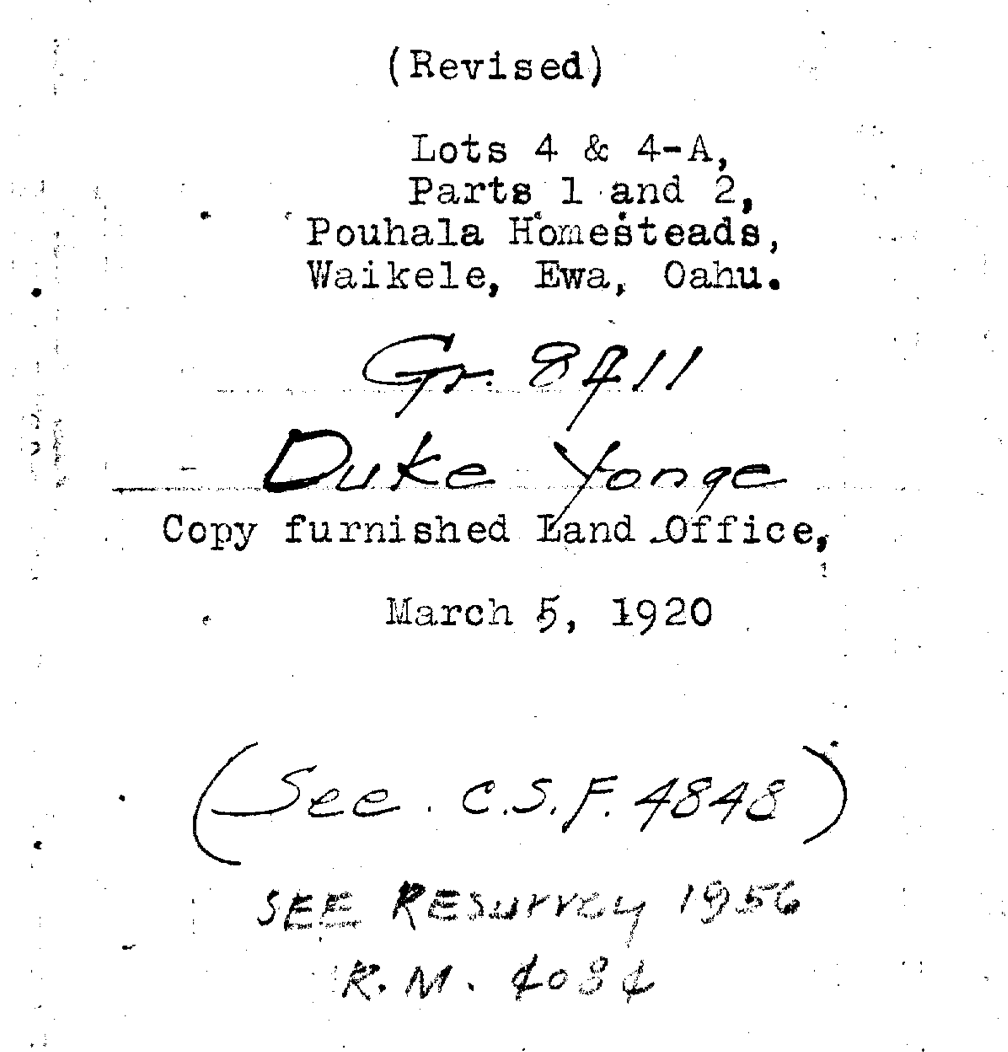
My late sister, Bonnie Stevens, tracked down this photo showing the church and the adjacent open lot being used as a garden. She understood that this was part of my grandparent’s property. And I was able to find a land grant in his name to Lots 4 and 4A in the Pouhala Homesteads, located next to St. Joseph Catholic Church along Farrington Highway in Waipahu. Based on that information, I looked up modern property records of a home now in that approximate location, and its deed showed it had indeed been part of the Duke Yonge homestead grant.

However, I was unable to find any further information (at least in my online search) to indicate whether he and my grandmother were among those represented by attorney Oliver Kinney, or were among the majority who sold under pressure and simply accepted the Navy’s offer.

I’m guessing they accepted the Navy’s compensation offer and used that money to buy the nearby property where their “new” house was built. The house was finished and they moved in around Thanksgiving 1947.

Although I’ve written about the military’s taking of land during that period, I was previously unaware that the process impacted our family so directly. But to track down more of their story, I’ll likely have to do some in-person digging at the Bureau of Conveyances, and then locate the federal court file from their condemnation case that’s probably stored in the federal archive in San Bruno, California.
Waipahu c. 1947

This started out as a simple post after I ran across a short video digitized from an old 8mm film of my parents. It was among a very few surviving family movies that survived since they were taken in the 1940s.

It shows my grandparent’s home in Waipahu, along the mauka side of Farrington Highway just after the bridge over Waikele Stream. My grandparents bought a large piece of property, built their home, and then sold off several other house lots over the years, using it as their savings account. It’s the house that I recall visiting when I was growing up. But my sister always referred to it as the “new” house, which sent me looking for more information. A quick search in Newspapers.comm turned up a legal notice that construction had been completed in January 1947. I was born in August of that year.

My original intent, besides just sharing the brief glimpses of the area in area nearly 80 years ago, was to see whether any readers have experience in using software to clean up old video like this. I would be very interested in hearing from anyone who has done that.

Okay. That was the plan. Simple.

But then it got complicated.

I’ll pick up the story and explain what happened in another post.

1961 letter: A moment in the history of international surfing

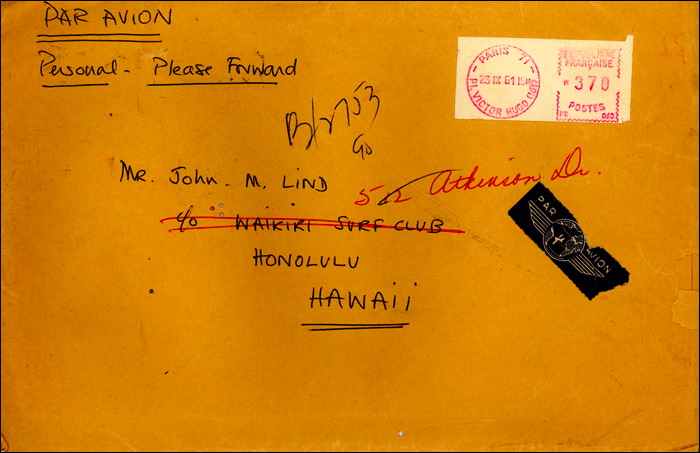
It was early in October 1961 when an envelope mailed from the Pl. Victor Hugo in Paris was delivered to my dad at his newly launched restaurant supply business that had set up shop in a small building on the corner of Atkinson Drive and Kona Street.

The letter turned out to be from Joel de Rosnay, a young surfing enthusiast in Paris, describing what he called the “surf fever” in France.

He wrote after seeing the brief introduction my father had written for a book about surfing by O.B. Patterson, now considered a classic.

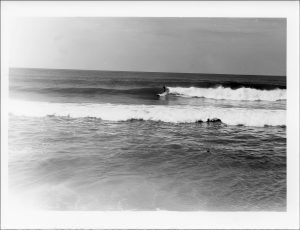
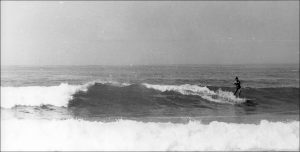
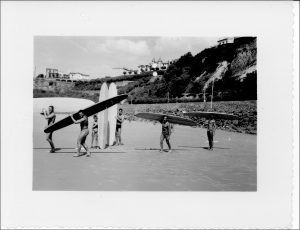
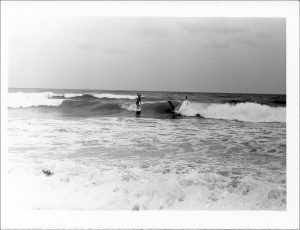
Here is a transcription of de Rosnay’s letter, followed by the photos that had been enclosed. And you can view the handwritten letter here.

JOEL DE ROSNAY

1 RUE CHARLES LAMOUREUX
PARIS 16
FRANCE

22 September 1961

Dear Mr. Lind

I have just read Mr. Patterson’s book- Surf Riding – Its Thrills & Techniques— which a Peruvian friend brought me.

I was amongst the first to surf at Biarritz in 1957. It was one of my friends, Peter Viertel (who is married to Deborah Kerr, the film star) who brought the first board from California to Biarritz in 1956. He lent me his board during the summer of 1957 and I rode my first waves with great enthusiasm, although I was not sure exactly how to go about it.

With the help of a young carpenter who lives in that part of the country and who made his own board, we looked for all possible photographs and films to help us know more about surfing. In 1958 Peter Viertel sent us 3 Balsa boards from Hobbie, and with these good boards we began to make good progress. The number of surfers getting bigger, he made our own boards in Biarritz.

In 1959, profiting from the presence of Mr. Carlos Dogny, President of the Waikiki Surf Club at Lima, Peru, we founded The Waikiki Surf Club at Biarritz, which had at that time, roughly 15 members. In 1960, The Club had 30 members, and organized the first French Championship of surfing, on the rules that the Peruvians had sent us. This year the Championship has again been held, and the Club has approximately 65 members. The first champion of 1960 was myself, and this year, Jack Rott. All the boards are now made in Bayonne (next door town to Biarritz) in foam and fibre glass, and cost approx. $80.

Michel Barland makes them in Bayonne, and Jack Rott in Dax. One can surf in 4 beaches at Biarritz, and if the sea is too strong and we cannot get out past the breakers, there are 2 beaches in St. Jean de Luz where the surf is very similar to that at Waikiki beach, being in a bay. Sometimes one can ride a wave for 500 metres. At Biarritz the waves are anything from 4 feet to 15 feet – for the most part of the time, they are 9-10 feet. The distance varies between 80 & 300 feet. But the surf is extremely irregular, and when the wind turns off the earth – which is rather rare, we hurry as there are marvellous hook type waves.

Sometimes, 4 or 5 days pass when the sea is like a lake, and everyone tears their hair out with impatience. There are two kinds of surfers at Biarritz. Those who live there all the year round, and who surf from March until November, wearing a wet suit when the sea is too cold, surfing Saturdays and Sundays, and after their work at 6 pm and the Parisiens like myself, who can only enjoy their favourite sport during the summer holidays. The surf in France has become very popular, and the News Reels and Television, and all the big glossy magazines have written articles about this new sport in France.

I would very much like all the American surfers who come to Europe for their vacation to know that our Club at Biarritz exists, and I would be only too glad to meet them, and to correspond with them. Enclosed are a few photographs taken 2 years ago, which aren’t very good, but the best ones are stuck in my press-book, but they will give you an idea of the kind of waves we have.

I hope that all this interests you, and know that after California, Hawaii, Peru, Australia, Britain, Mexico and Israel, France now with Biarritz has caught “Surf Fever”! And this is all thanks to your great enthusiasm for this sport.

Yours sincerely

Joel de Rosnay

Click on any photo to see a larger version.